Nadine Freischlad · · 5 min read
Soon everyone will be able to afford a smartphone. But what about data?

Smartphone manufacturing is becoming increasingly cheap and simple. “Akin to ordering a pizza,” quips Tim Culpan in a recent Bloomberg article. Culpan concludes that by tapping into a catalog of standardized components, Chinese companies can build smartphones for as little as US$20 apiece, at a minimum order of just 50 units. Anyone can start a smartphone brand for US$1,000.
This increase in efficiency and flexibility in the manufacturing process has led smartphone prices to fall off a cliff. Chinese and Taiwanese brands like Huawei, Lenovo, Acer, and Asus are specifically targeting first-time buyers in emerging markets like Southeast Asia with their entry-level models. A number of devices already go for US$100 or less, and the tendency clearly points to a further decline.
In Indonesia, the Huawei Ascend Y3 costs IDR 799,000 (US$59.50), Asus has the ZenFone4 (US$59.60), and as little as IDR 670,000 (US$49.90) buys a Lenovo A369i. Lenovo alone lists some 14 smartphone models on an Indonesian price comparison site – and those are just the ones in the 100-bucks-or-less category.
Choices
On top of that, there is an abundance of local brands getting into the game, partnering with Chinese firms in the “pizza-ordering” process described above. Parts are ordered in varying degrees of pre-assembly, put together in local factories, and branded with the local name.
Among such popular Indonesian brands with phones for US$100 are Evercoss, Mito, Andromax, Polytron, and Advan.
With such broad availability, smartphone penetration figures are expected to rise quickly in Indonesia. By 2018, forecasts predict, there will be more than 100 million smartphone users in the archipelago, making it the third biggest market behind China and India.
Hidden costs
There’s one problem though, and it needs to be addressed. 100 million low-cost phone owners do not translate into tens of millions of regular data plan subscribers. First-time buyers may be able to afford the device – it’s a one-time payment, sometimes payable in installments – but shy away from spending monthly on data plans. In Indonesia, almost all phone credit are pre-paid, which means phone owners simply won’t buy additional credits if they’re short on cash.
For reference: A 2GB data plan from Telkomsel, Indonesia’s state-owned and largest carrier, currently costs IDR 90,000 (US$6.70). If you think you need less, the entry level package is 600MB for IDR US$3.50). These costs, small as they may seem, add up.
Even in China, which is a more mature market by most measures and smartphone penetration is higher, data usage itself remains low. This tells us either Chinese smartphone users are not interested in using their phones on the go, or they are simply being thrifty.
A company called Jana put together this valuable overview of what data costs in relation to what people earn:
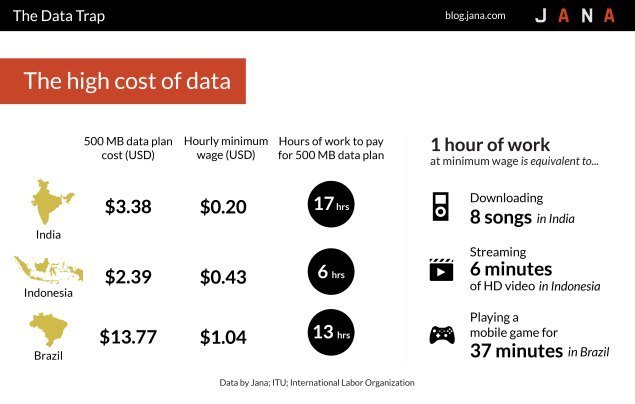
Jana concludes that in Indonesia, an hour of work at minimum wage equals roughly six minutes of watching high quality streaming video.
What’s the alternative?
What else can be done to bring data prices down for low-income communities?





Stay updated on the go with our mobile app.
Get latest insights with smoother, more personalized experience through TIA mobile app.