Paul Bischoff · · 3 min read
Tech Hive Sets the Bar for Beijing Hackathons, Still Lacks a Trophy Startup
Without a good reputation, you won’t attract good talent. Without good talent, you won’t earn a good reputation.
This is the catch-22 that all players in the startup ecosystem must overcome in order to succeed, and hackathons are no different. Beijing Tech Hive, the city’s most well-known Startup Weekend-style event, is slowly overcoming the conundrum, but it has yet to catapult a company it can point to as the ultimate testimony of success.
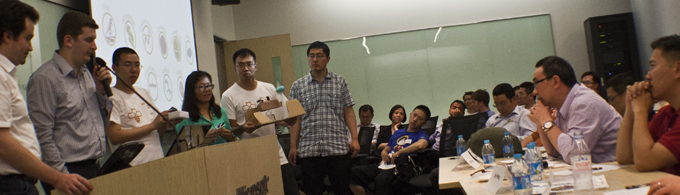
Remote building security startup Algen pitches to investors at Beijing Tech Hive.
This past weekend’s Beijing Tech Hive event included the usual five teams of six to seven people each. All participants were allowed to pitch their ideas if they had one. They then voted on the ideas, with the top five chosen as the projects to be worked on for the next 54 hours. Here’s the top three:
CoQuoter
The winner, decided by a panel of investors, was CoQuoter, led by Berni War. CoQuoter is a web platform for enterprises to buy specialized construction materials like doors and plywood from overseas factories at prices competitive with much larger corporations. In contrast to buying wholesale from B2B platforms like Alibaba that charge factories RMB 100,000 (~$16,300) or more just to be listed, War says CoQuoter will earn commissions by facilitating sales between enterprises and factories.
Coderobot Studio
The runner-up was Coderobot Studio, an online education platform for Chinese people to learn programming, similar to Treehouse or Codecademy.
Algen
Security hardware company Algen, which won first prize at last month’s 48 Hour Startup, walked home in third place at Beijing Tech Hive. They want to use their product to monitor unmanned remote buildings, i.e. electrical substations.
We’ll have to wait and see if any of these will turn out to be the success story that draws more experienced participants and mentors to Tech Hive in the future.
But success is relative. Tech Hive’s slogan is, “From idea to investment and beyond.” The problem with that seemingly harmless phrase, and perhaps all similar events, is they point to investment as the definition of success. Of course, even companies that receive investment can fail, as they often do. Healthcare startup Apricot Forest, Tech Hive’s closest thing to a success story and de facto poster boy, received several million dollars in investment and won several awards. It has a successful product, but the bar for success as a company can range from the first paying customer to a net profit to an IPO, all of which Apricot Forest has yet to achieve.
Tech Hive doesn’t have that definitive proof yet, so it’s still not attracting many experienced entrepreneurs. Five out of 40 of the previous Tech Hive teams went on to receive investment—not exactly an impressive ratio. Still, if anyone is up to the task, it’s Red Pagoda Resources, the startup recruitment company that has run nine of the events since 2010. Even if it’s not pumping out billion-dollar disruptive companies yet, the event helps entrepreneurs figure out whether to continue their current path or pivot much earlier. It’s a lesson that could save them a lot of time and money. For that reason, I hope Beijing Tech Hive keeps doing what it’s doing: helping the local startup community.
(Editing by Steven Millward and Anh-Minh Do)
Stay updated on the go with our mobile app.
Get latest insights with smoother, more personalized experience through TIA mobile app.
Recommended reads
 Indonesian AI startup goes global
 Forrest Li on scaling Sea, building smarter bots, and founder grit
 An AI assistant that joins sales calls and scores team skills
 SGX’s CEO says it doesn’t need a unicorn to win
 SMEs want AI too, but not the kind Big Tech is selling
 Oatside’s alt-milk rise hits a profitable gear
 Alibaba’s financial health in 12 charts
 Asia’s telcos bundle AI into mobile plans. Will it pay off?
 M-Daq chases bigger clients as revenue falls, losses grow
 VC tracker: Accel raises US$3.5b, including US$550m for India