- Insights This article was written by a TIA community member. Insights pieces undergo the same rigorous editorial process that newsroom-produced articles have.
 Awais Imran · · 6 min read
How startups can work with schools to create a win-win situation
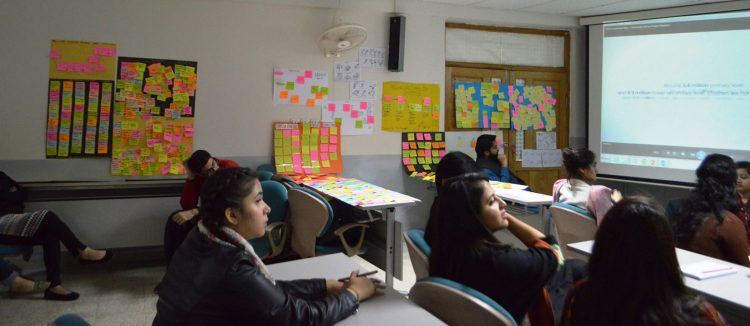
Product design and development students at NBS.
One big reason why western education systems are more successful than the ones in emerging economies like Pakistan is the exceptionally strong bond between industry and academia. Industry professionals and startup founders alike often work directly with universities to base their curricula on real market needs, enabling students to learn the right skills that land them to relevant jobs.
Correspondingly, advanced research projects in top universities such as MIT and Stanford routinely convert into commercially-viable products. In 2015 alone, University of California’s research launched 80+ startups, several of which went on to raise VC funding. This is the kind of incredible synergy that produces billion-dollar startups and invaluable talent to fuel the innovation economy.
Here in Pakistan, however, the industry-academia link remains weak. Based on my own observations as a recent graduate, startup founder, and academia collaborator, the industry’s interactions with academia are generally limited to grand events where they enjoy the limelight as ceremonial judges and chief guests. On the other hand, schools rarely engage with companies where their consultancy can have an impact.
Examples of startups emerging from academic research are difficult to find in Pakistan. CricFlex, a wearable device that detects illegal bowling action in cricket, is one of the few such startups that made it to the limelight in 2016. Most research work is shelved after students graduate or after professors move abroad to greener pastures. Academics that do go on to launch companies or work as executives in multinationals seldom return to campuses to bridge this gap.
Thankfully, we are beginning to see positive signs. Both parties are realizing the larger impact that comes from working together. Some prominent universities have launched incubators to push for the production of their research (e.g LUMS Center for Entrepreneurship and NUST Technology Incubation Center, where industry leaders remain directly involved as mentors). These incubators also regularly play host to hackathons and startup weekends where the industry and academia find opportunities to work together. Several popular Pakistani startups like Savaree and Trequant have emerged from such events.
In this article, I share the story of a successful industry-academia collaboration in which my price comparison shopping startup, PriceOye, was directly involved.
Laying the seeds for industry-academia partnerships
The senior BBA students at NUST Business School (NBS) take the Product Design and Development elective every year. In fall of 2016, NBS teamed up with Aneeqa Ishaq, then manager in customer experience at Telenor Pakistan, to reorient and co-teach the course. The curriculum was adapted to give students a hands-on experience of user-centered product design through a semester-long Design Thinking project in collaboration with industry partners.
With a master’s degree from Stanford d.school and work experience as a designer at HP Labs and Lutron Electronics, Aneeqa is one of the few foreign-educated Pakistanis who come back to work and teach here. It is a rare example of reverse brain drain—movement of human resources from developed economies to fast-growing, developing ones—and I believe this is serving as a foundation for improved industry-academia partnerships in Pakistan.
The Institute of Design at Stanford (commonly known as the d.school) is one of the most prestigious design schools in the world. Besides many other accomplishments, it is famous for popularizing the Design Thinking methodology—a set of powerful human-centered design strategies that is now being used in companies like IBM, SAP, Apple, and Google, to name a few.

Students interviewing mobile phone vendors at The Centaurus Mall in Islamabad.
Since returning to Pakistan, Aneeqa has exposed nearly 1,000 professionals and students to Design Thinking. By adding Design Thinking to the Product Design and Development curriculum and pairing up students with industry partners to solve real-world business problems using user-centered design, Aneeqa and NBS together have laid the foundation of continued industry-academia collaboration in Pakistan.
Design Thinking for startups
Academia partnerships a win-win-win





Stay updated on the go with our mobile app.
Get latest insights with smoother, more personalized experience through TIA mobile app.










📅 Upcoming Events
22 October 2026
Payoneer x CSPN Summit 2026