- Insights This article was written by a TIA community member. Insights pieces undergo the same rigorous editorial process that newsroom-produced articles have.
 Pranav Khanna · · 5 min read
How to run a product team, according to a VP of product

Photo credit: Fabio Formaggio
This article addresses the processes of running a product team. Other key components such as talent management, structure, vision, etc. will be discussed in future articles.
1. Vertical and horizontal alignment
On a basic level, there is a need to make sure that everyone’s goals are aligned and that the entire product team is pushing toward the same objectives (vertical alignment).
In addition, product teams have to work with many partners across different teams. So, product managers also have to make sure everyone is horizontally aligned.
How do we solve these twin problems?
- Clear vision and strategy: Everything starts with a clear articulation of the future you’re trying to build and how you plan to build it (more on how to do this in my previous article).
- Objectives and key results (OKRs): This is an effective tool for making sure individual goals are clear and transparent. A nested structure—where a manager’s key result becomes the objective for a direct report—ensures proper alignment. OKRs have a bunch of other benefits, which I’ll dive into more later.
- Weekly progress updates: Drafting a weekly update for your manager will ensure that you are making progress toward team-specific and institutional objectives.
- Meetings: Carefully designed meetings can be very effective. Here are the meetings I advocate for the product team: weekly product reviews, weekly monitoring review, quarterly strategy review, and all-hands.
- Roadmap: Publish a roadmap that is ideally based on specific themes/objectives/measurable KPIs and not just a list of features. These should be well defined for the next two to three quarters. Roadmaps help with horizontal alignment, telling partner teams and stakeholders what to expect.
2. Documentation and collaboration
Rigor is needed in making product decisions. One easy way to drive this is through good documentation. I am a firm believer that the act of writing pushes thinking and makes it better. (Check out this awesome Twitter thread on this topic.)
Documentation also helps with remote collaboration across geographies. Our team started using the framework below to address this.
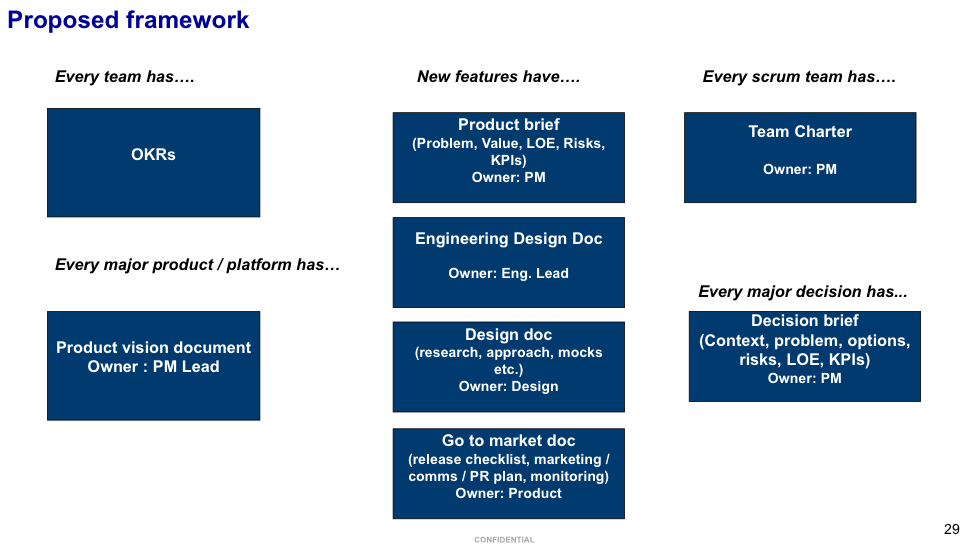
Photo credit: Amplitude
3. Proactive vs reactive
In any large company or team, there are many externalities and things vying for your attention. While it is easy to become reactive to emails, meeting invites, requests from people, etc., you have to take charge of your agenda and drive forward with clarity and focus.
How might we solve this problem?
- OKRs: Just as OKRs help with vertical and horizontal alignment, they force people to proactively meet long-term goals. Accordingly, anything new that comes up and requires reactive action can be assigned based on progress in OKRs.
- Saying no: If projects are not on OKRs, say no and get support from your leadership.
- Deep work for deeper thinking: Deep work individually or with teams can help to make more progress in half a day than hundreds of emails over a month.
4. Learning vs static
Skills become outdated rapidly, and like many others, our company is transforming massively. It is important to continue to learn new things, not only to future-proof your career but also to get inspired and enjoy your job.
5. Talent management and recruiting
6. Intentional culture vs culture by chance
7. Fun vs chores





Stay updated on the go with our mobile app.
Get latest insights with smoother, more personalized experience through TIA mobile app.










📅 Upcoming Events
22 October 2026
Payoneer x CSPN Summit 2026