Tim Romero · · 5 min read
Laundry robot creator talks about his difficulties of getting AI to fold clothes
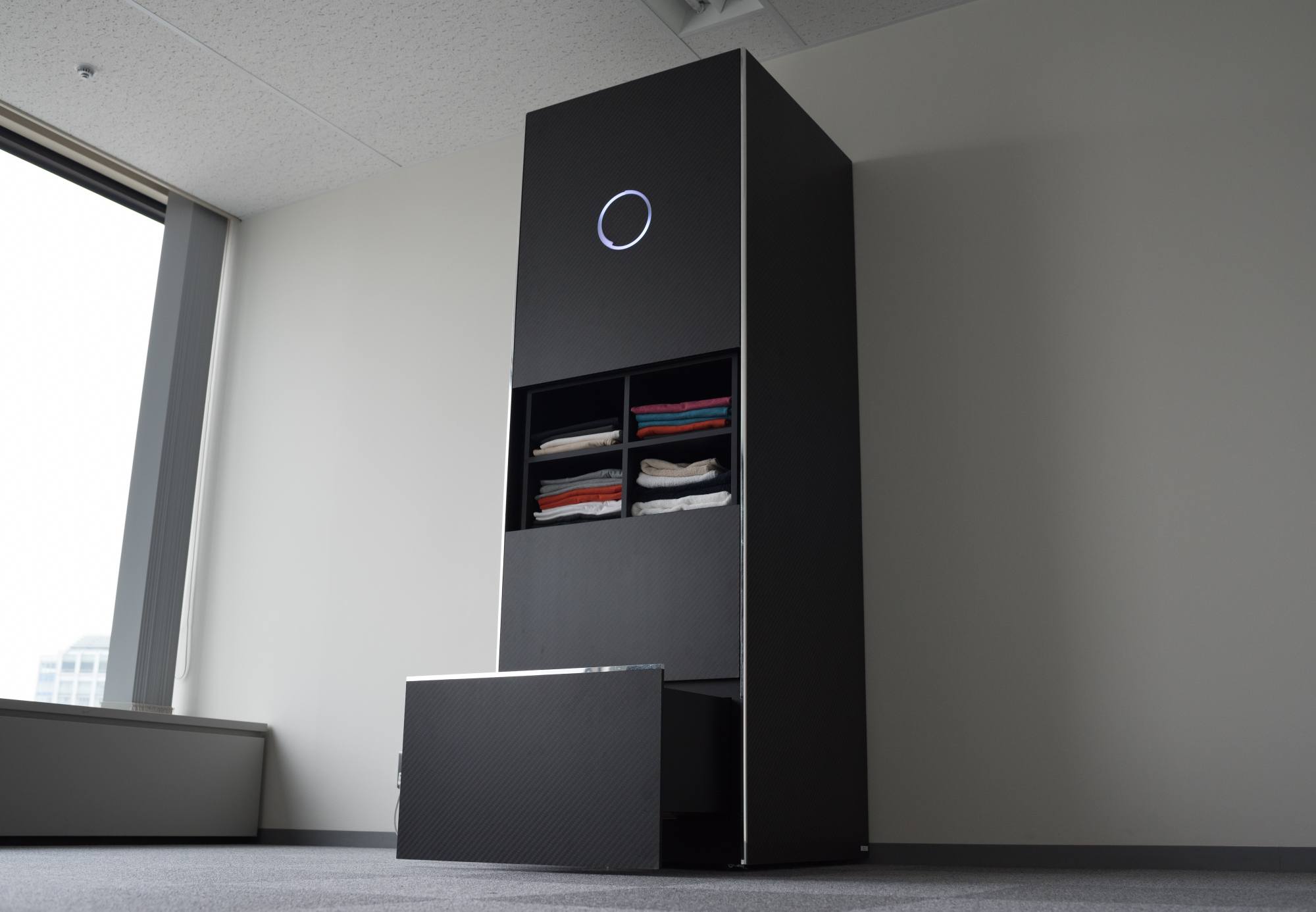
The Seven Dreamers Laundroid robot prototype. Photo credit: Akio Kon/Bloomberg.
This article is part of Tech in Asia’s partnership with Disrupting Japan where we publish the revised transcripts from the show’s podcast interviews with Japanese entrepreneurs. This is heavily revised from the original transcripts. For the full interview, go here.
Google’s driverless cars, IBM’s Watson, and other such projects have pushed the limits of what’s possible and have introduced astounding innovations in AI over the past few years. But sometimes, it’s surprising to take a look at the kinds of problems that are extremely difficult for AI to solve. It turns out that folding laundry is one of these problems.
I spoke with Seven Dreamers CEO Shin Sakane, who invented the Laundroid. This is the first commercially available, fully automatic laundry-folding robot. We talk about AI in general and what his firm had to go through to make the robot a reality.
What is the Laundroid?
We’ve been working on this project for the last 12 years. This robot folds clothes and separates them by categories or by family members.
The key feature of the robot is that after you dry your clothes, you can just put them into the insert box at the bottom. Then, with artificial intelligence, robotics, and vision analysis technology, the robot arm picks up the clothes one by one and folds and puts them in the pickup box. If you choose to separate by clothing category, the robot puts towels in the towel tray and shirts in the shirt tray.
If you want to separate the clothes by family members, you have to do a one-time registration process for each family member.
Why is this a hard problem for AI?
It was not that hard to develop a robot to just fold shirts, towels, and pants, for example. It took us about three years to achieve that. The hardest part was that the robot had to pick up one piece of clothing, reorganize if it’s a shirt, a pair of pants, or a towel, and then reorganize if it’s upside down, flipped, or something like that. It also has to place the clothing in a certain location in order to start folding. That’s the hardest part.
It’s so easy for human beings, but it’s so hard for robots and artificial intelligence.
What are the robot’s limitations?
It can fold pretty much all the regular clothes including shirts, long-sleeved shirts, pants, shorts, and towels. But there are three things the Laundroid can’t do. One is flipping clothes inside out. The second thing is closing buttons. Polo shirts are OK since the buttons don’t have to be done for them to be folded. But there are shirts that you have to close at least three buttons for the robot to fold them properly.
The third thing that the robot can’t do—but that it can do within a year—is pairing socks. This is kind of funny, but it’s so hard, you know? It could do this, but it will probably make a lot of mistakes. For example, it sometimes pairs very dark navy blue socks with black socks.
Tell us a little bit about yourself
After I got a PhD in the US, I came back to Japan in January 2000 with a 30-year plan to grow a business. In the first 15 years, my aim was to learn.
I had different choices, of course. I was able to work for Sony, Panasonic, and Toyota, for example. But my father also started his own company back in 1983. He was very successful and wanted me to join the company, but I was always rejecting him. But after I got my PhD and came back to Japan, I realized that maybe the best place I could learn the most was at my father’s company. So, I apologized and said, “Can I join your company?” And he said, “OK, sure.”
I started my business career at his company. He created a new group and I became the head there and was luckily successful.
Do you have plans to use the data you collect?
What is your motivation to go global so quickly?
Do you think Japan is faring well in robotics?
If you could change one thing about Japan, what would it be?





Stay updated on the go with our mobile app.
Get latest insights with smoother, more personalized experience through TIA mobile app.