- Insights This article was written by a TIA community member. Insights pieces undergo the same rigorous editorial process that newsroom-produced articles have.
 Raj Mitra · · 4 min read
Is it game over for us if machines get too smart?
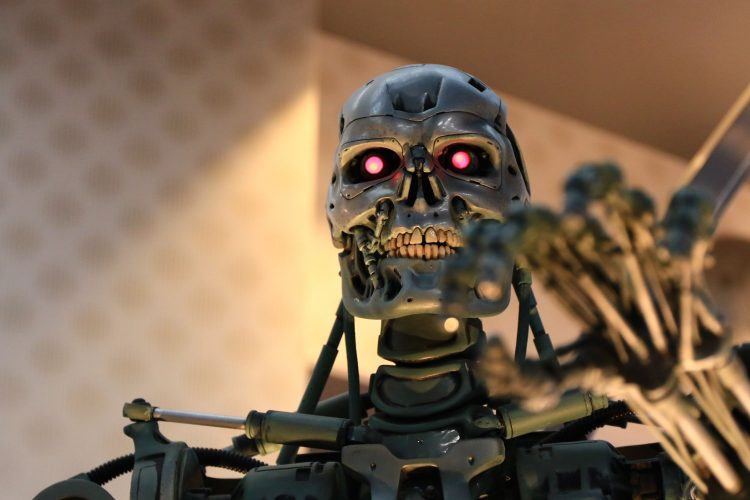
Photo credit: usataro / 123RF Stock Photo.
Modern science, according to Carl Sagan, is a voyage into the unknown with a lesson in humility at every stop. The rise of artificial intelligence (AI) and its potential to disrupt our “way of life” could very well be one such voyage through 2017.
Will AI challenge the fundamental notions of humanity: our biological needs, our social relations, and even our morality? Will humans, programmed by default to survive and reproduce, become a misfit in a world dominated by a complex array of algorithms?
Stephen Hawking, Bill Gates, and Elon Musk among others think so. Musk even went a step further by donating US$10 million to the Future of Life Foundation, which is dedicated to making sure AI remains people-friendly. Simply put, they believe that if our machines get too smart, it’s game over for the human race unless appropriate safety measures are built into the systems.
The curious case of existential risk
Doomsday declarations always make for good press. Hollywood sci-fi screenwriters love to narrate the dystopian fears of the futures that face this existential risk. In these futures, terrible things can happen that may exterminate the human race as a result of technology gone bad.
In the 1820s, when world population was only at a billion, Thomas Malthus, a leading economist in that period, predicted that “…nine parts in ten of the whole race of mankind were condemned to lives of abject poverty and grinding toil.” In 1894, a London Times columnist predicted that by 1950, London would get buried under nine feet of manure.
History is littered with stories of doomsayers who have come and gone only to return with their shock and awe theories — so they can get it right at least once. The world, however, has neither outgrown its ability to feed itself nor has it pushed itself to the brink of destruction. In fact, for the past two centuries, we have been flooded with stories of human progress through continued efforts for freedom and communication.
Existential risk does exist, but that threat would have more to do with human arrogance than smart machines.
That said, dismissing the apprehensions of three of the world’s most intelligent people as “fear mongering” or as “figments of their imagination” could prove to be juvenile antics. Existential risk does exist, but that threat would have more to do with human arrogance than smart machines.
For the latest apocalypse cult, the biggest fallacy lies in its assumption that machines would evolve to become much smarter than humans and eventually turn into a sadist psychopath hell bent on exterminating the very race (now a misfit in the scheme of things) that created them. In this light, let’s analyze what they are factoring in and, more importantly, what they are missing!
It’s not we versus they
In fact, we are they! As John Havens, the author of Heartificial Intelligence, succinctly puts it, “Since humans are programming the code for AI, this essentially means we have to codify our own values before programming them.”
The probability of the emergence of an intelligent system that could combine the power of computational algorithms with the wisdom and creativity of humans is much higher than the emergence of a rogue machine that sets out to exterminate the human race.
AI is neither artificial nor intelligent
Machines have historically been very bad at anticipating human behavior — as we are known to be predictably irrational. And there has been very little progress to suggest that’s even possible. Intelligence is much more than a complex array of algorithms. Logical thinking didn’t make humans superior; rather, it’s our ability to straddle the infinite realm of illogical possibilities without knowing the results in advance.
Machines need humans to be smart. The most intelligent machines are those that receive constant input from humans. Google’s search engine, for example, is intelligent because we constantly feed it with inputs while using the worldwide web. Facebook can identify faces because millions of people upload so many pictures every day on the platform.
Fear genuine stupidity more than artificial intelligence
Caveat: predicting the future is a tricky business





Stay updated on the go with our mobile app.
Get latest insights with smoother, more personalized experience through TIA mobile app.










📅 Upcoming Events
22 October 2026
Payoneer x CSPN Summit 2026