- Insights This article was written by a TIA community member. Insights pieces undergo the same rigorous editorial process that newsroom-produced articles have.
 Grant McConnaughey · · 5 min read
Here’s how I built my app from scratch and how it’s doing 1 month in
It has been about a month since I launched my app Lintly, an automated code linting website for Python, JavaScript, and CSS. I’ve learned a lot in the last 6 months while working on and deploying it. In this article, I’m going to recap the app’s first month and discuss all that goes into building a production app.
Specifically, I’ll talk about:
- My strategy for planning the app
- Project management I used during development
- The AWS services I used for deployment
- How I marketed the app without spending a dime
- The app’s finances (a breakdown of every dollar I’ve spent)
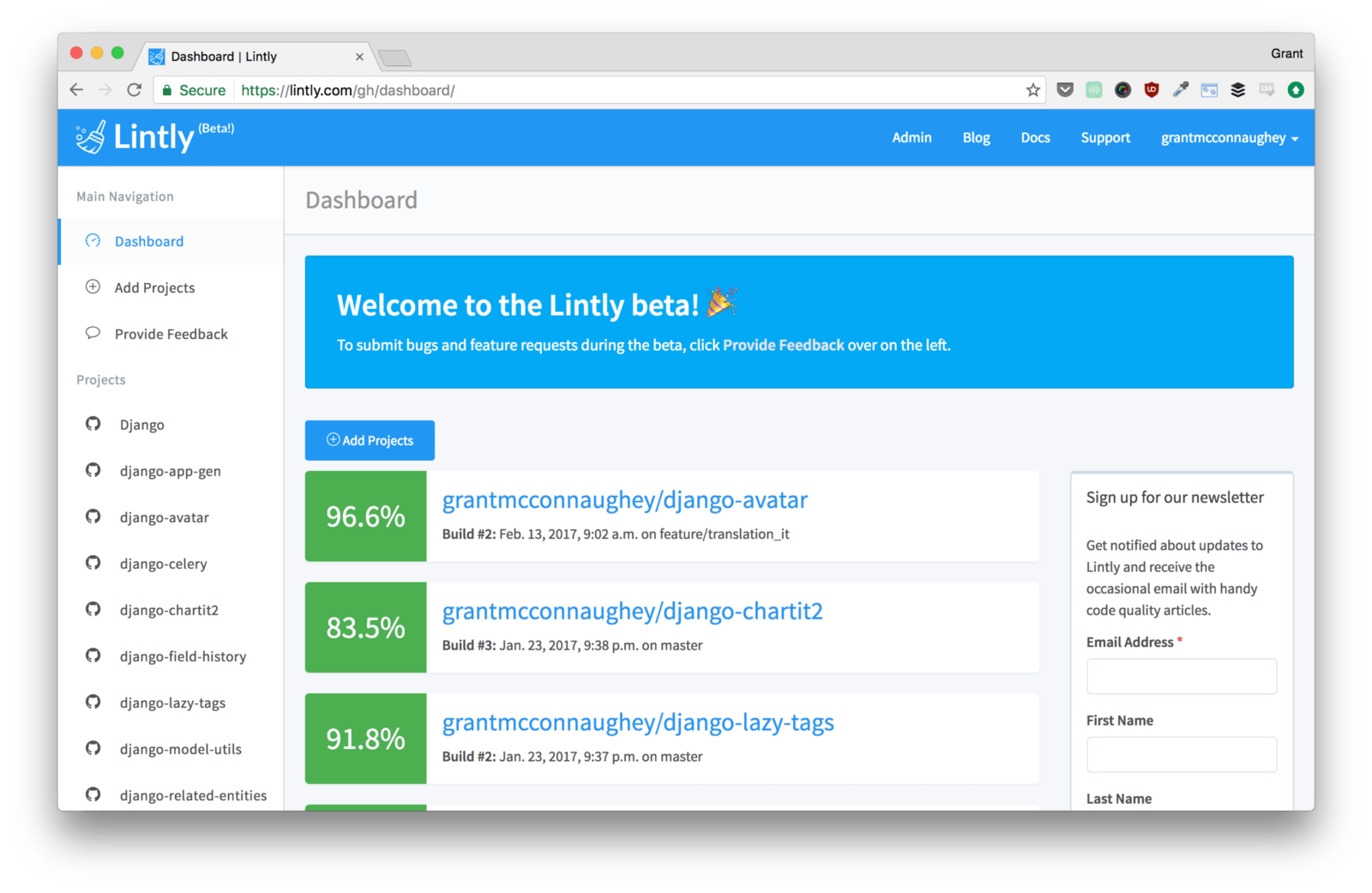
The app dashboard.
The numbers
Let’s get some statistics out of the way. Here is how Lintly performed in the last month:
- 78 user sign-ups
- 131 GitHub repos linted
- Linted code 642 times
- 320,146 lines of code linted
Not bad. I told my wife that if 10 people signed up in the first week, I would be happy. So getting 75 users in a month is certainly something I’m happy with.
Now let’s talk about building and deploying the app. First up: planning.
Planning
Planning was where I spent the least amount of time. There can be philosophical arguments about how much planning should be performed on a side project, but those are best left to smarter developers.
I do like to do one bit of planning: checking out competitors. I knew there was already a similar app in the Python landscape (wink, nudge), and several other competitors that work with all sorts of languages. So I went to the home page of all those sites and read about their features. I also checked out the documentation for those apps.
I did all of this to give me a good sense of what features are universal in code linting sites. For example, all sites integrate with GitHub webhooks, so I knew that would be important. On the other hand, some sites simply lint pull requests and don’t store the results, so perhaps that isn’t a required feature.
I wrote down all the essential and non-essential features. The former went into the “beta feature” set and the latter went into the “someday” or “v1.0 feature” set.
Development
After planning, it was time to start hacking on this thing. I’m pretty familiar with Python and Django, so those were what I used. I worked on the app in my spare time for about 6 months before finally releasing it. Occasionally, I wouldn’t work on it for weeks at a time, however, setting a goal to release on the first week of January helped me finally focus and ship a working product.
I used Trello to keep track of features that needed to be completed. I split the Trello board into five lanes:
Deployment
Marketing
Finances
Going forward





Stay updated on the go with our mobile app.
Get latest insights with smoother, more personalized experience through TIA mobile app.








📅 Upcoming Events
22 October 2026
Payoneer x CSPN Summit 2026