There’s lots of talk of venture funding slowing down in India this year. And that’s possibly true. But that doesn’t mean it’s going to come to a grinding halt. Ecommerce alone is estimated to cross US$36 billion during 2016. And since we all know these companies don’t make a profit, cash will have to come from somewhere. Here’s a prediction: in 2016, tech companies will raise more private money than IPOs will raise in India. And I believe a lot of that money could go towards (re)educating consumers, giving them access to debt for anything they want, and providing them a whole lot of video.
Here’s where I think a good chunk of money will flow in the consumer-based technology industry this year.
Education
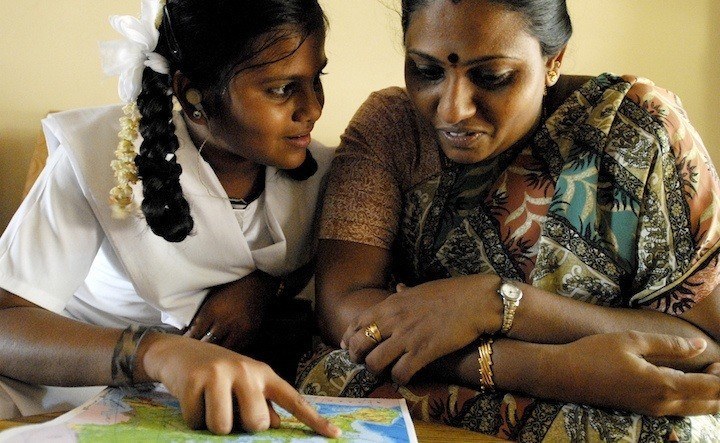
Photo credit: DFID
In India, education is failing our students and it’s failing our potential workforce. Earlier this year, The Pew Research Center questioned the existence of an Indian middle class. The article showcased how China’s middle class had blossomed from 2001 to 2011, creating massive disposable income. In India, unfortunately, this hasn’t happened. Instead, the really really poor people are now just poor people – still with little to no disposable income.
The article argued that this was mainly because of economic reforms but I would add education to this as well. We lack quality education in India. Scientist G Madhavan Nair, former chairman of Indian Space Research Organization (ISRO), compared Indian schools to factories recently. And he’s right. The majority of graduates in India aren’t qualified to get a job. And that’s a huge problem to try and solve. We need a system that prepares our students to obtain and retain employment. We need to change the way we create content, train our teachers, communicate with parents, distribute content, communicate with students, and certify graduates. And in each of these areas, technology will need to play a significant role.
I had thought that edtech was going to have a bigger year than it did in 2015. At the time, I didn’t realize how difficult it was going to be to prove product/market fit. Disrupting education is complicated. Just ask anyone trying to do it.
Two important variables that companies need in order to raise large sums of money are a product/market fit and subsequently proving that this “fit” can lead to monetization. Unfortunately, in education, proving a product/market fit takes longer than other industries. I mentioned this in an article recently. The transaction cycle for an educational course is significantly longer than almost any other transaction. For example, for test prep companies, consumers have to complete the course, take an exam, and then fulfill their end goal (like getting into college). And as long as this takes in the West, it takes even longer in India because we prepare for exams longer.
And once the startup has proven that their product works, they need to show that people will pay for it. Unfortunately, only then will serious money come behind the model. And for edtech startups, it’s even more important to prove this out because unlike other spaces, there aren’t comparable models in the West that investors can look at and use as a guide.
Luckily, I think a few companies have now done this. They’ve been spending small amounts of money testing the market. And it’s taken them a couple of years but I think they’re in a position to raise the big bucks. And once a few companies do large raises, more money will flow to the smaller ones. And that’s really exciting.
So where will money flow in 2016? I expect significant investment in test prep (not only IIT, but vocational test prep such as banking exams, CA exams and the like), local language content distribution (Khan Academy entering the market should excite others), and tutoring. I think we’re a little ways away from MOOCs starting in India. And as Richard Levin said some time ago, we’re a little ways away from truly disrupting traditional education.
Disclaimer: As a fund, Lightbox has invested in Embibe.
P2P lending

Photo credit: Dinesh Cyanam
Last year, I predicted B2C lending would get a lot of funding. Although I’m still excited about their prospects, I see more money going into peer-to-peer lending in 2016. (And especially since the RBI now is looking at preparing guidelines for it. )
Video





Stay updated on the go with our mobile app.
Get latest insights with smoother, more personalized experience through TIA mobile app.












📅 Upcoming Events
22 October 2026
Payoneer x CSPN Summit 2026