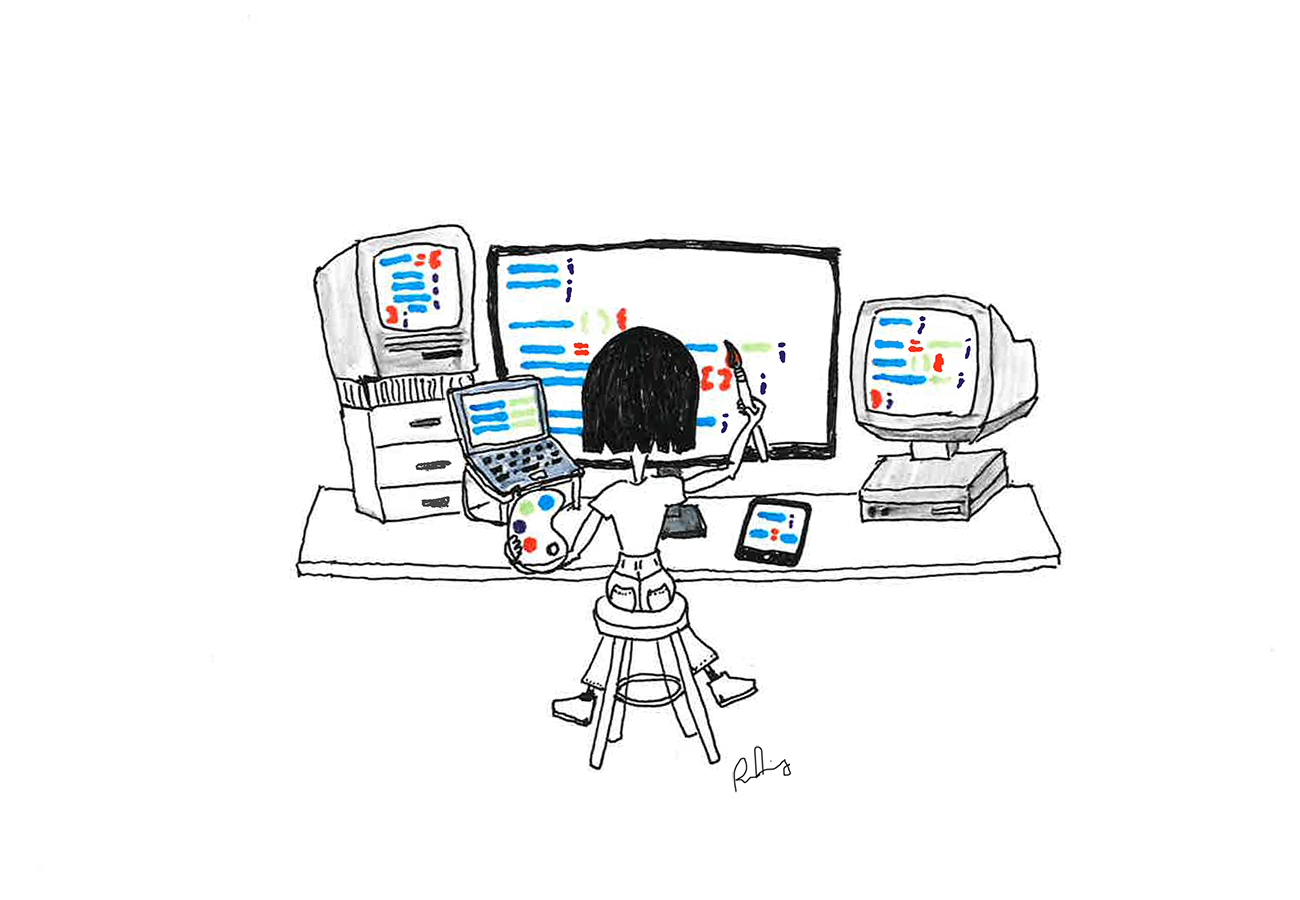
Illustration by Rosana Liang.
If you had asked my 10-year-old self what I wanted to be when I grew up, “engineer” would have probably been the second-to-last thing I’d mention (right after professional ice cube maker and right before director of cow poop communications). While I continue to experience the occasional how-on-earth-did-I-get-here feeling, my journey from living and breathing art to working as a full-time engineer—while not without its challenges—actually seems to make a lot of sense.
When art is life
From early on, my parents recognized my desire to create and did everything in their power to facilitate an environment in which I could do just that. I went from drawing/painting classes every Saturday morning to short, homespun (and probably totally nonsensical) theatrical productions every Tuesday night.
In middle school, I started creating personal websites for myself (and eventually, friends and classmates) just for kicks. I was only working with basic HTML and CSS and, quite honestly, barely knew what I was doing. But I remember staying up all night working on them and found myself obsessing over solving design problems. I had no inkling at the time that my interest in designing and building these silly little websites would become the foundation for my future career.
I endured high school—pimples, braces, depressing LiveJournal entries, and everything else—and eventually went on to study fine arts at the University of California, Santa Barbara. From there, I decided to go straight for an MFA in photography at Parsons School of Design.
The turning point
During my time at Parsons, I began to notice a shift in my art practice. My work started to steer away from personal storytelling and toward the possibilities of interactive art, and I began to explore how technology itself could become that intersection.
I wanted to make art that could be functional and actually helpful to others, the type that others could engage with and contribute to in their own way. As my work continued to develop in this direction, I soon realized that the only way I could make the work I wanted was by becoming a developer myself.
The bootcamp
I knew I couldn’t dive into the world of engineering without first equipping myself with the necessary tools. So, after a lot of thought and even more research, I decided to officially commit myself to learning these tools full-time.
I self-studied for months and was accepted into one of New York’s top immersive coding bootcamps, Fullstack Academy. I’m not going to lie, attending the bootcamp was probably one of the most mentally challenging months of my life. But for me, it was 100 percent worth it. The stack we were learning at the time (JavaScript, AngularJS, Express, and Node.js) opened the gates for developing the type of work I had been yearning to create. Moreover, what began as a pursuit of engineering in hopes of fulfilling my artistic vision soon developed into a passion for engineering itself.
Life as a full-time engineer
After the bootcamp, I was lucky to land my first official front-end engineering position at Transfix, where I’ve been for over nine months now.
At the company, I come in every morning with the expectation to create—whether it be through building a new feature or harnessing my creative energy to navigate my way through a frustrating bug. A typical day at the office involves collaborating with designers and other engineers on product goals and solutions, munching on snacks, and, of course, coding.
When I find myself at my desk coding for long chunks of uninterrupted time, the keys on my keyboard don’t feel so different from the bristles on my paintbrush or the shutter on my camera. While this engineering career is still pretty new to me, something about it already feels like home.
So much of what my art education has taught me to value (curiosity, attention to detail, creativity, and problem-solving) all seem to apply to everything I’ve been doing as a developer. Moreover, I’m contributing to something greater than myself and working on something that is actually functional and helpful to others. And that, in and of itself, is very rewarding.
In the end, programming is just another medium to create new and exciting things, and as long as I’m creating, I’m still making art.





Stay updated on the go with our mobile app.
Get latest insights with smoother, more personalized experience through TIA mobile app.