- Insights This article was written by a TIA community member. Insights pieces undergo the same rigorous editorial process that newsroom-produced articles have.
 Xin Wang · · 6 min read
AI-powered, personalized recommendations, the next stage of China’s reading apps
This article was co-authored by Xin Wang and Rhea Liu.
Qing Mang Magazine, a reading app launched in July 2016, has attracted significant attention from Chinese internet veterans after hosting a press event in December. Some of the public attention has been for star founder Wang Junyu, who sold his previous company, Wan Dou Jia, to Alibaba for an estimated US$200 million last July.
People are intrigued by the new model adopted by the reading app. It uses an interest-based subscription model: users subscribe to a specific interest and receive collections of articles curated by an algorithm based on that interest. A similar machine-powered scheme is behind one of the fastest unicorns in China over the past couple of years—Toutiao.
Industry observers are carefully assessing whether Qing Mang will turn out to be the next killer app. Will users embrace this new format? Or will it fail to compete with established models in the market? To answer these questions let’s first take a look at the status quo.
3 major content distribution channels
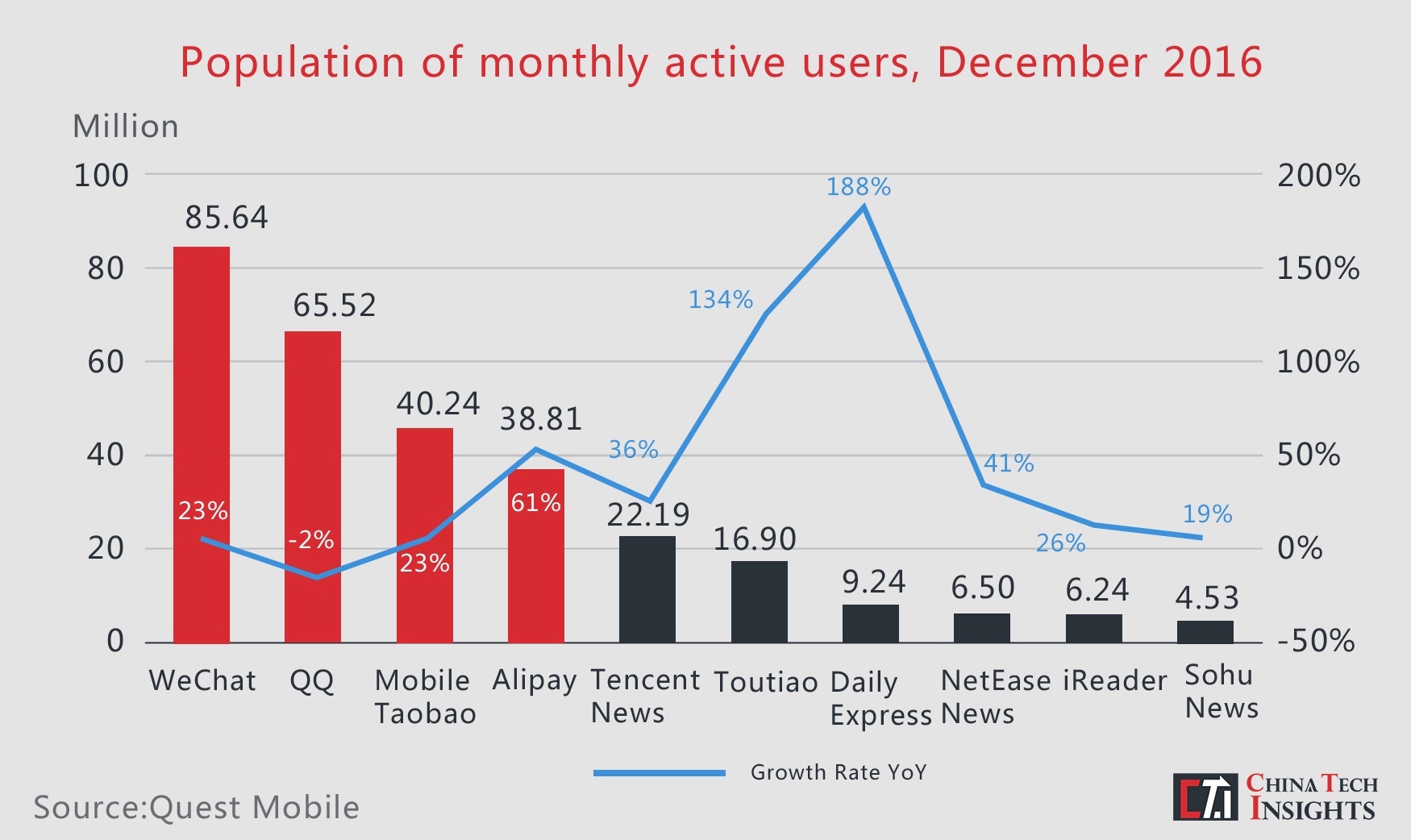
There are three major content distribution channels in China’s mobile market: mobile news apps, personalized news aggregators, and social media platforms.
Mobile news apps
Long ago, China’s portal news sites replaced print media, enjoying higher popularity among Chinese web users. As shown in the chart above, portal news site apps, such as Tencent News, have the most monthly active users among reading applications in the country. Because of the great amount of traffic, news portals in China have been one of the most significant channels for digital advertising in the country since the desktop era.
However, rapidly growing personalized news aggregators have made a difference in the sector. These aggregators not only enjoy expanding popularity among users but also with advertisers. Given this challenge, some news portals have begun to reform. NetEase News, for example, recently embraced live-streaming.
Personalized news aggregators
Toutiao is most representative of this category. It adopts an algorithm-based recommendation scheme. Instead of pushing the same general news to every user, the app and its ilk distribute articles based on subscriptions and data from user reading behaviors—including open rate and time spent.
The company labels itself as a technology company powered by big data and artificial intelligence. It’s working toward building a model of reading patterns which will be able to assist with recommending content and hopefully result in the app’s longer use. It now has the second longest average usage time in China according to QuestMobile, second only to social media app WeChat. The interest-based recommendation scheme has also attracted advertisers, thanks to its clearly sub-divided audience groups.
To deal with the challenge posed by Toutiao, news portals have also launched their own versions of personalized aggregators. Daily Express, for example, is now the third most used news reading application according to QuestMobile’s December report.
Social media platforms
What’s new about Qing Mang
You are what you read





Stay updated on the go with our mobile app.
Get latest insights with smoother, more personalized experience through TIA mobile app.










📅 Upcoming Events
22 October 2026
Payoneer x CSPN Summit 2026