- Insights This article was written by a TIA community member. Insights pieces undergo the same rigorous editorial process that newsroom-produced articles have.
 Anu Hariharan · · 16 min read
7 lessons on scaling from WeChat’s story

Founders are increasingly pointing to Asia when asked for an example of a product they aspire to create, and WeChat is very often that aspirational product. My friend and former colleague Connie Chan described WeChat as “the one app to rule them all.” It dominates the Chinese mobile market with 889 million MAUs (monthly active users).
WeChat has also completely evolved the way Chinese people communicate and socialize online, and changed the way they pay each other and pay for their groceries. WeChat is no longer just an app. And while its blazing success has been concentrated in China, everyone in the West has experienced WeChat’s work, as the service has inspired a new category of “messaging as a platform.” You don’t have to look hard to see hints of WeChat in other messaging platforms such as Apple’s iMessage or Facebook’s Messenger platform.
We partnered up with China Tech Insights, a research group within Tencent (WeChat’s parent company) to understand how WeChat drives its 889 million MAUs to use the app an average of more than 50 minutes, nine to 11 separate times per day, according to iResearch, Jiguang. To put that in context, it is the same as the “combined time” users spend across a portfolio of Facebook apps—Instagram, Facebook, and Facebook Messenger—on a daily basis.
This post dives into the growth strategy that led to key WeChat milestones and lessons learned, and gives insight into the method behind the madness as WeChat scaled from 0 to over 800 million MAUs in less than six years. Unlike AOL and Yahoo, Tencent is one of the few companies to have evolved its messaging product portfolio successfully from a web/desktop product to a mobile/messaging platform.
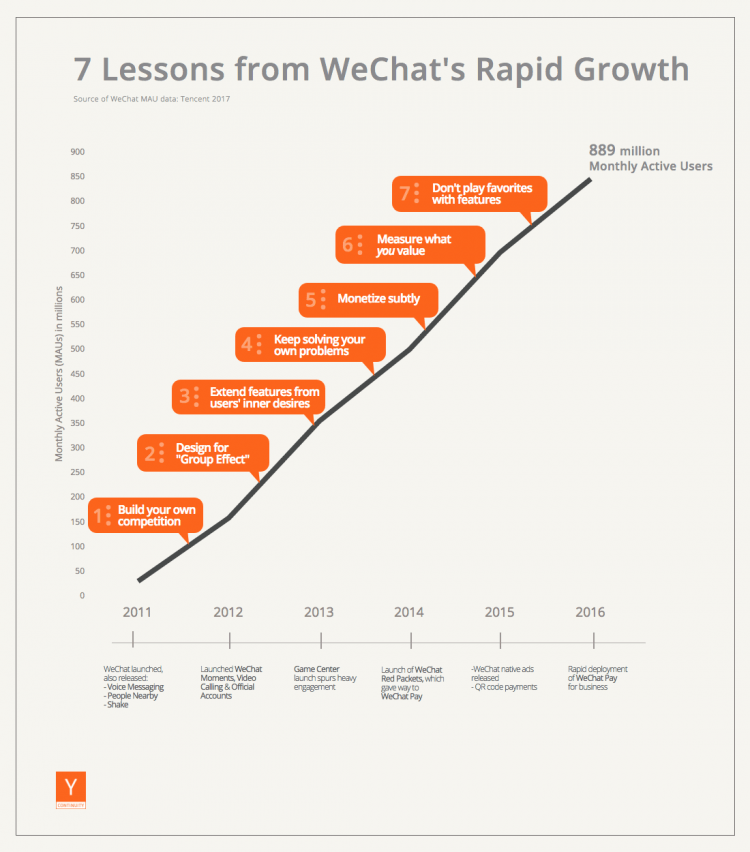
Lesson 1: Build your own competition
Tencent started WeChat (mobile-first messenger) as a side project, and it ended up reinventing messaging in China.
Tencent was already one of China’s top internet companies in 2010, and the biggest social company even before WeChat was launched. Many Chinese people grew up using Tencent’s QQ, a popular desktop messaging app (similar to ICQ and AOL Instant Messenger). At the time, Tencent’s products had approximately 650 million monthly active Instant Messenger accounts. Recognizing the growing importance of mobile, the company created a mobile version of QQ in 2008, but the app was weighed down by desktop-centric features (e.g. multiple user statuses, large file transfers, embedded services such as music streaming, etc.).
Tencent made a bold decision: put together a small skunkworks team from the QQ Mail team, its core product at that time, to create a new mobile app that could potentially compete with other product teams from other divisions within Tencent. This team of only seven engineers went on to create the first version of WeChat in just three months.
WeChat launched in January 2011 as a simple messaging and photo-sharing app, but it was not the first messaging app then.
If you don’t create a culture of disrupting yourself, then a competitor is likely to disrupt you.
WeChat was not the first mobile messaging app when it launched. Xiaomi’s MiTalk was the leader at that time with 5 million registered users. Due to the intense competition, WeChat did not see much growth right after its initial launch. It had to offer more than just chat to enable users to switch from other mobile chat solutions.
In May 2011, three months after the launch, WeChat turned on voice messaging, allowing people to send short audio notes (similar to the native iPhone iMessage feature that came out over three years later). The inspiration to add voice messaging came from TalkBox and Kakao Talk. Using voice messaging was strategic because the native mobile keyboard to type Chinese characters then was not easy to use and consumers found sending voice notes intuitive, personal, and convenient for daily life. As one of the first messengers to offer voice, text, and photos in a combined solution, WeChat’s daily downloads spiked 50,000 to 60,000 consistently.
Lesson 2: Design for groups (“group effect”)
Lesson 3: Extend features from users’ inner desires
Lesson 4: Big ideas come from solving your own problems
Lesson 5: Monetize subtly
Lesson 6: Measure what you value, not what you’re supposed to
Lesson 7: Don’t play favorites with features





Stay updated on the go with our mobile app.
Get latest insights with smoother, more personalized experience through TIA mobile app.