- Insights This article was written by a TIA community member. Insights pieces undergo the same rigorous editorial process that newsroom-produced articles have.
 Stephen Turban · · 6 min read
We spoke to 50+ founders to learn how startups can attract technical co-founders

Photo credit: Teo Yi Herng
Stephen is a TIA Star Contributor and publishes high-value content that serves the Asian tech community. You can read more from Stephen here. Also read more from TIA Star Contributors here.
This article was co-authored by Daniel Wu, a tech lawyer with a J.D. from Harvard, focused on urban innovation and ethical AI.
If you don’t have technical skills but are interested in startups, how do you successfully show your value and find a technical co-founder?
To answer this question, we began an informal research project spanning 50+ technical and non-technical co-founders. Our meta-analysis involves a quantitative component where we use founders’ blogs and writings to count the desired characteristics of non-technical founders. We also had a qualitative component where we validate these ideas in a series of one-on-one interviews.
Overwhelmingly, our founders agreed on one thing: viable companies can’t be split inorganically into business and technical “sides.” Instead, companies require a melding of expertise, traction, and technical skills.
As a non-technical co-founder, you need to build evidence that you’ll make the business happen, not just handle the business side.
We identified three key actions for those looking for a technical co-founder:
- Expertise: Show that (only) you can grow and sell the idea.
- Traction: Prove that your idea is valuable and has traction.
- Technical proficiency: Develop the technical skills you need.
1. Show that you can grow and sell the idea
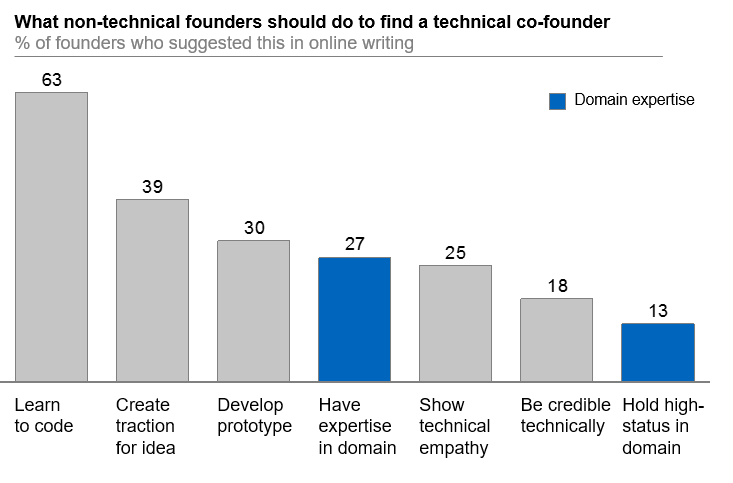
You’ve approached a technical founder with an idea that has traction. Great. Why would they want to work with you instead of another friend? Or, with someone else who has more technical skill?
To prove your worth, show that you—and perhaps only you—can grow and sell the idea. The majority of our founders agreed that you need to show expertise in the users and the problem.
Take the case of Zott, a rapidly growing entertainment distributor focused on children in hospitals. One of the co-founders, Taylor Carol, was diagnosed with leukemia at the age of 11. For the following five years, he was in and out of hospital wards. As he put it, “Video games were my escape while receiving treatment for months at a time.”
2. Build strong evidence that the idea is valuable and has traction
3. Develop the technical skills you need





Stay updated on the go with our mobile app.
Get latest insights with smoother, more personalized experience through TIA mobile app.












📅 Upcoming Events
22 October 2026
Payoneer x CSPN Summit 2026