- Insights This article was written by a TIA community member. Insights pieces undergo the same rigorous editorial process that newsroom-produced articles have.
 Jayme Hoffman · · 8 min read
13 mental models every founder should know
Mental models are to your brain as apps are to your smartphone.
Just like apps, there are a ton of mental models. They help you make decisions, solve problems, and see the world in an entirely new way. They basically make your brain more useful.
Charlie Munger, Elon Musk, and many others have stated that you’ve got to have a collection or latticework of models in your head to be able to make sense of the world around you. Trying to remember all the facts is not a winning strategy.
“You may have noticed students who just try to remember and pound back what is remembered. Well, they fail in school and in life. You’ve got to hang experience on a latticework of models in your head.” — Charlie Munger
There’s never a drought of new information to remember in the startup world. Between Tech in Asia, Product Hunt, Medium, Twitter, TechCrunch, HackerNews, Quora, and many other podcasts, it’s tough to remember the basics and what’s actually important when building something new.
Thanks to Warren Buffett and Munger, there is a large collection of mental models for identifying and investing in moats or defensible businesses. What about creating new moats or new businesses? What’s the latticework of mental models needed in the startup world?
Here is a small and early collection of some of the most important mental models you need as a founder. The news sources I listed above do a great job in helping you with what to think. The models below will help you with how to think.
1. Regret minimization framework
Maker: Jeff Bezos
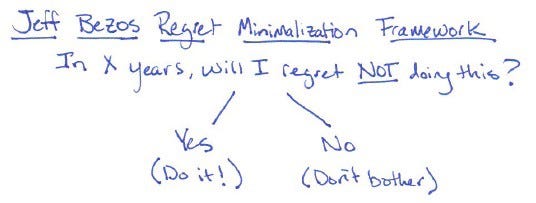
Regret minimization framework (RMF) helps you make tough decisions by projecting to your future self and looking backward on your current decision. RMF will help you leave your job and build the thing you’ve been thinking about for the last 2.5 years.
“I knew that when I was 80 I was not going to regret having tried this. I was not going to regret trying to participate in this thing called the internet that I thought was going to be a really big deal. I knew that if I failed I wouldn’t regret that, but I knew the one thing I might regret is not ever having tried.” — Jeff Bezos
Helpful resources:
2. The idea maze
3. Schlep blindness
4. Jobs-to-be-done
5. Minimum viable product
6. Confirmation bias
7. Product-market fit
8. 100 people love
9. AARRR
10. Network effects
11. Economies of scale
12. Disruptive innovation
13. Conjoined triangles of success





Stay updated on the go with our mobile app.
Get latest insights with smoother, more personalized experience through TIA mobile app.