C. Custer · · 3 min read
Something very weird is going on with China’s hottest social app
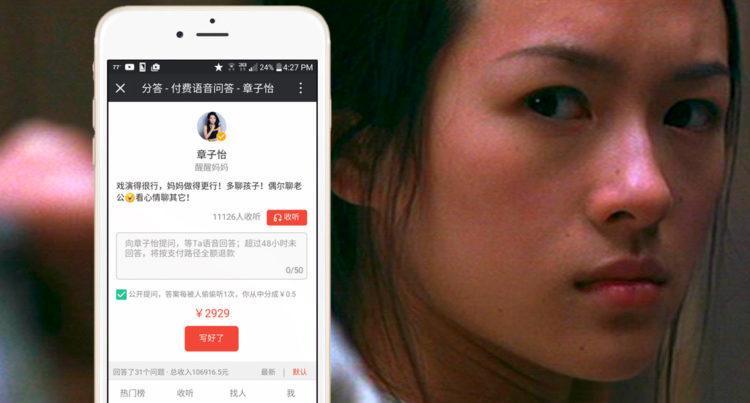
Background image: Crouching Tiger, Hidden Dragon (Sony Pictures).
Much ink has been spilled over the past few months about the rise of China’s paid Q&A platforms. Fenda, the largest and hottest of China’s new Q&A apps, was making big waves just a couple of weeks after its own launch. Everyone from movie stars like Zhang Ziyi to investors like Wang Sicong hopped on board.
But something is rotten in the state of Fenda. For nearly two weeks now, the platform has been basically offline – the app itself works but the content is virtually all gone.
Could this really just be an upgrade?
This began on the August 10, and on August 15 Fenda maker Zaihang added an introductory message explaining that the downtime was caused by “technology upgrades” and promising “an even better Fenda.” But here we are on August 23, and the platform is still down.
Understandably, people have begun to question the “upgrade” explanation. And it does defy belief: why would an app that launched just a couple of months ago need to upgrade its tech already? And why would that upgrade take weeks? Zaihang is by all accounts a competently-run and well-backed startup; Wang Sicong himself is one of the company’s investors. It seems unlikely that they would have built the platform on unscalable technology or made any other error so significant that a massive, weeks-long overhaul would be necessary so soon after the initial product launch.
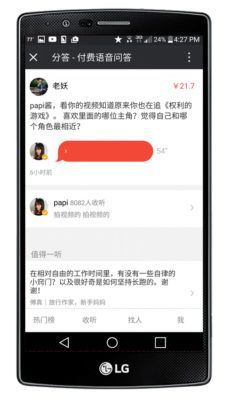
Papi Jiang answers the Game of Thrones question on Fenda.
A darker secret?
Nobody knows what’s really going on, and Zaihang/Fenda founder Ji Shisan isn’t talking. But the most popular theory is that the app has been forced to remove all of its content, at least temporarily, because it’s under investigation by some government regulatory arm.
It certainly is possible that Fenda could have run afoul of regulators. Any platform that allows user-generated content runs that risk, and Fenda got its viral boost early on in part thanks to celebrities like Wang Sicong answering user questions like “What’s your favorite sex position?” And while mildly scandalous questions like that probably wouldn’t have gotten Fenda into trouble, it’s entirely possible that other users (both askers and answerers) may have taken things a bit further, possibly running afoul of China’s rather vague ban on “vulgar” content.
It’s also possible that users have been broaching other taboo subjects, like sensitive political topics, on the platform.
If that’s true, how screwed is Fenda?
If the prevailing theories are true, and Fenda really is under investigation by government regulators, it could be in for some trouble, for a couple of reasons.
First, although the government usually gives online platforms with user-generated content a chance to reform and filter their content more thoroughly, that doesn’t always happen. Remember Fanfou? Neither does anyone else. Fanfou was China’s first Twitter clone, and it hit the country long before Weibo did. But the government shut it down and kept it shut down until Sina and Tencent, large companies the government had better control of, could launch their Weibo platforms. The same sort of thing could happen to Fenda if government regulators decide they like the concept but are more comfortable having it in the hands of a bigger internet company.
Second and probably more important, because Fenda’s answers are voice-recorded, they’re not going to be very easy to filter for messages that are too sexual, too political, or otherwise illegal. On a platform like Weibo, Sina can use keyword filters and other kinds of automation to reduce the number of posts human censors at the company have to read. But Fenda will need to hire censors to listen to every single answer posted on its site, or license some very accurate speech-to-text software and hope it doesn’t miss anything important. Either way, if the government decides Fenda’s current censorship methods aren’t up to snuff, the company could be in for a rather expensive fix.
(In China, the government rarely censors content itself; media outlets and UGC platforms are typically required to self-censor, with the government stepping in only when it thinks they’ve screwed up).





Stay updated on the go with our mobile app.
Get latest insights with smoother, more personalized experience through TIA mobile app.