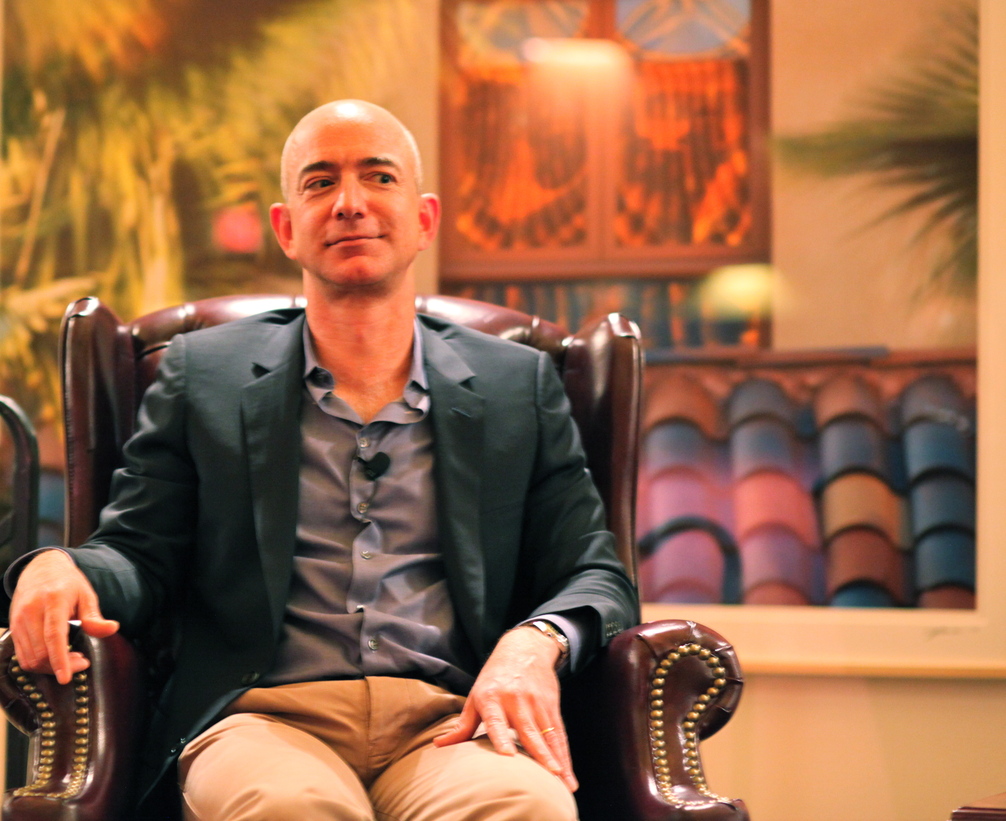
Jeff Bezos must be pleased as a punch at Amazon’s success. / Photo credit: Steve Jurvetson
The following is an edited excerpt from Amazon and Jeff Bezos: From Startup to Success, published via Digital Literacy. You can read the full paper here.
When the Kindle was released in 2007, electronic books had been on the market for fifteen years but had never been big sellers. Earlier versions of electronic readers were not easy to use, and there were not many electronic books available for sale. If Amazon’s Kindle was going to be a success, Bezos had to offer a device that seemed more convenient than an actual book, a tall order when people were used to reading in a more traditional format.
He asked himself why he loved books and the smell of glue and ink. The answer was that those smells were linked “with all those worlds I have been transported to,” he stated in a Newsweek interview. “What we love is the words and ideas.” The breakthrough for electronic readers came in 2006 with the development of electronic ink (e-ink). E-ink was designed to cause far less eyestrain than the LCD display on machines such as a laptop, tablet, or cell phone.
In an interview on The Charlie Rose Show, Bezos said that reading on those devices was like “reading with a flashlight flashing in your eyes.” The company does offer free Kindle applications for these devices so that customers who own PCs, iPads, Blackberries, Android phones, and the like can still buy e-books through Amazon. The Kindle DX has a larger screen than the Kindle that was introduced in 2007, making the viewing of charts, textbooks, and e-books without having to be connected to a computer.
In less than 60 seconds, customers could have not just books but also blogs, newspapers, and magazines available at their fingertips. The long battery life of the Kindle added to its appeal, as did the ability to change the font size, creating a large-print book using a button at the bottom of the keyboard. Amazon already had a large and loyal customer base from which to draw as long as the Kindle delivered on its promises.
A shaky start
The Kindle’s release wasn’t without problems. The e-reader sold out in five and a half hours, and some customers had to wait as long as six weeks for their Kindle. Bezos was forced to put an apology letter on Amazon’s Web site that stated, in part, “We hope to be able to announce to you within the next few weeks that we’re back in stock and that when you order a Kindle, we’ll ship it to you that very same day.” Amazon prided itself on its excellent customer service, so this was an embarrassment to the company at a crucial time.
There were a few analysts, however, who believed that Bezos orchestrated the shortage to make it seem as if the Kindle was in higher demand than it actually was. Reviews of the first-generation Kindle were positive overall, although some critics felt that its original asking price of $399 was too high. Prices for most e-books were set at $9.99, which Bezos thought was fair considering that readers couldn’t lend out the books, give them as gifts, or resell them. Some publishers, including Macmillan, thought the price of e-books was too low. In 2010, Amazon temporarily pulled all Macmillan ebooks from its Web site before agreeing to charge $14.99, a price Amazon called “needlessly high” in a statement.
On September 28, 2011, Bezos introduced four new Kindles, including the Kindle Fire. According to analysts, customers pre-ordered an estimated ninety-five books as the reason why Amazon had no choice but to give in to its demands. It is clear from Amazon’s statement, however, that Bezos was unhappy with the outcome of this conflict. At present, most new releases in Amazon’s Kindle store are offered at a price of $12.99 or less. Despite the high price of the first Kindle, within six months more than 6 percent of Amazon’s book sales were Kindle downloads, and before a year was up that number was at 10 percent. The trend continued upward. By early 2011, Amazon customers were choosing electronic books more often than print books, hardcover or paperback.
“We had high hopes that this would happen eventually, but we never imagined it would happen this quickly,” Bezos said in a press release. “[W]e’ve been selling print books for fifteen years and Kindle books for less than four years.” The first million-seller e-book for the Kindle was Stieg Larsson’s The Girl with the Dragon Tattoo.
The next generation
As with any entirely new system, Bezos knew that the Kindle would need improvements over time. Within a year, a second-generation Kindle was rolled out, and in 2009 the Kindle DX, an alternate version with a larger screen and more storage capacity, was released.
As of 2012, Amazon offers two Kindle families at different price points: the Kindle e-readers, which use touchscreen technology for navigation; and the Kindle Fire tablets, which have an LCD display and access to books, apps, the Web, games, movies, and more. The Kindle e-readers have a feature called X-Ray that sends a second file to the Kindle when a customer downloads a book. This file contains information about the characters and settings of the book gathered from sources such as Wikipedia and Shelfari, a social networking site for readers owned by Amazon.
All of these machines use black-and-white e-ink and feature page numbers, as well as the ability to download e-books from the library. Amazon Prime members now have access to a lending library, where thousands of titles, including current and past best sellers, are available to borrow for free. College students now have the option of renting textbooks for their Kindles or for devices such as laptops or smartphones using a free, downloadable application. Students have tens of thousands of textbooks to choose from with discounts of up to 80 percent off the purchase price. The books would be available for up to 360 days, but students would have to pay for only the amount of time they used. Any notes or highlighted material from a Kindle could be kept in a remote server.
This server, called a cloud drive, holds the notes even after the rental period expired so that they could be accessed anytime. Along with these convenient features, the newest Kindles are also much less expensive, ranging in price from $69 for the Kindle to $159 for the Kindle Fire. When announcing the new lineup of Kindles, Bezos referred to them as “premium products at non-premium prices,” according to the Washington Post.





Stay updated on the go with our mobile app.
Get latest insights with smoother, more personalized experience through TIA mobile app.












📅 Upcoming Events
22 October 2026
Payoneer x CSPN Summit 2026