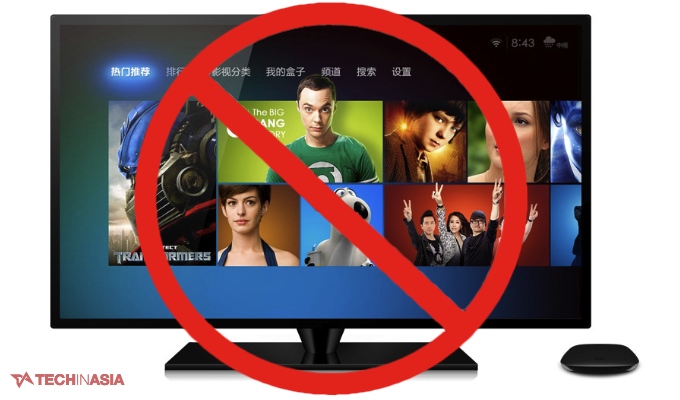
Set-top boxes (think Roku or Apple TV) are a hot commodity in China, and it’s not hard to see why: they’re cheap and easy to set up, but they can turn any screen into an internet-streaming smart TV with just the plugging of an HDMI cable. For example, Alibaba’s second-gen set top box, the Tmall Box 2, can turn your dumb TV into a video-streaming, game-playing smart TV for just RMB 299 (US$46). It even supports 4K video! Xiaomi and a number of other internet companies have similarly powerful offerings in the same price range.
But the set-top box market hit a bump in the road recently, when China’s State Administration of Press, Publication, Radio, Film and Television (SAPPRFT) issued new rules to govern the set-top box marketplace, banning 81 third-party apps in the process. The list of now-illegal apps includes some pretty popular ones:
- Fengyun Live, a video streaming app that broadcasts content from China’s TV stations, including satellite and local networks as well as the CCTV channels and sports.
- Ximalaya FM, a radio streaming app that lets users listen to hundreds of different radio stations as well as create their own stations and other audio content.
- Xiongmao Tingshu, an app that allows users to listen to audiobooks.
It seems SAPPRFT’s beef with the apps may be related to the regulation that requires any company in the internet television industry to be partnered with one of the seven Chinese firms to have an internet TV license. Companies like Xiaomi and Alibaba have of course secured those partnerships for their first-party apps, but the banned third-party apps may have run afoul of this rule.

Alibaba’s Tmall Box in action.
An update to Alibaba’s Tmall Box blocked access to all 81 apps SAPPRFT listed on Sunday. Other systems using Alibaba’s YunOS operating system also need to make similar updates soon. Android boxes probably aren’t far behind either. The focus on Alibaba’s systems first is likely due to their relative dominance: Alibaba claims that YunOS machines account for about 70 percent of the set-top box market.
Tech in Asia has contacted Alibaba for comment on this story and will update if we hear back.
Popular response to the move has been overwhelmingly negative. A Jiangsu-based commenter, for example, struck a chord with Sina Tech readers when he wrote of the change: “Management [of industry] should be people-oriented. This kind of management is completely anti-people.” Other popular comments include sarcastic suggestions that SAPPRFT ban digital signals entirely and return China to the era of bunny-ears-antenna, or that SAPPRFT should be investigated under China’s anti-trust laws. The general feeling is that SAPPRFT is using its regulatory muscle to prop up China’s cable companies and old-media establishment.
An anonymous industry source told China’s National Business Daily that the move could potentially cut the functionality of set-top boxes in half, and that it was a major obstacle in the development of the set-top box industry.
Do you own a set-top box? Do you use third-party apps on it?





Stay updated on the go with our mobile app.
Get latest insights with smoother, more personalized experience through TIA mobile app.