
While most of the hype around blockchain tech has revolved around financial applications, its gaming space has quickly emerged as an area of significant growth for Web3 enthusiasts.
In recent years, breakout play-to-earn (P2E) titles like Axie Infinity and Pegaxy have helped blockchain gaming soar in popularity. In 2021, gaming-related NFTs raked in US$4.8 billion in revenue, while nearly 50% of all wallet activity in November of that year was connected to GameFi applications.
Michael McClenaghan, CTO and co-founder of blockchain gaming company Defy Labs, argues that the sector’s ability to “convert time spent in-game into a user owned asset” is its main selling point.

Michael McClenaghan, CTO and co-founder of Defy Labs / Photo credit: Defy Labs
Early iterations of the P2E model emerged somewhat by accident when games like “Runescape* and Diablo II allowed players to earn big bucks for desirable in-game loot sold on informal marketplaces. Blockchain gaming brought structure to this economy by formalizing players’ ownership of digital goods, allowing them to keep, sell, and trade these items – in the form of non-fungible tokens or NFTs – for real money.
“The real value that blockchain games provide is in provable ownership of in-game assets as well as interoperability both in the assets and the currencies,” says McClenaghan.
Enter the world of Defy
Defy Labs was launched in 2021 with a vision to create hyper-immersive Web3 experiences that merge the real and virtual worlds. To build and maintain its metaverse, Defy Labs relies on PubNub, an API developer platform with a track record of supporting virtual space development.
As the first step to realizing its vision, Defy Labs set out to make a product that would boost blockchain adoption in the real world by capitalizing on the widespread appeal of gaming. This culminated in the April 2022 launch of its first blockchain game, Defy, an augmented reality (AR) mobile title set in a near-future dystopian world. Players can collect and craft weapons and tools, all of which are represented as NFTs.
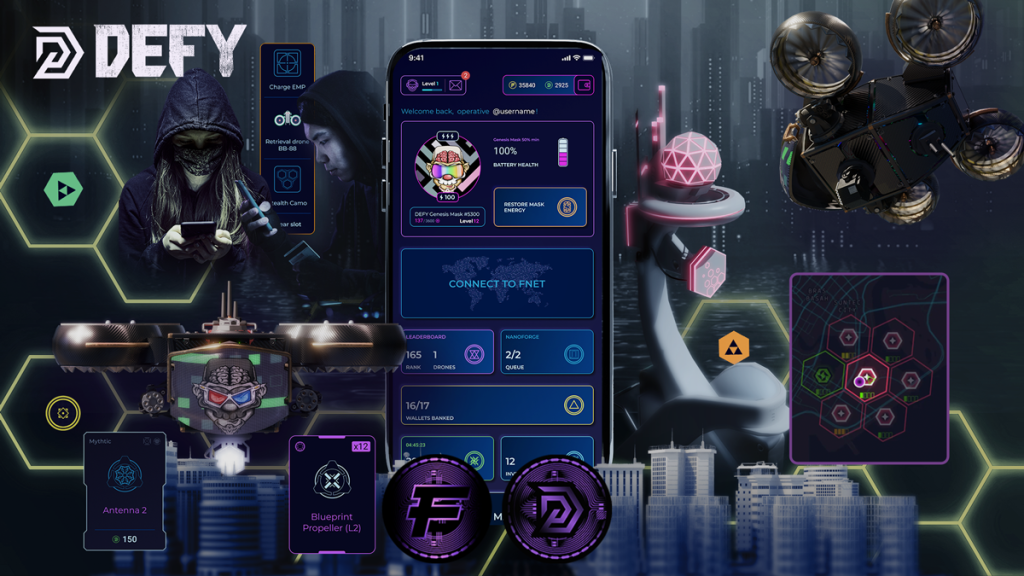
Defy / Photo credit: Defy Labs
A couple of things set Defy apart from other blockchain games. For one, it leverages the move-to-earn model, similar to the one popularized by Pokémon Go. With the help of AR technology, gamers move around the real world to reveal code-breaking tasks that equip them with new tools and materials to craft their in-game assets.
These assets and the complex economy formed around them make up another distinctive feature of Defy. McClenaghan notes that rather than creating singular NFTs with individual values, the game is experimenting with a form of “NFT crafting” that may “forge a new path for game economies.”
“With our Defy token, you can purchase parts that can be merged together for more powerful gameplay or sold on any marketplace,” he adds. Defy’s leveling system also disallows pay-to-win strategies that are rampant in other blockchain games.
No limits on scale
McClenaghan points out that Defy was designed to be a multiplayer game, making it key that players’ experiences weren’t happening in a vacuum.
“The power of this space is that it allows all interactions within the game to take place in real time across our entire playerbase,” he shares. “To achieve this, we needed to create a truly global infrastructure layer that allowed all of our players to work together in the same universe.”

Photo credit: 123rf
Developing infrastructure is easier said than done, especially when it comes to online gaming where real-time, uninterrupted play is expected. The problem becomes more challenging when you take into account Defy Labs’ global audience and its small team.
To address these issues, the company used PubNub’s technology to build and ship the first versions of the game. PubNub’s solutions are designed to help developers by providing access to a library of APIs and SDKs that enable a variety of functions and features.
By leveraging this library, Defy Labs didn’t have to build its own in-game messaging platform and could instead focus on “successfully shipping gameplay,” says McClenaghan.
Streamlining server communication
Of course, the issues didn’t end after the game’s launch. Defy faced a number of other hurdles that kept it from running perfectly 24/7. This issue isn’t specific to blockchain gaming but a symptom of the challenging nature of online games in general.
To ensure Defy would be able to run at all times regardless of how many users were logged on, the company relied on a farm of real-time servers. While these servers are crucial to ensuring players’ experiences are uninterrupted, they pose an issue when Defy Labs has to roll out updates for the game.
“It’s not as simple as just deploying a new version since we need to ensure that any live gamestate continues even as we roll out the updates,” McClenaghan explains.
Defy Labs started implementing a blue-green protocol that concurrently runs old and new versions of the server code in order to ensure a smooth handoff. PubNub’s platform provides a layer of communication between the game and the real-time servers that enable it to run.
“It also allows our servers to coordinate with one another during the handoff,” McClenaghan adds. “The low latencies of PubNub’s edge network makes it all happen quickly, regardless of geographic location.”
Blending virtual and real worlds
While it’s still running and polishing Defy, McClenaghan says the company is already working on new “modalities of play” that twist the relationship between the virtual and real worlds.
“We are particularly excited about providing the ability for drones crafted virtually to interact with gamers participating in the game’s location-based aspects,” he says. “Beyond that, we are planning AR drone battles, as well as larger-scale team-based play.”
McClenaghan reveals that Defy Labs is also collaborating with large corporations who are interested in leveraging its tech.
“Many brands are moving to Web3 to open up new possibilities for engaging people,” he says. “We see NFTs, location-based experiences, and AR as technologies that can enrich experiences in ways that haven’t yet been brought mainstream because they haven’t been designed the right way.”
Though McClenaghan is optimistic that these Web3 tools will unlock a whole new paradigm of value, he emphasizes that partnerships with enablers like PubNub will be key to realizing Defy Labs’ ambitions.
“PubNub will remain a core piece of our infrastructure as we continue to build out more and more real-time features into our game,” he says. “This ensures we are able to focus on building the best experiences.”
PubNub powers the latest developments in blockchain gaming, bringing people together in real time to experience a new way to engage. Companies like Defy Labs use PubNub’s developer platform and APIs as the foundation to run real-time, responsive, and round-the-clock gameplay at a global scale. Since 2010, PubNub has invested in the tools and global infrastructure required to serve customers like Adobe, Pocket Gems, DocuSign, and Swiggy.
Find out more and start developing a virtual space for free with PubNub by checking out its website.
This content was produced by Tech in Asia Studios, which connects brands with Asia’s tech community. Learn more about partnering with Tech in Asia Studios.
Stay updated on the go with our mobile app.
Get latest insights with smoother, more personalized experience through TIA mobile app.
Recommended reads
 Making carbon emissions data auditable for financial regulators
 This system is tackling Indonesia’s $422m payment fraud
 This startup helps chipmakers stop repeating the same mistakes
 ‘Not how humans act’: how agentic AI is changing cyberattacks
 Killing ‘zombie’ projects: PH bets big on offshore wind
 Sarvam is here, but will India’s startups use it?
 The hardware secret that gave OpenAI the edge on Anthropic
 Why relying on AI models could hurt software profits
 This startup’s AI refuses to answer legal questions without proof
 India tech titans caught snoozing by AI





Editing by Winston Zhang, Lorenzo Kyle Subido, and Eileen C. Ang
(And yes, we’re serious about ethics and transparency. More information here.)







📅 Upcoming Events
22 October 2026
Payoneer x CSPN Summit 2026