Summary:
- AI agents can take repetitive tasks off sales teams’ plates, but saving time alone does not guarantee better revenue outcomes.
- Customer conversations contain signals around buyers, deal progress, risks, and opportunities. Revenue AI can help teams identify them at scale and put them in context.
- That context can help teams decide where to focus their newfound time, from better-prepared customer conversations to progressing the right opportunities.
- Learn more about Gong’s revenue AI.
Have you ever taken a rare day off and, instead of enjoying it, spent half the morning trying to figure out what to do? By the time you decide, a good chunk of the day has already slipped away.
It happens to the best of us – even to businesses.
AI can now take over sales teams’ repetitive tasks, such as summarizing calls and drafting follow-ups. Syed Hasan, general manager for Asia Pacific at revenue AI company Gong, estimates that agents can take roughly 20% to 30% of this workload off a rep’s plate. That’s equivalent to seven to eight hours in a 40-hour week – basically an extra workday.
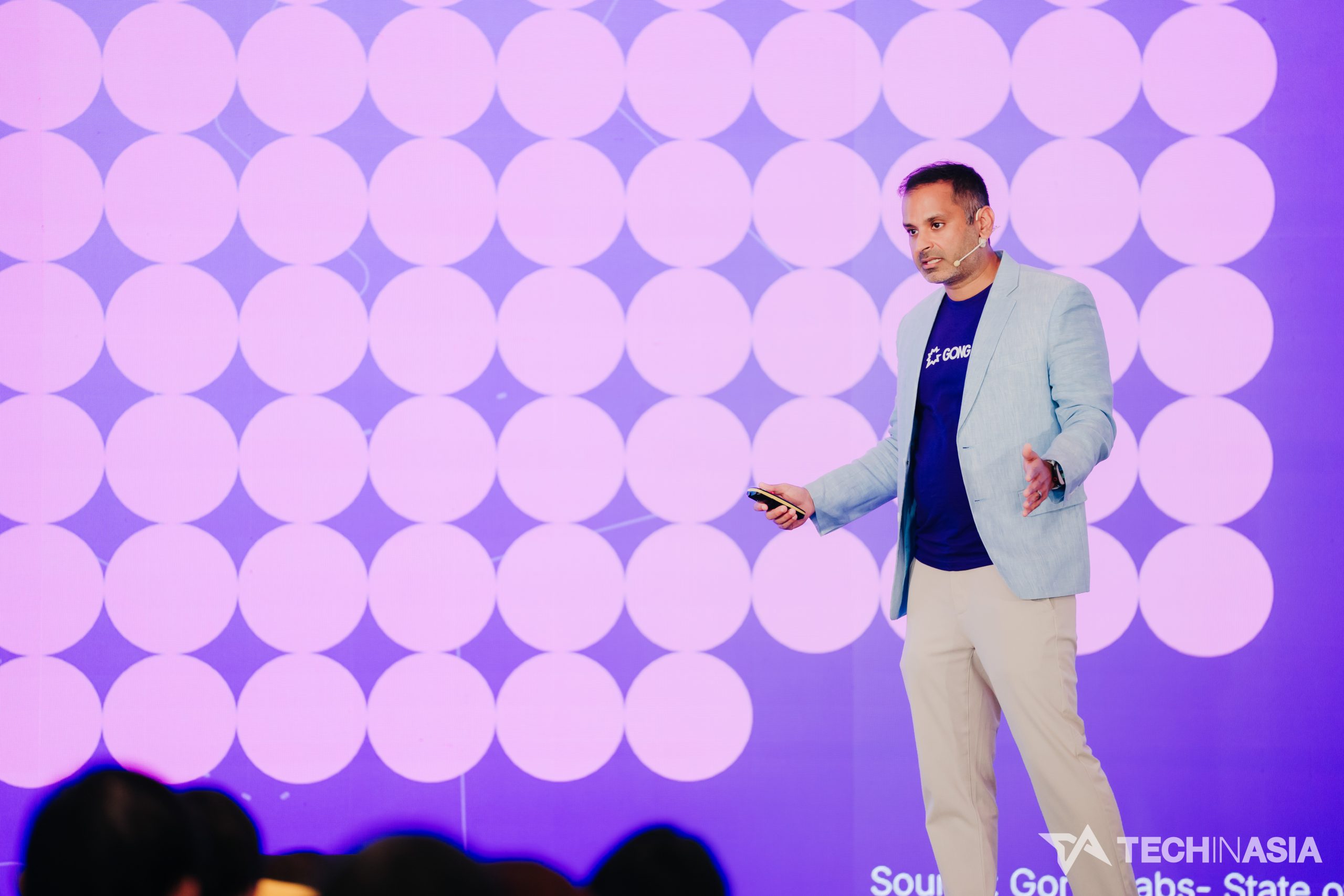
Syed Hasan, general manager for Asia Pacific at Gong / Photo credit: Tech in Asia
This raises an important question: What should sales teams do with that extra time?
“It’s not just about time savings,” Hasan says. “It’s what you do with that time that drives the revenue per headcount.”
Needle in the haystack
Research by PwC shows that even as AI adoption grows, only 20% of organizations are expected to capture 74% of the tech’s economic value.
In other words, creating more capacity does not automatically guarantee better results. Revenue teams still need to know what deserves their attention.
These clues often show up in customer conversations, like when a buyer repeatedly raises the same concern or when a new decision-maker or competitor enters the picture.
“The signals and trends have existed for a long period of time,” Hasan says. What has changed is how quickly teams can make sense of them and “prioritize the next best action.”
Doing that consistently becomes challenging when teams have to parse hundreds or thousands of interactions. A single enterprise deal can involve several stakeholders, each bringing different priorities to the conversation. Multiply that across an entire pipeline, and it can quickly become overwhelming.
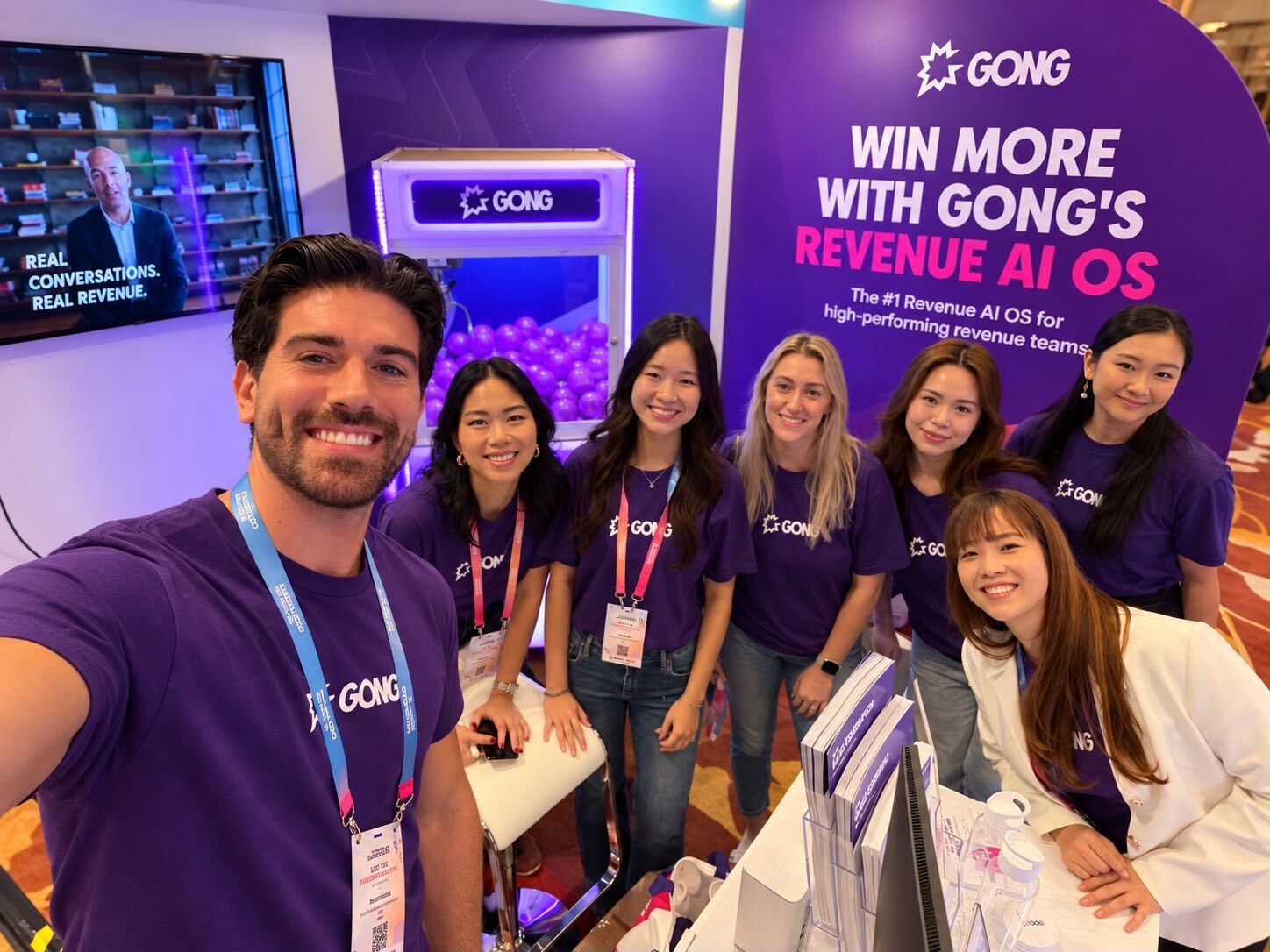
Gong’s team at Tech in Asia Conference 2026 / Photo credit: Gong
Different teams also look for different things in these conversations. Sales enablement may look at which messages resonate with buyers, while revenue operations may search for patterns to improve forecasting. Sales leaders, on the other hand, may want to understand what top performers do differently.
But they ultimately share the same goal, according to Hasan.
“At the end of the day, the main goal is driving revenue outcomes,” he says. “There’s a lot of these signals that can all drive the same outcome.”
The challenge is capturing them in a way that makes them actionable across different functions.
Reading the room
Signals require context before they can drive meaningful action.
Hasan cites people in a sales conversation as an example. To decide whose concerns matter most and whether the right people are involved to move a deal forward, a rep needs to ask questions like, “Is he or she a decision-maker or just coming along for the ride?”
Context can also reveal when a deal’s timeline does not match historical expectations. Imagine an enterprise deal expected to close in 35 to 45 days. The math does not add up if security or procurement has not even begun, where similar deals typically spend around 60 days in that stage.
This is where Gong’s revenue AI comes in. The AI platform unifies customer interaction data, analytics, and automated workflows to help revenue teams forecast and progress deals.

The system draws on go-to-market interactions across calls, emails, and messages to understand context such as persona and industry. By connecting individual signals with revenue-specific context, it can give teams visibility into what is happening, predictability around what could happen next, and ultimately something they can act on.
Going back to the timeline, Gong can flag the mismatch by comparing what is happening in a deal with previous sales cycles. This gives teams a clear view of the risks behind an opportunity, allowing them to either reassess or intervene.
“When you’re using technology for a proper outcome – an AI that was built for driving revenue outcomes – that’s where you’re making a real difference,” Hasan says.
The next best action
Once teams figure out what deserves attention, they can make the most of their time.
Hasan points to more customer conversations and deeper engagement with prospects, with AI helping reps to show up better prepared for them.
Gong’s revenue AI can also give teams more than just their time back. He says staffing company BruntWork doubled its revenue per agent while scaling its remote workforce globally, using Gong’s platform to scale coaching and improve visibility into deal progress and sales cycles.
And that’s not all.
“The best, which I’m looking forward to the most, is taking out the guesswork after a meeting or a conversation,” Hasan notes.
After a sales call, for instance, AI could handle routine follow-ups, recommend the next course of action, and increasingly leave people to step in only where judgment is needed. He describes this next phase of revenue AI as the “activation of next steps.”
But as AI takes on more of what happens next, businesses first need to be clear about what they want those actions to achieve.
“As long as you start with the outcome first,” Hasan says, teams can work out “what the agentic work looks like,” and “what the human work looks like.”
Named a leader for the second consecutive year in Gartner’s Magic Quadrant for Revenue Action Orchestration, Gong helps revenue leaders gain visibility, predictability, and actionability across their revenue operations.
Sign up for a free demo.
This content was produced by Tech in Asia Studios, which connects brands with Asia’s tech community. Learn more about partnering with Tech in Asia Studios.
Editing by Stefanie Yeo and Mina Deocareza
(And yes, we’re serious about ethics and transparency. More information here.)




📅 Upcoming Events
30-31 March 2027
Upskill Fest