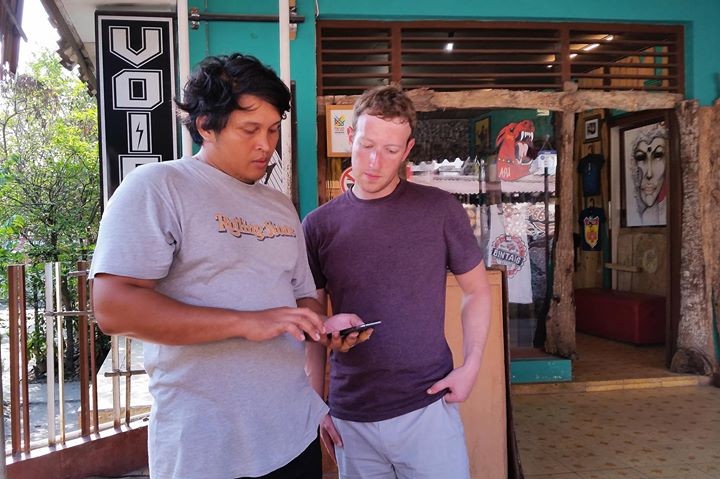
Facebook founder Mark Zuckerberg during a trip to Indonesia / Photo credit: Mark Zuckerberg
Indonesia, one of the most active countries on Facebook with 130 million accounts, has repeatedly threatened to block the social network if it fails to keep user data safe, prevent hate speech, and curb fake news. A criminal investigation was launched against the firm in the wake of the Cambridge Analytica data scandal earlier this month, and its local management was called to testify in front of the Indonesian parliament today.
This type of strong action from the government against global internet firms isn’t uncommon – sites like Tumblr, Reddit, and Vimeo have been blocked permanently in the country.
Yet it’s highly unlikely that Facebook will meet a similar fate, according to analysts. The company has already taken steps to cooperate, and many Indonesian firms rely on the platform for advertising and sales.
The government might instead find other ways to exert influence, like taking control over Facebook’s business activities in Indonesia, suggests Yohan Misero of non-government organization (NGO) Community Legal Aid Institute.
According to him, it’s unlikely for the data misuse case to be escalated, even though there is a legal foundation in Indonesia’s Electronic Information and Transactions Law. The law states that electronic information and documents may not be transferred to a third party that does not have the right to access this data. Any breach could theoretically lead to a fine or even jail time.
“The law is difficult to enforce. If you want to follow it through to the end, would this go all the way up to Mark Zuckerberg? Does Indonesia have the power to do that? It’s hard to find an individual perpetrator because this was done by Facebook systematically,” Misero said.
He thinks that the momentum might instead be used to force Facebook into investing more in its local office, and launching more workplaces and local data centers. The US firm is in a long-standing debate with local authorities over what type of business unit it needs to register in the archipelago, which has consequences on taxation, among other things.
Damar Juniarto, founder of digital rights advocacy group Digital Democracy Forum, has the same view. “I see the government using [the shutdown threat] as an intimidation attempt. It’s the only weapon the government has if the dialogue between the two doesn’t flow smoothly.” He thinks the Indonesian legal system is ultimately not equipped to crack down on Facebook.
Taking response measures
When Facebook’s local management was called in for questioning, it admitted that more than 700 Indonesian users had installed “This Is Your Digital Life,” the app linked to Cambridge Analytica that scraped data off these accounts and their friends. In total, more than one million user profiles were affected.
Facebook is already taking measures to appease the Indonesian government, including an audit of all third-party apps that had access to user data through the firm’s API and limiting the data that the Facebook Login feature can collect. It took these same measures globally.
To stamp out fake news in Indonesia, the firm launched a fact-checking initiative with Tirto, a local online media organization, and plans to partner with NGOs like a youth group and the election monitoring agency to improve digital literacy through workshops and via Facebook notifications.
Facebook declined to comment on the specifics of its collaborations, but Tirto founder Sapto Anggoro told Tech in Asia that the social media behemoth is funding the program. While he could not reveal how much the program’s budget is, he said it would allow Tirto to hire full-time staff in the future.
Anggoro, however, believes more needs to be done, saying that the fake news and hate speech problem is massive in Asia. “[Facebook] needs more partners, with a mix of technical solutions and more people and training. And it needs coordination with institutions like the IT Ministry and the Press Council so that this work is regarded as legitimate.”
Both parties need each other





Stay updated on the go with our mobile app.
Get latest insights with smoother, more personalized experience through TIA mobile app.













📅 Upcoming Events
22 October 2026
Payoneer x CSPN Summit 2026