Here is the 2nd part on my recent experience as a judge in a business plan competition. Of course, it is a good learning experience for me to see why some business plans fail. In fact, here is a known secret from investors. There is a very simple way to know which start-ups we do not want to invest. We decide by whether the entrepreneurs can provide us a realistic cashflow forecast on their start-ups. Realistic Forecasting is an Art
After going to a lot of business presentations at the university, I often see that the teams try to show the judges and investors that they can break even within a year. When they do that, we immediately know that they have eliminated themselves to be a credible start-up. Perhaps, it is easier to explain why investors don’t find the promise of being able to break even within a year to be realistic. Let me illustrate using a simple business case study. Imagine you start a business to produce a new textile product and you need to set up a factory. In a typical business school setting, you usually get the story from the team in the following manner. First, they claim that they need about a few million to set up the factory, and they usually assume that the factory will take them nine months to build. Then they followed with the claim that the factory can immediately produce the textile goods within 3 months, and generate enough yield to break even. Will you be gullible enough to invest in such a team? The answer is no. The reason why investors and judges know that it would fail, is the risk involved. First of all, it is not possible to get a factory up and running within 9 months. Even the machines (that you need to import for the production) require a while before the workers can maximize the output for the business. Hence it is not realistic to claim that you can break even within a year. Usually a 2-3 years period of breaking even sounds reasonable, and for those who may want to know, the horizon for a biotech start-up to break even goes even further to 5-7 years. Assessing the risk of your business is a matter of forecasting. Of course, risks are never absolute, but rather relative, in the sense that they can only be estimated on the basis of assumptions. Of course, one good way to assess risk is to look at the different scenarios that ensure that the future business development of the company are stress-tested in several conditions. In a business plan, that comes in the form of a cumulated cash flow projections. Let’s take a look at the cash flow diagram which we have drawn here.
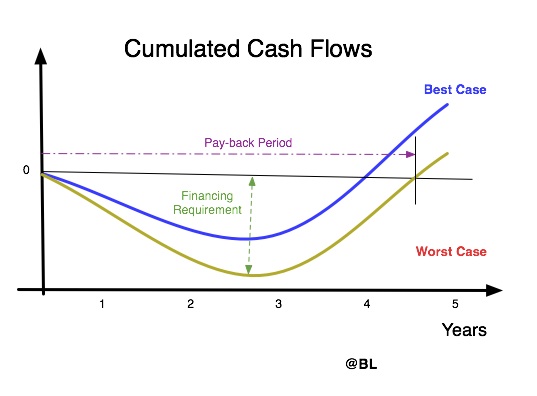 On the cashflow diagram, you can see two curves. The blue curve indicates the best case sscenario, where you can tell what will happen if you can seize the opportunities you see and all the positive expectations are generally fulfilled. The yellow curve is the base case scenario, which is the case that it is likely to happen. Of course, anything below these two curves are the worst case scenario, where the major risks occur and the negative expectations are generally fulfilled. The realistic part is the break even point, or turning around the valley of death. All start-ups work on the basis that they will go negative in the first 2-3 years. The lowest point on the curve is the maximum amount of debt that you can go before your start-up goes bust. Hence it is important to minimize by working out a good financial plan to ensure that your cashflow don’t go haywire. In a business plan, one should give a short description of the scenarios in the business plan. What kind of events, how much sales, what amount of prices are your financial analysis based on? How much capital is really needed to finance the business, and when is the time to break even such that your cashflow can go positive? Finally, what is the effective return on the investment and when will it come? All these questions will direct you the entrepreneur to make a realistic assessment on whether your business can survive.





Stay updated on the go with our mobile app.
Get latest insights with smoother, more personalized experience through TIA mobile app.