 Malavika Velayanikal · · 3 min read
Meet Razorpay, the first Indian startup to get YCombinator backing this year
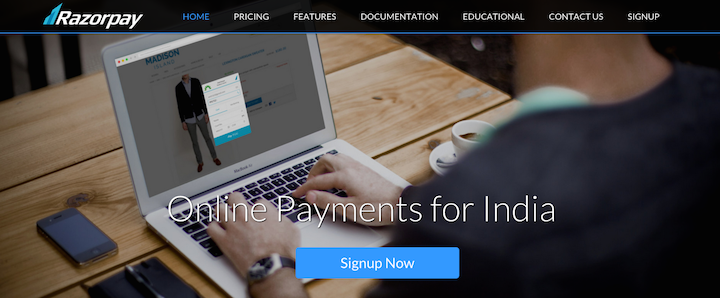
There are 48.8 million small- and medium-sized businesses registered in India. Most of them are offline, just 1.4 million have email access, and 1.3 million are online through aggregators or listing services. The hardest part of going online with their businesses for these SMBs is accepting payments, because the gateways are so cumbersome and insecure. It’s not just retailers who are affected, but various other small organizations like schools and training centers as well.
Razorpay aims to remove this pain point. It is building a platform to make it easy for small organizations in India to accept online payments in an easy, affordable, and secure manner. It just got the backing of YCombinator, with US$120,000 in funding and a three-month stint in Silicon Valley as part of the YCombinator accelerator program (disclosure: YCombinator is an investor in Tech in Asia too. See our ethics policy for more info).
Razorpay is among the handful of Indian companies to be selected for mentoring by YCombinator. Last year, Cleartax got picked for trying to solve the hassle of paying taxes in India.
Razorpay founders and IIT Roorkee alumni Shashank Kumar and Harshil Mathur initially quit their jobs with Microsoft and Schlumberger to start a crowdfunding portal. Their startup was incubated at Startup Oasis in Jaipur, set up jointly by the Rajasthan Industrial Investment Corporation (RIICO) and IIM Ahmedabad’s Centre for Innovation Incubation and Entrepreneurship (CIIE). It was while working on the crowdfunding portal that Kumar and Mathur saw how muddled the online payment process was in India, and changed tracks to work on this problem.
“We realized that most online payment gateway solutions were extremely cumbersome to get started on, especially for startups and small- and medium-sized enterprises. When we contacted a few payment gateway companies, we were asked for our past operational records, presence of physical offices, security deposits, and very high set-up fees. Online reviews of most payment gateways in India confirmed similar bad experiences,” Mathur says. This prompted them to build a startup-friendly online payment gateway which was easy to integrate and use. “After doing some initial market surveys to verify the feasibility of the idea and getting a very positive response from potential customers, we started working full-time on the Razorpay idea,” Kumar adds.
The entrepreneurs chose to base Razorpay in Jaipur after weighing cost and convenience factors. The capital of Rajasthan is not a metropolitan city like Delhi or Bangalore, but Jaipur has the infrastructure to support a tech company and is well-connected to Delhi by rail, road, and air. Besides, Startup Oasis itself had several other startups who were also feeling the pinch of payments, and were glad to try Razorpay’s prototype as soon as it was ready.
The Razorpay product is fully cloud-hosted with automated backup. It is PCI DSS Compliant, so its clients do not have the burden of compliance.The Payment Card Industry Data Security Standard (PCI DSS) is a set of requirements to ensure that companies that process, store, or transmit credit card information maintain a secure environment.
Taking into account that most of the SMBs will need some hand-holding to begin with, Razorpay has a 24X7 customer support system. Schools and colleges can also use its solution to collect and manage payments from students.
The biggest beneficiaries will be small startups and retailers. Ecommerce is booming in India, but it has by-passed millions of retailers who are not tech savvy enough to negotiate the labyrinth of online payments in India. Razorpay wants to make sure they’re included in the India success story.
Editing by Josh Horwitz and Terence Lee
(And yes, we’re serious about ethics and transparency. More information here.)





Stay updated on the go with our mobile app.
Get latest insights with smoother, more personalized experience through TIA mobile app.








📅 Upcoming Events
22 October 2026
Payoneer x CSPN Summit 2026