 Winston Zhang · · 7 min read
From data to durians: H2O.ai’s journey to AI-led accessibility

Summary:
- Founded by Sri Ambati to “use math to save lives,” H2O.ai has evolved from leveraging predictive analytics to creating specialized agentic AI.
- The firm, which views Singapore as a “creator destination,” collaborates with local firms like Singtel and Certis Group and hires local university graduates, thereby enjoying a mutually beneficial relationship with the city-state.
- Partnering with Singapore’s Infocomm Media Development Authority (IMDA), H2O.ai is working to lower the costs and technical barriers associated with AI, aiming to provide mid-tier organizations with the same tools global corporations use to fight fraud and predict market trends.
- H2O.ai is part of the IMDA Accreditation program, which helps nurture the city-state’s tech ecosystem. Here’s how you can become part of it.
It’s only been a few years since generative AI gripped the public’s imagination, showing people how easily they could produce copy, images, and videos.
Accessibility is indeed at the heart of the techy’s popularity, and many soon learned that AI could also be used to quickly build entire websites, apps, and even companies.
But as the saying popularized by a superhero comic goes, “With great power comes great responsibility.” This means that the sustainable and responsible use and growth of this tech can only be possible if AI firms work together with the public sector.
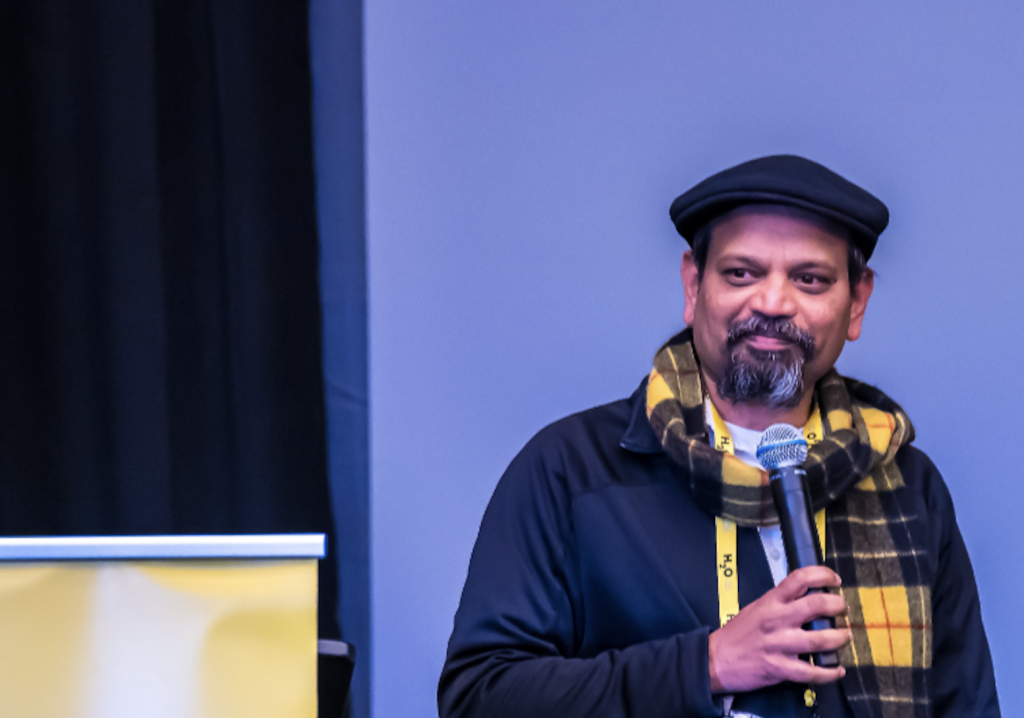
Sri Ambati, CEO and founder of H2O.ai. / Photo credit: H2O.ai
“Like electricity, AI is such a transformative force,” says Sri Ambati, CEO and founder of agentic and predictive AI company H2O.ai. “But we want to uplift the whole planet, not just a few trillionaires. A vision like that is not usually the focus of any one company, so we need to work very closely with governments that are in the service of people to transform public services.”
“Using math to save lives”
Ambati came to believe early on – through personal experience – that AI could help people. His mother was diagnosed with breast cancer, so the first problem the firm looked into was high false-positive rates for mammograms.
This idea to transform healthcare using AI soon expanded to preventing scams and fraud in the financial services space, tallying the numbers of endangered species for a nonprofit firm in Kenya, and even predicting wildfires and bushfires in California and Australia.
The use cases are dizzyingly diverse. However, Ambati says that “fundamentally, we are talking about using math to save lives.”
“The signals [for these occurrences] are trapped in data, and you’re trying to sieve through enormous amounts of it to level up the features that lead to better identification of something that’s going to happen,” he explains.
Predictive AI powered many of H2O.ai’s early solutions, but with the rise of genAI came a new approach. This meant not touching anything the team had previously created and instead going all in on building small language models (SLMs) – compact, faster versions of AI models – from first principles.
This resulted in the firm’s Danube and Mississippi SLMs, the former of which offers cost efficiency and accessibility, as it can run on smartphones and edge devices. Further development led to agentic AI solutions.
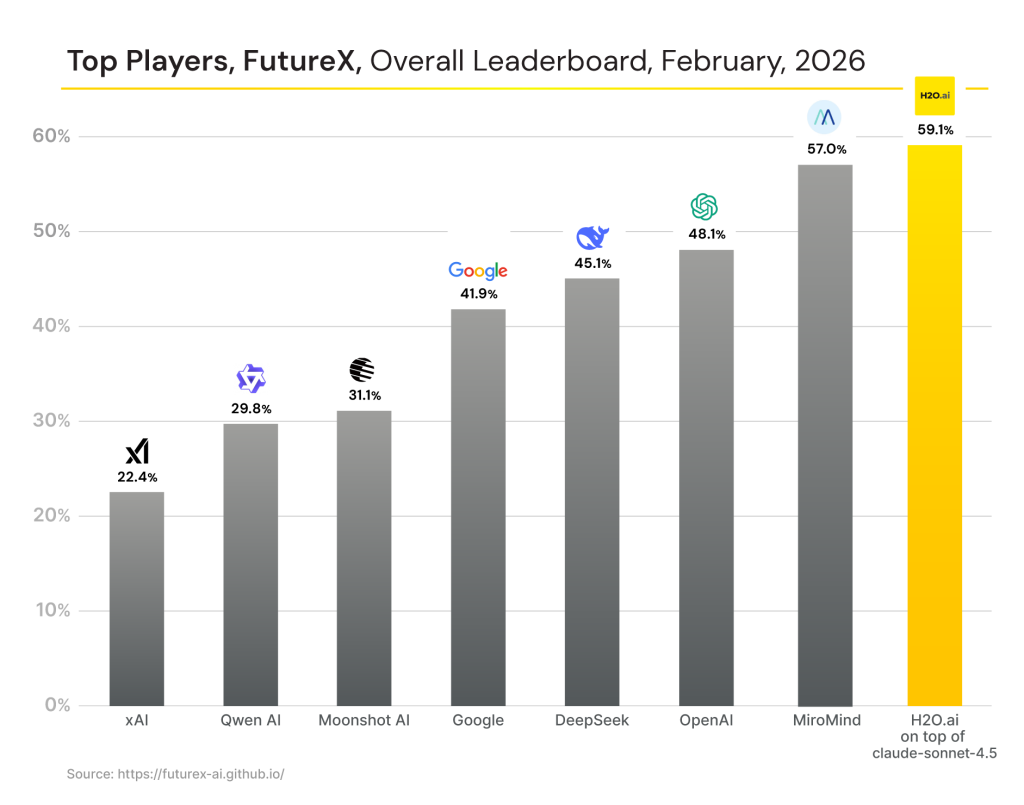
FutureX is a live benchmark which evaluates AI agents. / Photo credit: H2O.ai
“We took a ‘super agent’ approach – one that acts like a CEO and gives orders to and manages purpose-built tools,” Ambati says, explaining that the tools in question are vertical agents specializing in a given task, such as scanning Wikipedia entries for information while also keeping track of details like changes in entries.
He adds that it’s like a manager with the big picture directing a team of talented individual contributors.
Majulah, Singapura
Today, H2O.ai has combined all its experiences into an H2O AI Super Agent. It’s a best-of-all-worlds approach that can effectively parse large amounts of data and make strategic decisions and recommendations.
With that setup, an agent can sort customer service calls into more than 80 types using a low-cost, custom-trained model. The system employs an agentic AI framework to automatically assign the right staff to each case, helping resolve complaints faster and more efficiently.
It’s worth noting, however, that agentic AI’s reliability and safety are dependent on consistent reinforcement and learning. This is where the Singaporean government and other local entities have come in as invaluable partners to H2O.ai.
“Feedback loops make AI better,” says Ambati. “And so that’s why we love the economy and the ecosystem of Singapore – they’re not afraid to try new stuff quickly. The good thing about Singapore is that you quickly get an answer if it’s not working. We get straightforward feedback the very next morning.”
The CEO lists Dell, NCS Group, and Ingram Micro as local partners that welcomed the firm with open arms. Additionally, telecom giant Singtel has collaborated with H2O.ai to deliver AI-powered services to its customers.
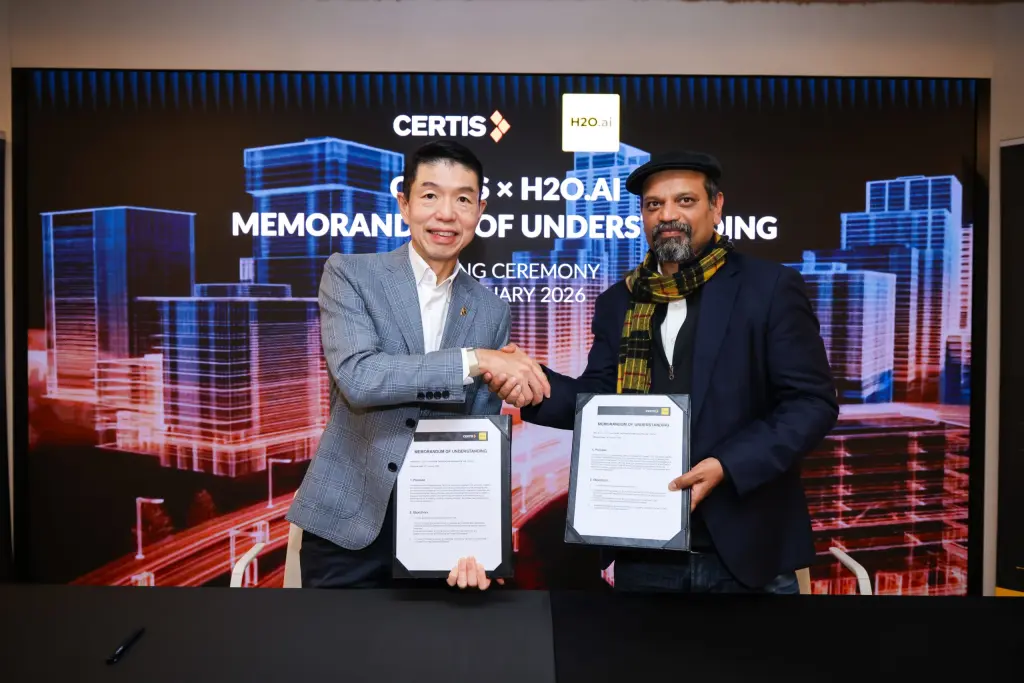
Certis is another significant local firm that H2O.ai has collaborated with. / Photo credit: H2O.ai
Beyond business partnerships, Ambati also sees great potential in the city-state’s talent, describing fresh graduates of local universities that the firm has hired as fast learners with new ideas for improving products.

“We have made-in-Singapore products that have been very successful in America,” he says. “In that sense, Singapore for us is not just a customer destination. It’s actually a creator destination.”
What lies ahead
This US-Singapore connection is something IMDA nurtures as well. Ambati points out that the agency does a very good job at bringing Silicon Valley companies to the city-state and hosting them locally.
And while H2O.ai has proven experience working with large, global companies, it’s also collaborating with IMDA. The goal is to make its solutions accessible to a wider range of companies by lowering the costs and requirements of deploying agents.
“The mid-tier organizations that do not have a data scientist, that do not have an AI superstar… we’re partnering with IMDA to see if we can offer all the AI pieces that we build to this next level of companies that cannot afford to have the same kind of talent and insight,” Ambati explains. “They have the same demands – they need to fight fraud, they need to be able to predict [what’s going to happen next in their business and industry], and they need to do all this efficiently.”
Looking ahead, even with all the advances the AI industry has seen in the past couple of years, Ambati still sees much more room for growth and development.
“I love durians, so I take durian tasting reasonably seriously,” he says. “And I think there needs to be a multi-modal large language model to distinguish the difference between old tree Musang and D24 (Sultan) varieties, matching and ranking it to satisfy the sophisticated durian palates of our community.”
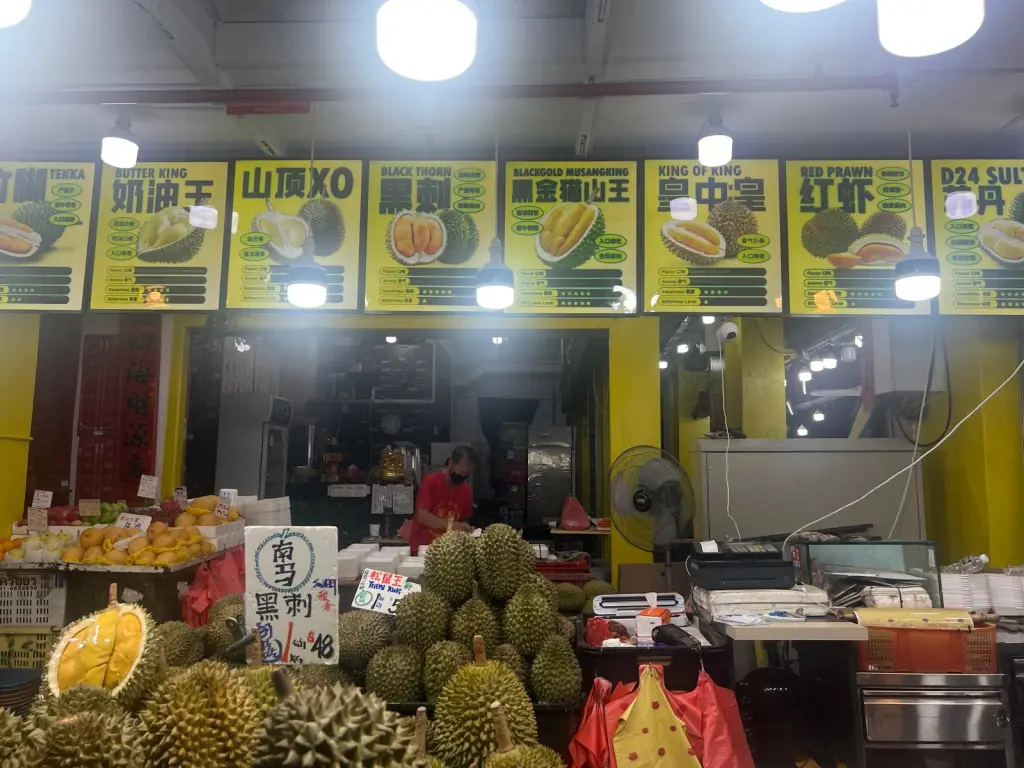
Types of durians, labelled by taste. / Photo credit: H2O.ai
It’s a funny use case to bring up, but smell and taste are indeed signals that AI hasn’t been able to capture just yet.
Ambati also mentions how natural intelligence lets us pick the right partners in our business and personal lives, sometimes within an instant.
Taking these real-world examples as inspiration, he thinks AI’s next boundaries would lie in reducing the tech’s computational cost and learning to achieve that same speed and understanding.
At the philosophical level, Ambati believes the tech can create a world that’s free of resource struggles.
“How do you think of the world, not in scarcity, but in abundance?” he says. “I think AI is going to unlock that, and I think we need to let it unlock that abundance. I think once that happens, the world will be even more fun to kind of navigate and live in, and I think the planet will be much happier.”
Launched in 2014, the IMDA Accreditation aims to accelerate the growth of promising Singapore-based enterprise tech companies. It helps them establish credentials, build business traction, compete in the global market, and gain more opportunities to showcase their solutions to spur adoption. Find out how the IMDA Accreditation can grow and accelerate your business.
YOUR IMDA ACCREDITATION JOURNEY STARTS HERE
H2O.ai is a leading agentic and predictive AI company, accredited by IMDA for enterprise-grade GenAI h2oGPTe. The firm helps Singapore’s public and private sectors deploy sovereign, secure, air-gapped AI systems that deliver real business and citizen impact – from fraud reduction to smarter services – while keeping sensitive data fully protected.
This content was produced by Tech in Asia Studios, which connects brands with Asia’s tech community. Learn more about partnering with Tech in Asia Studios.
Stay updated on the go with our mobile app.
Get latest insights with smoother, more personalized experience through TIA mobile app.
Recommended reads
 Solving mid-market finance pain with AI agents
 Mark Cuban on AI scale: why Apple wins while data centers bleed
 How AI is breaking SaaS where trust matters most
 Freeze headcount until AI becomes the true production line
 How AI-powered tools are clearing up construction’s data debris
 Why construction giants are using this WhatsApp AI tool
 How AI agents will be the new software buyers
 Anthropic’s trillion-dollar question
 A new platform digitizes Cambodia’s local pharmacies
 Why AI is hiring problem, not just a technology one





Editing by Stefanie Yeo and Mina Deocareza
(And yes, we’re serious about ethics and transparency. More information here.)







📅 Upcoming Events
22 October 2026
Payoneer x CSPN Summit 2026