 C. Custer · · 6 min read
Civilization Beyond Earth review: your favorite strategy game goes sci-fi

I am history’s greatest villain. If there’s one thing the Civilization franchise has taught me, it’s that. There are lots of peaceful ways to win a game of Civ, but my years with the 4X strategy franchise have been marked by brutality, and by the utter and complete subjugation of anyone who opposed me. I ruled the world from a throne of bones, watching as my elite troops stomped through the irradiated remains of neighboring nations.
So with Civilization: Beyond Earth, I decided it was time for a new start. Unlike previous Civ games, which begin in the distant past, Beyond Earth starts hundreds of years in the future. Your civilization, along with a number of others, have landed on an alien world, and it’s up to you to colonize it. The game’s opening cinematic makes a point of stressing that humanity needs to learn from its experiences on earth, so I was resolved not to wage another campaign of ruthless aggression.
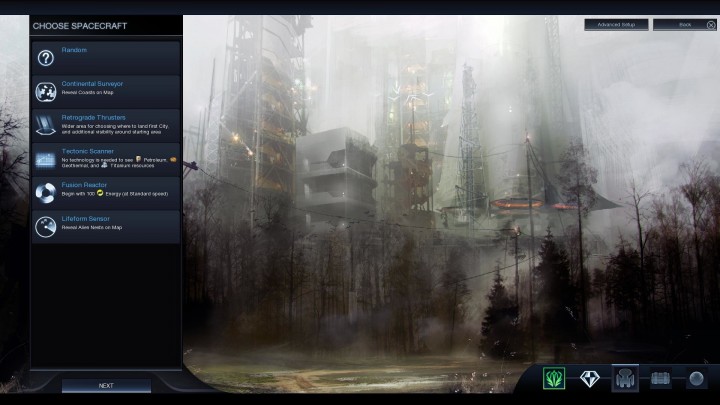
New options to ponder before you start a game
Time to colonize
As you would expect, you’re presented with a number of customization options before you start the game, so exactly how many other civilizations you’ll be up against, what sort of map you’ll be playing on, and other details like that are in your hands. But Beyond Earth also gives you the option to customize your own civilization. As in previous Civ games, each civilization has its own specific perks, but once you’ve chosen one you also get to choose some other details like your landing craft (which affects how much of the map you can see) and what cargo you brought along (which affects what resources you start the game with).
Once you’re planetside, you’ll pick up on one of the biggest differences between previous Civ games and Beyond Earth quickly: Beyond Earth is full of aliens. These indigenous life forms aren’t particularly intelligent, and in practice they function like the barbarians of previous Civ games: they’re the neutral faction that attacks everyone. But you’ve got to be especially careful in Beyond Earth because a significant portion of the planet is covered in miasma, which heals them and harms you. Plus, the giant siege worm will destroy entire military units with a single attack if you try to take it on too early.
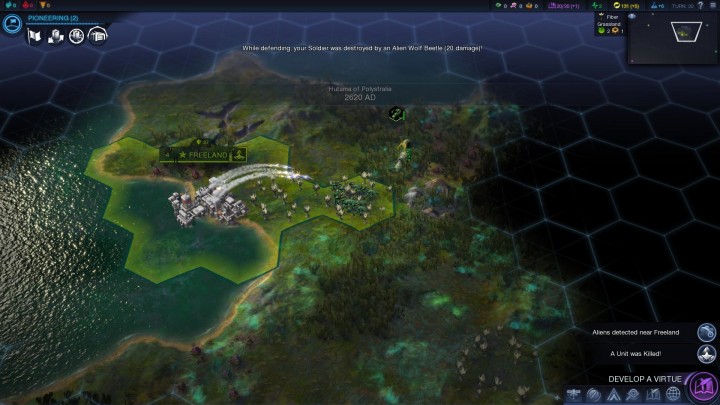
Taking on the aliens early
What’s your affinity?
The other major difference between Beyond Earth and previous Civ games is the affinity system. Particular areas of the research tree are labeled as being part of one of the three affinities: Purity, Supremacy, and Harmony. Researching a technology marked by one of the affinities gives you an affinity point, and the more points you have in a particular affinity, the more you’ll be able to upgrade your military units, so it pays to focus on one. For my first game, I went with Harmony, which meant developing a lot of technologies aimed at living in harmony with the planet’s natural ecosystem: befriending and domesticating the aliens and eventually even adopting some of their DNA.
As you might expect, the addition of the affinity system can pull you in multiple directions when it comes to choosing your next line of scientific research. Is it worth sitting through another very long wait to unlock another affinity point and level up one type of military unit, or are you better off researching simpler technologies that’ll help you in the here-and-now but won’t increase your affinity?
Whichever affinity you choose, you’ll end up being at odds with some of the other civilizations on the map. I was unfortunate enough to end up next to a militaristic, Supremacy-focused ARC corporation that was disgusted by my embrace of the aliens. After an early treaty that the ARC leader then violated with a surprise attack, we maintained an uneasy but peaceful cold war, with troops gathering along the border but no outright hostilities flaring up.





Stay updated on the go with our mobile app.
Get latest insights with smoother, more personalized experience through TIA mobile app.












📅 Upcoming Events
22 October 2026
Payoneer x CSPN Summit 2026