 Osman Husain · · 7 min read
Meet the man propelling Pakistan into the digital age
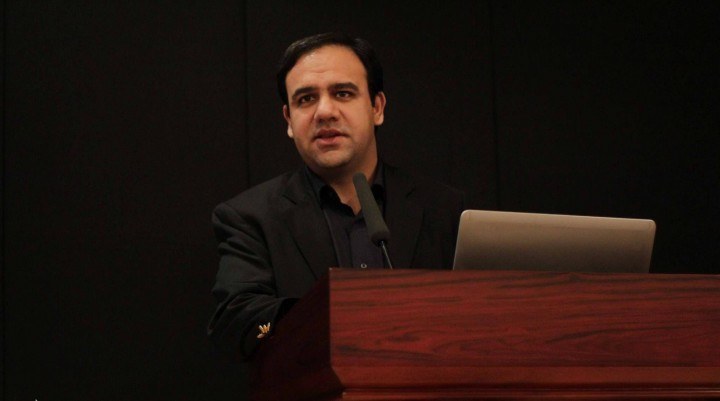
I’m waiting for my interview with Dr. Umar Saif, chairman of the Punjab Information Technology Board (PITB), outside his offices on the 11th floor of a glistening building in the heart of Lahore. There’s an air of nervous trepidation – it’s my first time interviewing someone associated with the government, and the common stereotype suggests it’ll be difficult to have a relaxed and comfortable talk. While I’m aware of Dr Saif’s credentials – he received his doctorate in computer science from Cambridge at the age of 22 and then taught at MIT before moving back to Pakistan – I’m unsure of what to expect. I hope for the best.
As I’m ushered into the office by his secretary, Dr Saif greets me with a firm handshake and indicates that I should take a seat and wait a few minutes longer. He has a beautiful, sprawling office with a mesmerizing view of the city and I take the opportunity to cater to my amateur photography hobby. Dr Saif remains hunkered down on his desk, typing away furiously on a computer and attending to calls.
After what seems like an eternity, but in reality is only about ten minutes, Dr Saif gets up from his chair and makes his way towards me. I’m immediately caught off guard; there’s a smile on his face and he seems warm, welcoming, and jovial.
I try my usual tactic of asking a few ice-breaking questions to lighten the atmosphere and make the interviewee feel at ease. However, he’s having none of it. Dr Saif is first interested in finding out more about myself. He wants to know where I went to college, my career trajectory so far, and my passions in life. I’m taken aback – it’s very rare for people to exhibit genuine interest. Most are obsessed with their own or their company’s publicity and leave no stone unturned to elaborate how they’re the next big thing.
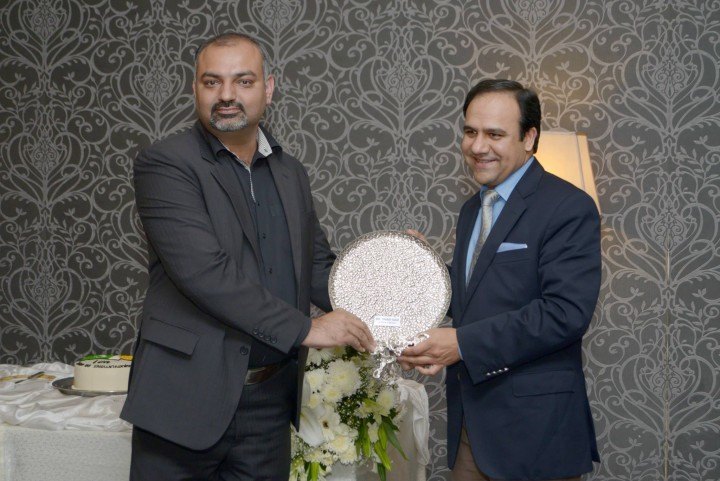
Receiving an award
MIT and beyond
Frankly speaking, it wouldn’t have been much of an exaggeration if Dr Saif claimed that about himself. He’s a perennial overachiever, finishing high school at 16, graduating from college at 19, and eventually completing his doctorate at an age when most are still struggling to understand which line of work to enter. At MIT, where he started his postdoc, he was part of Project Oxygen, a visionary project trying to fundamentally redesign the way mankind interacts with machines. Dr Saif’s work on the project focused on ubiquitous computing, building embedded operating systems for mobile platforms.
After several years teaching and researching at MIT, Dr Saif moved back to Pakistan. He tells me it wasn’t an easy decision at all – up until that time he had been solely focused on an academic career and that requires a “certain type of lifestyle.” Nevertheless, it was a combination of his desire to assist his country of birth and pressing family commitments which resulted in the decision. This was in 2005.
Later that year, Dr Saif accepted a faculty position at his alma mater – the Lahore University of Management Sciences (LUMS). He was eager to replicate some of the things he had learned during his time at MIT and started working with some of his brightest students to develop scalable, innovative solutions. One of these was SMSall, a text message-based social network that he claims has sent billions of messages since it was first rolled out. Another was BitMate, a bittorrent client specifically engineered for people in countries with low bandwidth. As a result of his work, in 2011, the MIT Technology Review named him as one of their ‘World’s Top Young Innovators’ – the first Pakistani to be bestowed this honor.
Career pivot
Pakistan’s media was quick to catch on to these exploits. As a result of the coverage, Dr Saif received a call from a senior government minister, inviting him to breakfast. At the meeting, he was offered the opportunity to lead PITB. “I thought this was an opportunity to help make a difference – I had obtained a sabbatical from LUMS and thought three or four months wouldn’t matter much. Now, it’s been four years,” he smiles.
PITB is now recognized as an institution at the forefront of using technology to solve social problems. Its work has permeated into almost all sectors of service delivery, including education, healthcare, and rescue services. Amongst other things, the Punjab government has digitized school textbooks, used technology to identify and correct public health outbreaks, and introduced a number of e-government services, allowing citizens to interact with the state far more efficiently. He tells me he’s a fan of “using big data to solve problems,” and that their approach is proactive rather than reactive. “We’re constantly sniffing out problems and trying to solve them,” he adds.
People like me, we don’t usually work for the government. There’s not a lot of money. But the impact that we’re having is incredible – the velocity is amazing. Public sectors such as education and healthcare are much better now than in the past.
Building the tech ecosystem





Stay updated on the go with our mobile app.
Get latest insights with smoother, more personalized experience through TIA mobile app.











📅 Upcoming Events
22 October 2026
Payoneer x CSPN Summit 2026