 Rita Liao · · 6 min read
Why African ecommerce unicorn Jumia is going to Alibaba’s backyard

Photo credit: Andriy Popov / 123RF.
Over 100 cross-border vendors arrive punctually at the towering Hilton in downtown Shenzhen despite pouring rain in early spring. They’ve come for Jumia, a major ecommerce player on the African continent.
“If you bet on Africa, you are betting on a high growth rate. You are betting on the future,” Jumia’s global unit CEO Eric Lauer tells a roomful of sellers.
The startup began as an online marketplace connecting African vendors and shoppers in 2012. In 2015, it set up shop in China – home to the world’s biggest ecommerce company, Alibaba – to bring Chinese goods back to Africa.
Jumia is eyeing the continent’s growing zest for imported goods. In recent years, Africa’s spending power has skyrocketed, particularly in its largest economies, such as Nigeria and Egypt. By 2025, 65 percent of African households will earn at least US$5,000 a year, the level at which people start spending portions of their income on items other than food, according to a McKinsey report.
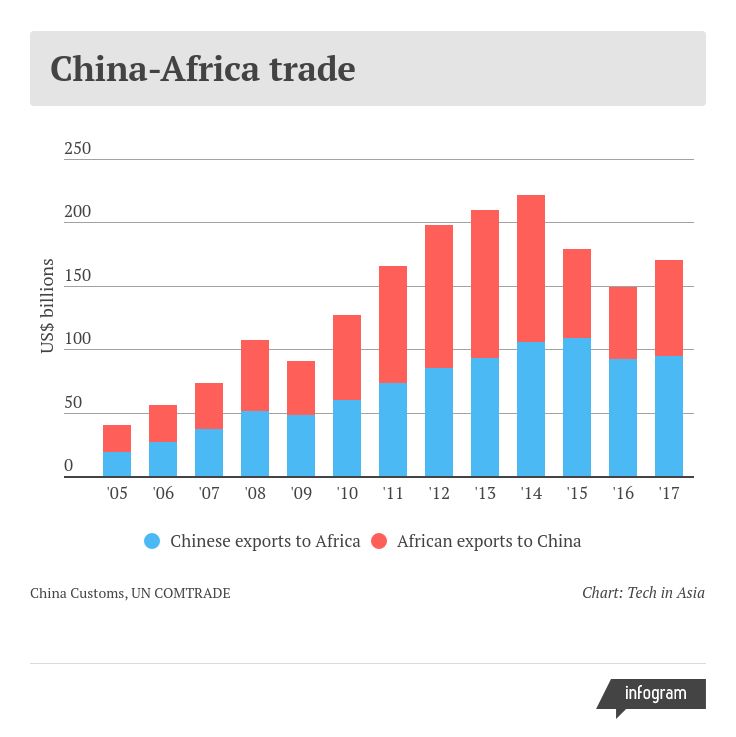
But there’s not much people can buy locally. “Africa isn’t a manufacturing continent yet,” says Lauer. That’s an opportunity for China’s myriad of consumer goods: from smart watches and furniture to clothes and diapers that are of high quality and affordable. China is already Africa’s largest trade partner. In 2017, the bilateral trade volume hit US$170 billion.
 At the same time, offline shopping options are scant. There’s one mall for approximately 60,000 Africans, while that ratio is 1:400 in the US, according to Jumia.
Consumers in Africa are leapfrogging bricks and mortar retail and going directly online, a trend spurred by growing internet penetration across the region. By 2025, half of Africans will have access to the internet, and ecommerce could account for 10 percent of retail sales in Africa’s largest economies, says the McKinsey report.
In turn, the gaps in physical retailers and local manufacturing make room for cross-border ecommerce, which will, at some point, “make up 40-50 percent of the total ecommerce in Africa,” says Lauer in an interview with Tech in Asia.
“We source where there’s the highest assortment, meaning China,” he adds.
For now, the most imminent task for Jumia is to bring more Chinese vendors onboard. To that end, the African startup is touting itself as a better alternative to the old way of China-Africa trade.
Middleman trading
For years, China’s small commodity sellers have relied on middlemen to sell to Africa, an uncharted frontier too far for them to navigate. Swarms of African traders fill stretches of Guangzhou, a southern Chinese metropolis flanked by factories, and Yiwu, a small city in eastern China with the world’s largest wholesale market. They bargain with local sellers, scouting for cheaply manufactured goods to carry home.
Other Chinese vendors choose to take their wares straight to local agents in Africa, handling the cross-continent shipment themselves. Either way, Chinese sellers bear low margins from the trade.
Ecommerce leapfrogging
Challenges for the unicorn





Stay updated on the go with our mobile app.
Get latest insights with smoother, more personalized experience through TIA mobile app.








📅 Upcoming Events
22 October 2026
Payoneer x CSPN Summit 2026