 Elliott Zaagman · · 5 min read
Opinion: Chinese tech is losing its individuality, and that’s disappointing
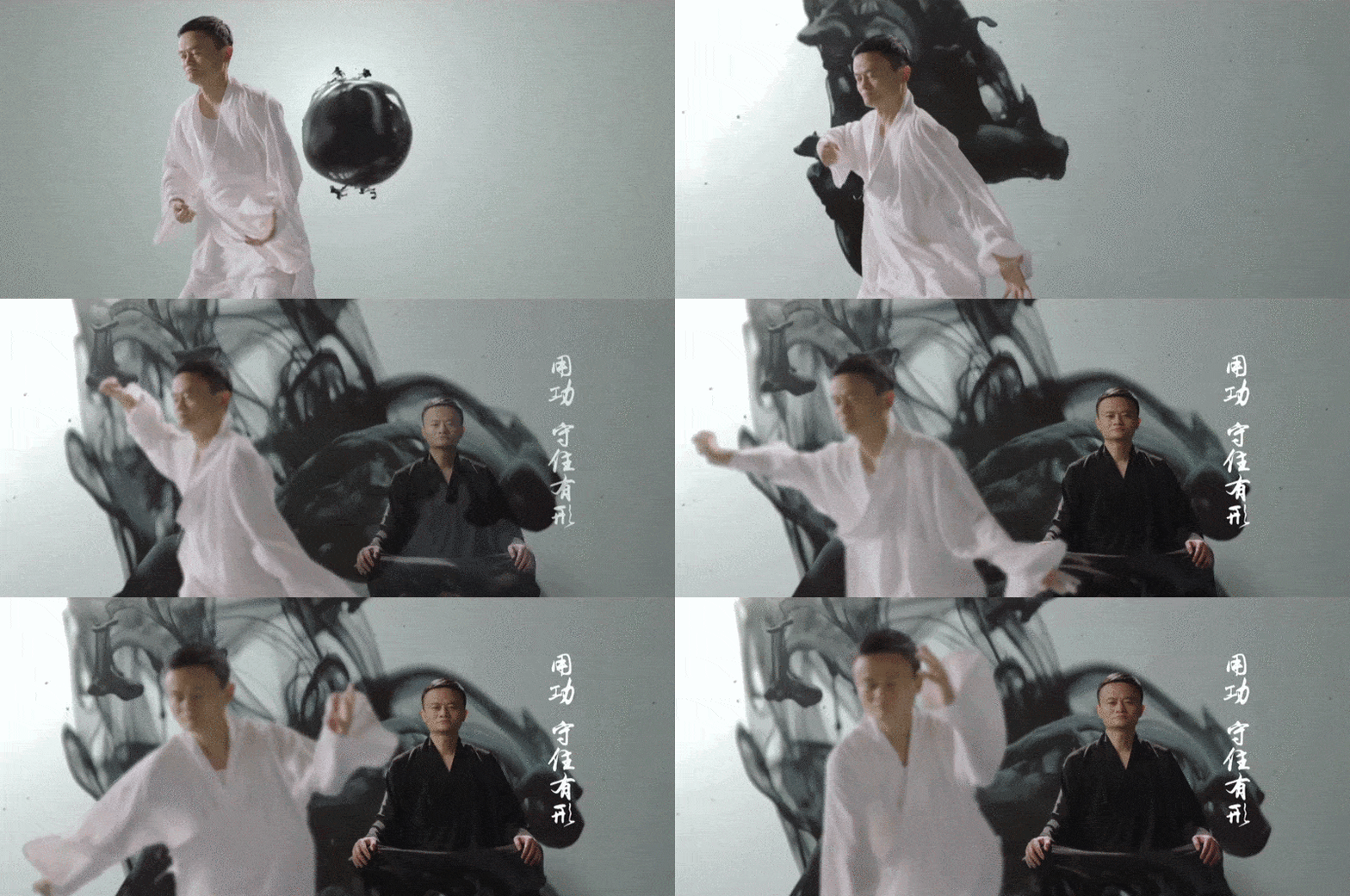
Scene from Gong Shou Dao, a movie starring Jack Ma / GIF by Tech in Asia
Recently, Chinese President Xi Jinping announced that the country’s internet, already one of the world’s most tightly controlled, will likely become even more so. “China must strengthen its grip on the internet to ensure broader social and economic goals are met,” reported state-run Xinhua News Agency.
Xi and the ruling Chinese Communist Party (CCP) have already asserted greater state control over the country’s rapidly growing internet firms. Earlier this month, Bytedance – best known in China as Jinri Toutiao – received its most severe punishment via a string of regulatory action. These measures, which were also imposed on other content platforms, resulted in the permanent takedown of Bytedance’s “Neihan Duanzi” app (literally translated as “implied jokes”).
Under fire for a series of perceived infractions, Toutiao founder and CEO Zhang Yiming released a public apology that, even by Chinese standards, seemed to resemble the self-criticisms of decades past more than the typical corporate apologies of today. Zhang’s apology contained numerous references to key buzzwords of Xi’s ideology.
The power of party committees (paywall) at Chinese tech firms as well as foreign firms in the country also appears to be on the rise. Government regulators have even discussed taking an ownership stake in top tech giants Alibaba and Tencent. In an opinion piece on Bloomberg, a China-based economist describes this trend as China’s “nationalization” of its tech sector. In a surprisingly frank assessment of the situation, Wang Xiaochuan, CEO of search engine Sougou, summed it up this way:
“We’re entering an era in which [the government and the tech sector will] be fused together. It might be that there will be a request to establish a Party committee within your company, or that you should let state investors take a stake, you know, as a form of mixed ownership. If you think clearly about this, you really can resonate together with the state. You can receive massive support. But if it’s your nature to want to go your own way, to think that your interests differ from what the state is advocating, then you’ll probably find that things are painful, more painful than in the past.”
Less autonomy, fewer personalities
China’s state-control mechanisms seem to be getting involved earlier in companies’ growth processes as well, with venture capital being largely state-directed and the increasing rarity of unicorns outside of either Tencent’s or Alibaba’s umbrellas.
I’m not an economist or tech investor, so it’s difficult for someone like me to reach a conclusion about whether this approach will be effective. However, I’ve had the pleasure to work for and with many of these tech firms and their leaders, and I wonder about what the future will be for the cultural aspects of these companies that I appreciate most.
Over the roughly eight years that I’ve spent in China, one of the most captivating aspects of living there was a remarkable sense of individualism, particularly among those born in the ’70s, ’80s, and ’90s.
I attribute much of this to the wild cultural and political fluctuations that the country went through for much of the 20th century. Since these generations grew up without many of the consistent philosophical, religious, and otherwise traditional institutions that helped determine a sense of meaning for most of the world’s people, those who belong to that particular Chinese cohort had to define life’s meaning for themselves. This phenomenon, coupled with historic levels of economic growth and opportunity, have endowed many of these people with a sense that nothing was impossible and that the future was a wide and open road.
Chinese society may at times be repressive, but if you find a good company, it can be your own bubble of freedom.
This created a flowering of incredible individuality of all sorts: Creative artists, religious fanatics, vapid consumerists, visionary dreamers, and armchair philosophers. Is this good or bad? I don’t know. But I do know that these people, their stories, and their thinking are absolutely riveting to me. The most pronounced manifestation of this can be seen in China’s well-known tech entrepreneurs, each of whom has built products, companies, and cultures around their unique identities.
Go from one company to the next and you can sense it: the brutal dictator who controls all with an iron fist, the visionary whose head is so far in the clouds that he loses track of where he’s going, the geek who just was the right person in the right place at the right time with the right idea, and the wannabe movie star who can do whatever he wants because he’s made it.
Many of these founders and leaders came from modest backgrounds, without strong ties to the party or government. Most of the ones I’ve become familiar with value freedom and independence while resenting authority – just like entrepreneurs all over the world. Many Chinese tech executives feel that one of the perks of overseas listings and expansion was that it would provide greater independence from the political powers in China.
Bubbles of freedom





Stay updated on the go with our mobile app.
Get latest insights with smoother, more personalized experience through TIA mobile app.










📅 Upcoming Events
22 October 2026
Payoneer x CSPN Summit 2026