 Jonathan Chew · · 5 min read
How online marketplaces enable Asia’s OTT platforms reach their true potential

Asia Pacific appears to be one of the few places in the world where consumers are still taking up online streaming in huge numbers.
While the region’s video-streaming market is still going strong, over-the-top (OTT) media services – which provide video content directly to consumers through online channels – in markets like the US and Europe are experiencing a leveling off in user growth.
For example, Netflix saw the number of subscribers in Asia Pacific jump by more than a million despite losing subscribers in other regions in the first quarter of 2022.
Much of this was fueled by a post-pandemic shift toward home-based entertainment. For instance, a survey by The Trade Desk in Southeast Asia found that over half of respondents were streaming more OTT content during the pandemic.
With such a strong consumer base, more OTT players are stepping in, and some countries – such as South Korea – have moved to invest heavily in digital media content.
Having said that, while the industry’s rapid growth is a good sign for those in the sector, it has also brought some new challenges for stakeholders.
Physical limitations
Since subscribing to OTT platforms has become common, consumers in Asia now have plenty of options and are more discerning about the types of content they watch, says Peter Choe, CEO and founder of Blintn, an online media rights marketplace.
This places a greater demand on OTT platforms to offer a wider selection of content to attract more viewers. However, obtaining the rights to produce or host such content is difficult because the traditional distribution model in Asia can’t support consumers’ growing needs for wide-ranging content.
According to Choe, buyers and sellers of media content rights in the region typically rely on in-person meet-ups or events – such as film festivals – to connect and establish a sales pipeline.

However, this poses several challenges. For one, the pandemic effectively put a stop to face-to-face marketplaces.
“That was a really big issue, because the industry is accustomed to communicating and selling media rights globally through the offline market – by setting up booths and sharing hard copy and digital brochures,” Choe shares.
Moreover, in tangible marketplaces, the information that participants need to connect with each other might not be widely available. This affects the number of deals they can secure in one-on-one conversations. For instance, finding out who the rights holders are and their contact information can be painstaking without a consolidated repository or database.
“There must be really good content in Sweden, Bhutan, Turkey, or other non-English-speaking countries,” Choe points out. “But for us, especially in Asia, it’s very difficult to get any kind of simple basic information about high-quality content from non-English-speaking countries.”
Additionally, not all buyers or sellers can be present at every event. Because of this, they may not always be exposed to each other or even know that the other exists, which severely hampers the potential global reach of both parties.
Taking the marketplace online
According to Choe, there were some early efforts to rectify these issues prior to 2020, including online platforms that consolidated information for buyers and sellers.
However, this was not enough to meet the needs of stakeholders in the industry, he notes.
As such, online media rights marketplaces have stepped in to make the sales process for media content rights easier and more efficient. Not only do these marketplaces serve as a central platform that provides both parties with detailed information, but they also offer a host of additional capabilities.
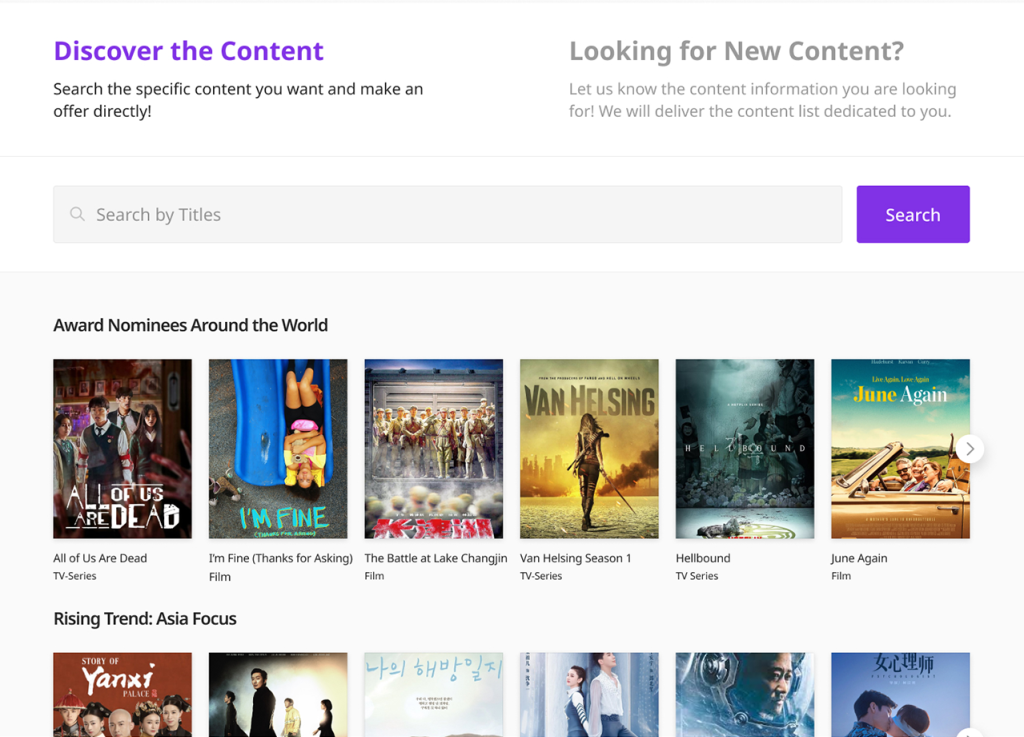
Blintn offers a curated search system for those looking to purchase media licensing rights / Photo credit: Blintn
The most important one is allowing buyers and sellers to close deals through the platform itself. Blintn, for example, provides functionalities – such as an offer management system and a negotiation solution – that let both parties check and screen content, work out details, and deliver contracts.
Blintn allows for much faster communication and negotiations compared to the traditional method for international media rights transactions. Typically, once buyers and sellers get in touch with each other, subsequent communication and negotiations would take place over email and could last up to two months or longer, according to Choe.
With online media rights marketplaces, it’s possible for the entire process to be completed within a day.
Apart from that, solutions that support the specific needs of buyers and sellers are a key component of online media rights marketplaces.
As for Blintn, it uses a data-driven system to curate the content suggested to buyers and has a detailed search filter to make it easier for them to find the type of content they’re looking for.
“We’re not creating noise for buyers. If a buyer is looking for Thai content, then promoting Turkish content could be considered spam,” Choe says. “We always want to automatically promote the right content to buyers.”
Sellers, on the other hand, get to benefit from solutions such as automatic push promotions that help market them to potential buyers.
The future of online marketplaces
While online marketplaces could revolutionize the way media content rights are distributed in Asia in the coming years, Choe is quick to point out that they’re not meant to completely replace the human factor. Rather, he believes that it’s still important for stakeholders to maintain a human network and connection and that online marketplaces will enable people to make real connections and stitch strong relationships.
Additionally, one thing that online media rights marketplaces should be cognizant of is ensuring that they remain a neutral platform for buyers and sellers. This means that platforms should not cater exclusively to certain customers, much like how some content is locked to a specific OTT provider.
This guarantees that the neutral platforms can be accepted by as many of the existing players in the industry as possible and can, thus, build a healthy ecosystem for themselves.
“We are not a sales agency or distributor, so we must act as a tool for existing players,” he says. “Making a neutral platform would be the best way forward for that.”
Should online marketplaces ensure this, the CEO and founder of Blintn believes that they will be well-placed to capitalize on the huge potential for growth in the Asian media industry.
“Population is deeply related to revenue, and there is a huge population in Asia,” Choe says. “In that case, Asia would be the biggest market in the media industry.”
Blintn is a global online B2B media rights marketplace platform. Its mission is to provide a fair and transparent marketplace for all content businesses through solutions that accelerate the content acquisition and distribution process.
If you’re a producer of media content and would like to start a virtual seller booth on Blintn, visit its website.
This content was produced by Tech in Asia Studios, which connects brands with Asia’s tech community. Learn more about partnering with Tech in Asia Studios.
Stay updated on the go with our mobile app.
Get latest insights with smoother, more personalized experience through TIA mobile app.
Recommended reads
 Indonesia’s QRIS launches feature for fund transfers, ATM withdrawals
 Indonesian minister warns TikTok over ‘monopolistic’ practices
 Will Blibli’s smartphone play be a game-changer?
 Carousell names Ox Street founder as head of luxury
 GudangAda gears up for challenges as it guns for profitability
 The ‘jockeys’ traversing Indonesia’s fintech wilderness
 Experts weigh in on Indonesia’s proposal to ban imported goods below $100
 Philippine fintech firm partners with Alipay+
 Malaysia’s GHL extends Grab’s PayLater to offline merchants
 Shopee emerges as no. 1 liveselling platform in SEA survey





Editing by Nathaniel Fetalvero, Eileen C. Ang, Jaclyn Tiu, and Joy Tirkey
(And yes, we’re serious about ethics and transparency. More information here.)



📅 Upcoming Events
22 October 2026
Payoneer x CSPN Summit 2026