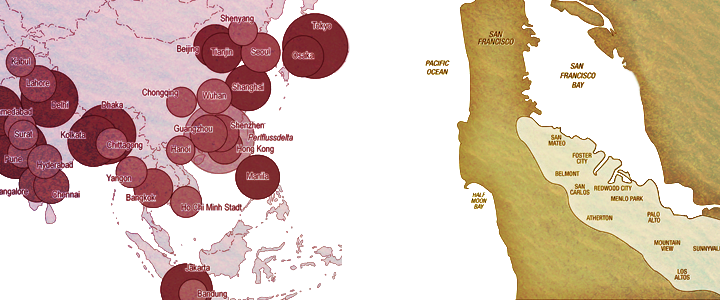
After spending a week here in San Francisco, hanging out with Valley startups, and attending TechCrunch Disrupt, I’ve noticed a few things that are rather unique about the Valley that you won’t see back in Asia. They play a huge role in what kinds of startups come out of the ecosytem. And although it’s not Asia’s heyday yet and the Silicon Valley is still the indisputable Mecca of startups, we’re starting to see the inklings of a distinct culture in Asia. Here’s seven things in the Valley you just won’t see in Asia.
1. A strong early adopter culture
I was sitting with a bunch of non-tech friends the other day, when one of them whips out her iPhone. She says, “Hey guys, check out this new app I found called VenMo. It allows you to be able to transfer money to your friends after you get the bill.” I was mesmerized. You just don’t have this kind of situation in Vietnam. Most of the time, if you’re hearing such talk in Asia, you’re probably hanging out with other tech people. In San Francisco, startups have the convenient advantage of being able to assume that early adopters are in abundance.
There is no such luck in Asia. More often than not, ideas die before they even get implemented because there’s no early adopter culture. It could be a great idea, but no one wants to try it. That means startups that do make it, have to work really hard to make sure that their idea actually has value to either businesses or consumers. Valley startups can work on frivolous things like UX design, hilarious marketing tactics, or as we saw at TechCrunch Disrupt’s hackathon, base ideas like TitStare.
2. A willingness to share and grow together
My hat goes off to Valley folks: they really care about each other in a way that I don’t see happening here in Asia. Putting Apple aside, you’d just have to spend a few hours on Quora and its startups topic and you’ll see how much people are willing to divulge about how to do startup, startup culture, and the trials and tribulations of being a founder. Valley people, nurtured in the heart of the yuppie and hippie culture of California, have grown to share and help each other.
In Asia, we certainly see pockets of this, with mentorship becoming an imperative, but Asian culture is held back profoundly by not only an immaturity in how to work together but also a defensiveness in competing. If you fly around Asia meeting startup communities, you’ll slowly start to hear of all the dramas that torment each. Fundamentally, this prevents the kind of growth we see in the Valley. In the Valley there’s drama, but it’s profoundly swept away by 1) the sheer size of the community and 2) the overwhelming sense that “we should help each other for everyone to win”. It’s ultimately all about win-win.
3. Failure as a rite of passage
People have been harping on this one repeatedly and it’s for good reason. Failure, across Asia, remains a stigma. As Dave McClure yelled at the top of his lungs in Japan, “someone in a high position has to publicly fail so that other people can learn how to do it”. Nobody wants to fail and it’s inextricably tied to long-held Asian culture. In other words, it’s not going away anytime soon.

via TVrage.com
4. Everybody wants to help everybody
With almost every person I met on this trip, whether it be a startup or an investor or a journalist, everyone offered to help me in some way. And I noticed very quickly that they also offered to help everyone they met.
As competitive as Asia is, offering your help to someone else can also mean doing favors for a potential enemy. But people are unable to see past that and look at the long-term benefits.
5. The Valley is a land of layers
Every time I come back to the United States, it looks exactly the same. The landscape hasn’t changed much except for a few new Starbucks’ and a new building or statue here and there. Offices still have landline phones and people still drive cars on the same exact highways. Everything is like clockwork. It’s this firm foundation that Valley startups can build on top of.
Uber is a great example of this. It takes existing resources and people and fashions a business model that sits perfectly on top of the infrastructure that already exists.
In Asia, especially developing Asia, forget about infrastructure. Forget about widespread usage of landlines and aligned highways. Asian startups are building for a land without layers; they are forced to be the layers themselves. Texting is one beautiful example of how Asia leapfrogged landlines into new technologies that the Western world has only caught up to in the last few years. And today, we’re seeing unique examples of this with payment, logistics, and e-commerce at the forefront.
6. Valley startups create problems to solve because they don’t have any problems
7. The ecosystem dreams really really big
Conclusion: the bubble and the ocean





Stay updated on the go with our mobile app.
Get latest insights with smoother, more personalized experience through TIA mobile app.













📅 Upcoming Events
22 October 2026
Payoneer x CSPN Summit 2026