 Peter Rothenberg · · 5 min read
Interrogated and kicked out of the US, this entrepreneur hustled her way back in

Nix Hyrda founder and CEO Lina Chen.
Lina Chen’s personality rubs off on her startup. Its unique culture includes a four-day workweek and “onesie Wednesday” on the first Wednesday of each month.
“My co-founder and I love onesies. I have at least 14,” says Lina. “It’s just a fun thing that developed into a tradition. It takes you out of your comfort zone.”
Nix Hydra is her startup, and she’s the CEO. I met her at Pioneers Asia. She’s whimsical, full of energy, and serious about changing the gaming world.
Company culture is extremely important, she says. “We are making games to make people happy, so you should be happy yourself. How can you take things so seriously when everyone is running around as dinosaurs and skeletons?”
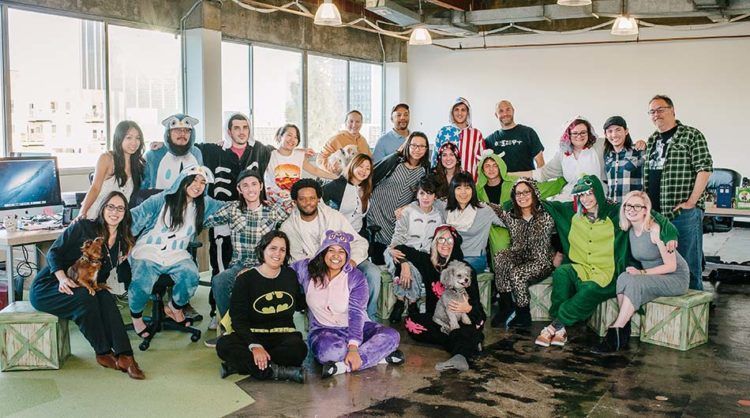
Just another Wednesday at work.
Why not us?
Lina grew up in South Africa but studied in the US. She met co-founder Naomi Ladizinsky at Yale where the two worked together on a campus-wide TV show. “I can be very intense and demanding,” smiles Lina politely. “Naomi did not like me for the first three years, but in our fourth year we discovered that we had a lot of overlapping interests and that we would actually work well together. We like the same things but see it in different ways, which is good. It gives us more perspectives.”
After graduating, Lina moved to Los Angeles to work for a talent agency and Naomi went home to work on animation. “I really wanted her to come to LA because that’s where she needed to be for animation. Oh, and I needed a roommate,” she laughs. Lina set up some animation meetings on behalf of Naomi to put pressure for her to come to California.
The plan worked. Naomi moved in a few months later. The two started playing video games that they had enjoyed when younger. “Why are there no games we like?” they thought. Lina attended more game-related events to see what was going on in the space. Meanwhile, Naomi’s animation studio was using video game engines more and more. After discussions about the homogeneity of both games and the male-dominated industry, the two decided, Why not us? We could make games.”
The American inquisition
Lina was still on a US business visa, traveling between the States, Shanghai, and South Africa for meetings to raise money. “Every time I came back, my stay was shortened,” remembers Lina. “First it was six months, then it was 30 days, then 10. Finally they told me, ‘You have seven days and then you can’t come back anytime soon.’”
They treat you like a criminal.
Lina was put on a US watchlist and was stopped each time at customs. “I was terrified,” she says. “They pull you into this tiny room and interrogate you for an hour. They go through your bags, sometimes even your phone and laptop. They treat you like a criminal.”
Lina ran out of money. She couldn’t get into the US. No investment leads were strong and her co-founder was stressed. “It was not good.” She went home to South Africa for a little before going to China to meet people in the gaming space. After a number of introductions from friends of friends, Brandon Beck of Riot Games led a five-person angel investment in her fledgling gaming startup.
Party on, eggcellent
Eggcited for the next one





Stay updated on the go with our mobile app.
Get latest insights with smoother, more personalized experience through TIA mobile app.








📅 Upcoming Events
22 October 2026
Payoneer x CSPN Summit 2026