- Insights This article was written by a TIA community member. Insights pieces undergo the same rigorous editorial process that newsroom-produced articles have.
 Wu Ying Ying · · 5 min read
More travelers are becoming mobile-first in Asia. Here’s what businesses should do
Even as the world gets smaller, people’s desire to travel never ceases. Reflecting this demand, online travel, which comprises online sales of flights and accommodations, accounted for more than 38 percent of the estimated US$78 billion internet economy of Southeast Asia last year. Google and Temasek project that online travel will grow 15 percent year-on-year until 2025.
The momentum for this projection is apparent. Looking at our own data at ShopBack, we found that the volume of online travel bookings saw 260 percent growth in 2018 as more consumers bought online travel products.

We expect the online travel sector to maintain this momentum through 2019. As such, travel operators should appropriately position themselves to capitalize on this growth.
To this end, we analyzed online travel bookings made by over 8 million shoppers via our platform across seven countries in Asia Pacific last year. Here’s what we found.
Mobile growth
While 60 percent of transactions in 2018 were still made via desktop, more and more transactions were happening on mobile apps.
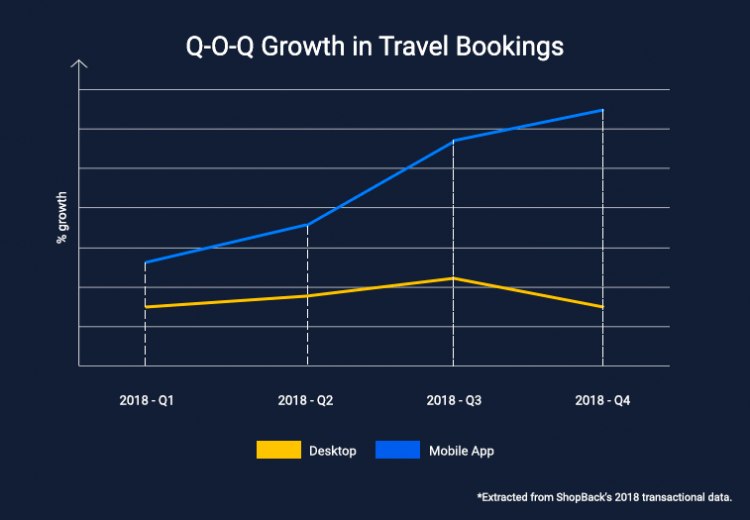
In fact, mobile app’s growth rate was at least 1.5 times that of desktop in 2018. This is consistent with the findings we highlighted here, where we saw more sales conducted on mobile apps across most major online categories. If this trend continues, mobile is bound to leapfrog desktop in the coming quarters as the leading platform on which online travel sales are transacted.
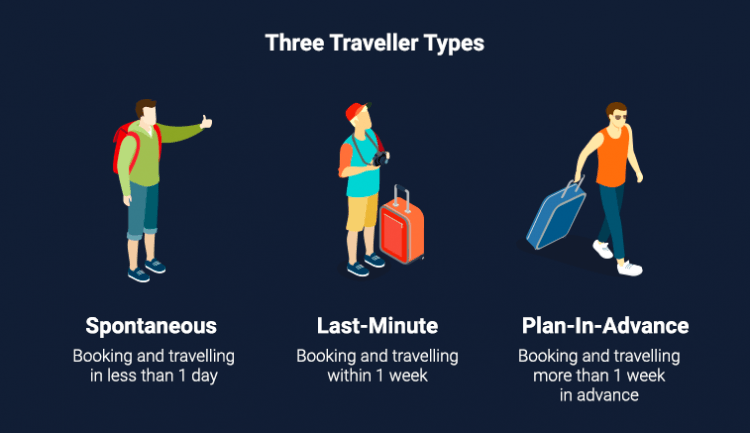
The implication is clear: we have to identify the behavioral drivers behind the mobile-led growth in online travel bookings. To do this, we divided our online travel customers into three distinct profiles: Spontaneous Travelers, Last-Minute Travelers, and Plan-in-Advance Travelers.
Who used mobile app the most?
Over 70 percent of customers who booked and traveled in less than a day (i.e. Spontaneous Travelers) completed their online travel bookings on mobile app. These travelers who made plans at very short notice typically include those who went on business trips or quick getaways.
Where did Spontaneous Travelers go?
How much did travelers spend?
A mobile-first future for Asia-Pacific travelers





Stay updated on the go with our mobile app.
Get latest insights with smoother, more personalized experience through TIA mobile app.