 C. Custer · · 3 min read
Apple’s court victory over the FBI sparks a political debate online in China
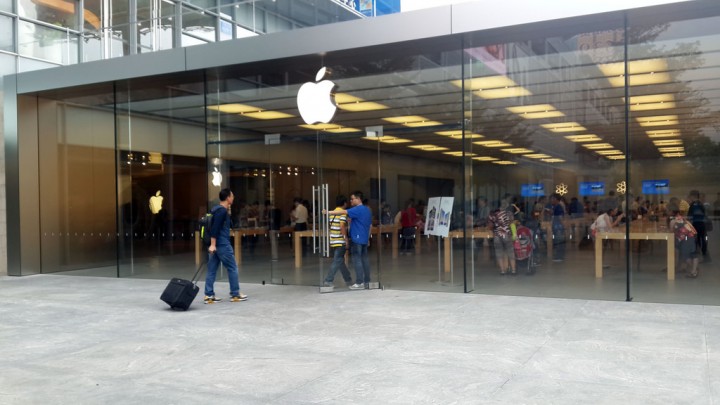
Photo by Chris
Apple got some legal help in its battle with the American FBI on Monday. A federal judge in New York ruled that the FBI cannot force Apple to unlock an iPhone because Congress already considered but did not pass legislation that would force companies to unlock their phones. The New York ruling is legally unrelated to Apple’s high-profile battle with the FBI over the iPhone of one of the San Bernardino shooters – that case is playing out in California – but it sets a strong precedent that Apple can cite in its favor as the California case moves forward.
In China, tech industry watchers and Apple fans have been following the Apple vs. FBI story with significant interest. It has made headlines across China’s major tech portals almost every day since Tim Cook’s public letter a few weeks ago. Monday’s New York ruling also made headlines in China, and it’s got commenters talking.
For example, a Sina Tech commenter from Liaoning wrote, “I want to know what this would be like if it were in China.”
A loss for the FBI is increasingly looking like it would mean a big win for Apple and for American soft power.
That’s purely rhetorical, of course. Everybody knows what would happen to Apple if this fight were in China. As another Sina commenter put it: “Not cracking the phone is kind of like secretly participating in crime, and China will definitely not permit criminals to exist, so naturally the phone would be unlocked.” That’s not really hypothetical; although Apple has never unlocked a phone in this manner for Chinese authorities, it has jumped through all sorts of hoops to keep its products available in the country. It has censored apps, moved data onto state-owned servers, and even submitted to a government “security audit.” If China’s government were to come to Apple with a request similar to the FBI’s, many suspect the company would cave, since the alternative would likely be a wholesale ban on Apple products in China.
As the battle in the US plays out, though, a loss for the FBI is increasingly looking like it would mean a big win for Apple and for American soft power in the region. Numerous comments on the Monday ruling story, for example, suggest that commenters are impressed by the American legal system and the fact that the government doesn’t (necessarily) get exactly what it wants. “Democracy!” wrote one Sina commenter in Sichuan. “That’s real respect for the law,” another commenter in Shaanxi added.
“Only in America would there be this kind of outcome,” opined a Shanghai commenter. “The constitution comes first.”
Of course there are also those who think the failure to immediately knock over Apple makes the US government look weak. And many commenters are convinced that the public legal battle is actually a front. Apple must, they figure, be collaborating with the FBI behind closed doors, perhaps covering up the fact that the phone has already been unlocked. “Do you really think the FBI can’t hack a phone?” wrote another Sina commenter. “Give me a break.”





Stay updated on the go with our mobile app.
Get latest insights with smoother, more personalized experience through TIA mobile app.








📅 Upcoming Events
22 October 2026
Payoneer x CSPN Summit 2026