Jonathan Chew · · 6 min read
Meet the team that keeps the AWS data centers running like clockwork

Last year, cloud computing data centers reached a significant milestone.
For the first time ever, the share of enterprise workloads run on on-premise servers – as opposed to cloud-based data centers – fell below 50%. Cloud is now the preferred choice.
As these data centers become more integral to companies’ global operations, it’s imperative that the right talent oversee them.

Photo credit: Shutterstock
At cloud services provider Amazon Web Services, data center operations engineer Elsa Mathew Samuel as well as Anna Chua, one of the firm’s cluster managers in Singapore for infrastructure delivery, help to keep such data centers running optimally.
“We’ve got to maintain 100% uptime to deliver the best results for our customers, partners, and cloud users,” says Samuel.
Fresh opportunities
Landing her role at AWS came out of left field for Samuel.
“Having majored in mechanical engineering, I was more used to seeing traditional jobs that work with things like heating or ventilation systems,” she says. However, after she met with an AWS representative during a university recruitment initiative, a new path lit up.

Elsa Mathew Samuel, data center operations engineer at AWS / Photo credit: AWS
“The more I knew, the more I liked it, and eventually, something clicked in me,” she shares. “AWS was always my dream company, too, so it was a good opportunity to explore other types of engineering.”
Chua, meanwhile, came from a rather different background. The computer engineering graduate had about two decades of experience in infrastructure operations before joining AWS in 2019 as a data center operations manager.
“I had a friend working in AWS Singapore who shared with me that there was an opening for that role,” Chua says. “The data center industry was booming, so I jumped at the opportunity.”
Despite the difference in how they got there, one common factor attracted both of them to the company: the opportunity to learn, grow, and expand their horizons.
“In IT, the industry moves as fast as lightning. If you get too comfortable with where you’re currently at, you’re not learning or growing as much,” says Samuel.
For Chua, it was an eagerness to learn from experts in the field that interested her
Smooth as butter
As a data center operations engineer, Samuel looks after the power delivery and cooling systems.
“Together with my team, we ensure we can provide 24/7 power to the servers,” she explains.
It’s a crucial job, as servers generate heat, and the only way to make sure it’s all systems go is to maintain “an ideal temperature.”

An army of fans helps to keep the servers cool / Photo credit: Thomas Kvistholt
Preventing overheating sounds straightforward, but in practice, it’s a huge task – data centers often have a huge number of server racks. On the job, Samuel quickly found out that there was a lot of learning to do.
“A lot of the electrical engineering concepts were new to me,” she says. “One thing I found particularly difficult was the single line diagram (SLD).”
SLDs are extremely detailed, technical documents that lay out a set of equipment and infrastructure. Without prior experience in deciphering these, Samuel used to take 30 minutes to understand an SLD while her teammates only needed 10.
“Initially, it was a huge task for me every single time,” she shares.
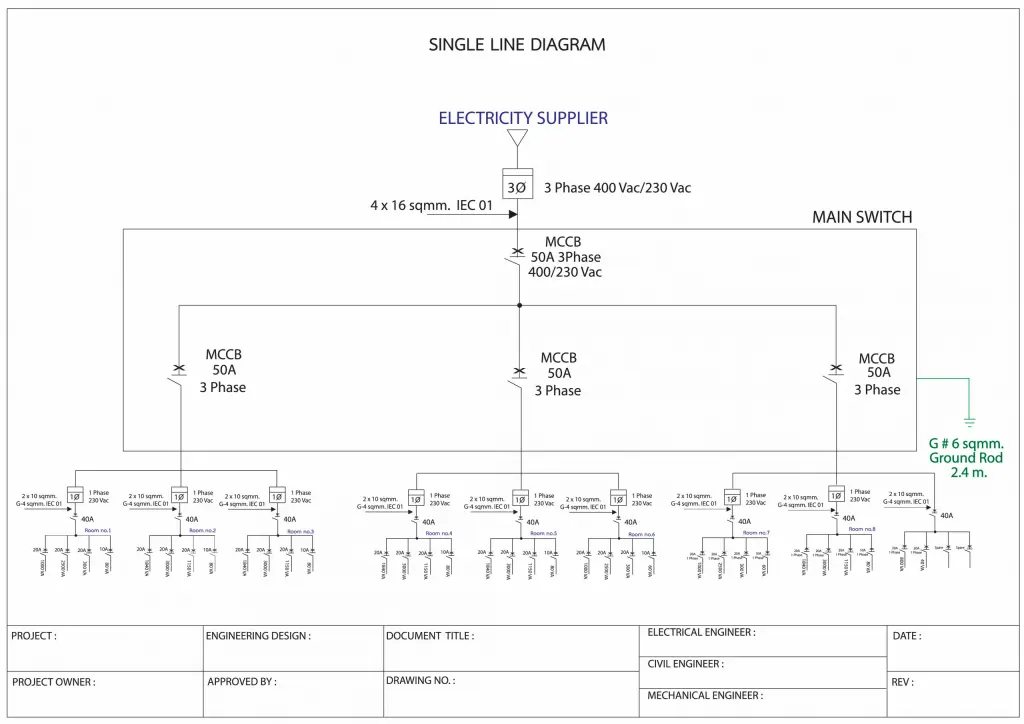
An example of what an SLD could look like / Photo credit: Shutterstock
However, as someone who feels that it’s “better to face a good challenge head on,” Samuel resolved to find a better way. She began creating simplified SLDs in the form of flowcharts, which helped her shave down the time she spent on these documents. It now takes her about two minutes on average to comprehend each one fully.
“Everyone was encouraging and supportive of my efforts, and I even won an internal award for it,” she says. “Even though it wasn’t a particularly big invention, simplifying the SLDs was helpful since they are very dense documents.”
Samuel also credits her manager, Prasad Wasdikar, and her assigned buddy, Rajendra Ram, with supporting her through those early days. Wasdikar would slowly assign her electrical engineering tasks to build up her confidence, while Ram guided her at each step.
“[Ram] would help with even the slightest doubts I had – even down to things like how I should address other people,” she says. “They were both very warm and welcoming.”
Delivering results with speed
In Chua’s case, she – together with her team – is responsible for delivering network infrastructure to customers.
Part of her job is making sure that every single component, such as switches and routers, is in place to ensure full functionality.
“In the event that we need to scale up the bandwidth or network to host new types of technology, we must be able to do it promptly,” she shares. The rise of AI and machine learning services is an example of instances when new components need to be added to computational power, storage, and more.
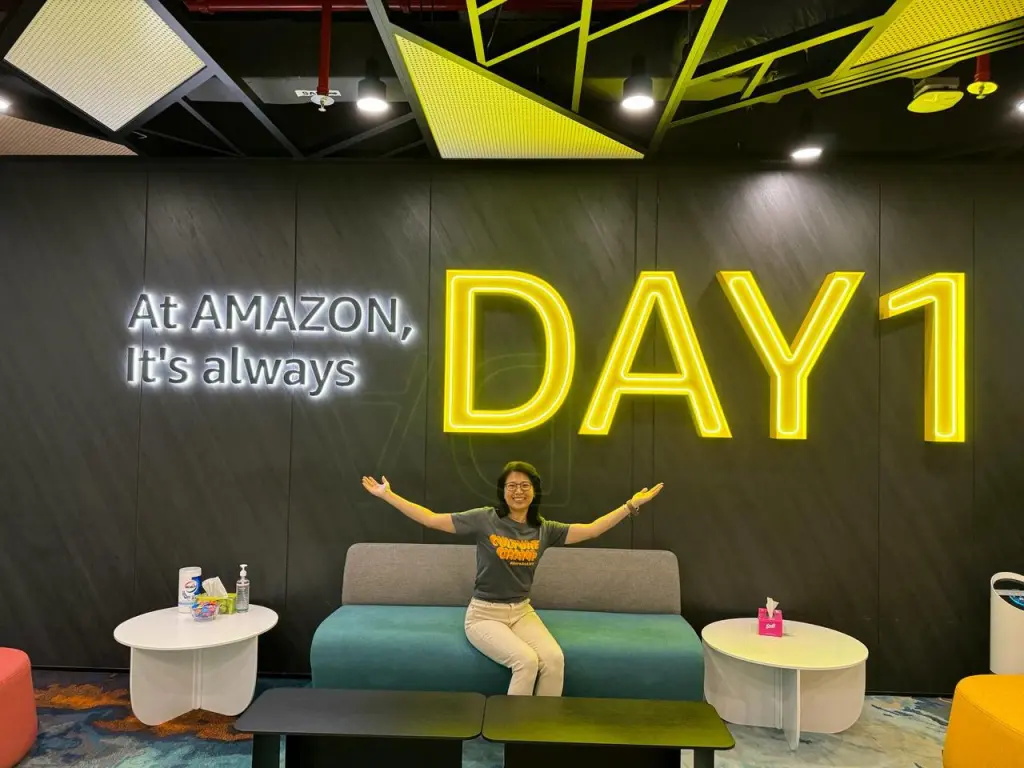
Anna Chua, a cluster manager for infrastructure delivery at AWS Singapore / Photo credit: AWS
Additionally, Chua and her team ensure that the proper cooling and power systems are added so that everything runs smoothly. In her past experience, this was a process with many moving parts that took up to a few months to complete. However, things go much faster at AWS.
“We have a highly scalable and reliable infrastructure, and processes are well-established so that we’re empowered to address demand promptly.”
To elevate her work even further, Chua developed a process to evaluate clients more thoroughly, allowing her team to put the best members forward to support their customers’ specific needs.
“That allowed us to craft a proper action plan, which helped us deliver projects on time,” she says. “If there’s an opportunity for us to do better, we train our teams up and close those gaps.”
Making their mark
Samuel and Chua have a lot on their plates, but that hasn’t stopped them from exploring other interests.
Samuel often volunteers to plan employee events such as sports days or celebrations for national holidays and festivals.
She also helped out with an AWS initiative called Girls’ Tech Day, which is aimed at encouraging school-aged girls to pursue their interests in STEAM subjects.
“I conducted workshops with middle and high school girls to talk about coding and creating robots,” she says. “They’re actually very interested and have lots of amazing ideas. One of the girls even told me she wants to be an aerospace engineer.”
As for Chua, she helps other AWS colleagues imbibe a Day One mindset as an AWS Culture Champ, which involves helping people stay constantly curious, nimble, and experimental in their approaches to work.
In IT, the industry moves as fast as lightning. If you get too comfortable with where you’re currently at, you’re not learning or growing as much
She’s also part of a management book club.
“I relate a lot with the lessons I learned from a book called The Agility Factor,” she shares. “It taught us how various companies incorporate an agile culture within their teams and how to embrace a Day One mindset.”
Amid their different responsibilities, Samuel and Chua agree on one thing: data center employees will always have a critical role to play.
“In the past, the demand was tied to storage computation and backups. Now, with ML and AI, many things are moving forward in exciting ways,” says Chua.
“As the need for servers and storage increases, the industry needs qualified talent to maintain those systems, which should provide a lot of opportunities for training and growth,” Samuel notes.
AWS is the world’s most comprehensive and broadly adopted cloud, offering over 200 fully featured services from data centers globally. Curious to learn how you can play a part in shaping the future of technology? Click this link and check out the open roles.
This content was produced by Tech in Asia Studios, which connects brands with Asia’s tech community. Learn more about partnering with Tech in Asia Studios.
Stay updated on the go with our mobile app.
Get latest insights with smoother, more personalized experience through TIA mobile app.
Recommended reads
 Indonesian AI startup goes global
 Forrest Li on scaling Sea, building smarter bots, and founder grit
 An AI assistant that joins sales calls and scores team skills
 SGX’s CEO says it doesn’t need a unicorn to win
 SMEs want AI too, but not the kind Big Tech is selling
 Oatside’s alt-milk rise hits a profitable gear
 Alibaba’s financial health in 12 charts
 Asia’s telcos bundle AI into mobile plans. Will it pay off?
 M-Daq chases bigger clients as revenue falls, losses grow
 VC tracker: Accel raises US$3.5b, including US$550m for India





Editing by Winston Zhang and Jaclyn Tiu
(And yes, we’re serious about ethics and transparency. More information here.)