Paul Bischoff · · 3 min read
Email isn’t dying, it just needs a makeover. This startup turns email into a chat app

Email is dying, if you believe the critics. In five to 10 years, it could be obsolete, they say. The medium is nearly as old as the internet itself, and the onset of mobile messaging means the use of email is on the decline. Email is time consuming, distracting, and full of stuff we don’t actually want to read.
But on the other hand, email is universal, easy to use, and free. Perhaps email doesn’t need a replacement, but a makeover.
"Every messenger is a closed platform. I’m on WeChat, you are on WhatsApp, so we cannot talk to each other. […] But email is different because email is a decentralized, open platform," says Heatherm Huong, co-founder of MailTime. "It cannot die, because there is nobody who can shut email down."
MailTime, a startup that makes an app by the same name, adapts email to the messaging app medium. It takes all of your email and reformats it into a chat app interface, similar to WhatsApp or WeChat. The app parses out the body of emails so you just see the meat of the messages in a single chat dialogue – no salutations, no signatures, no timestamps.
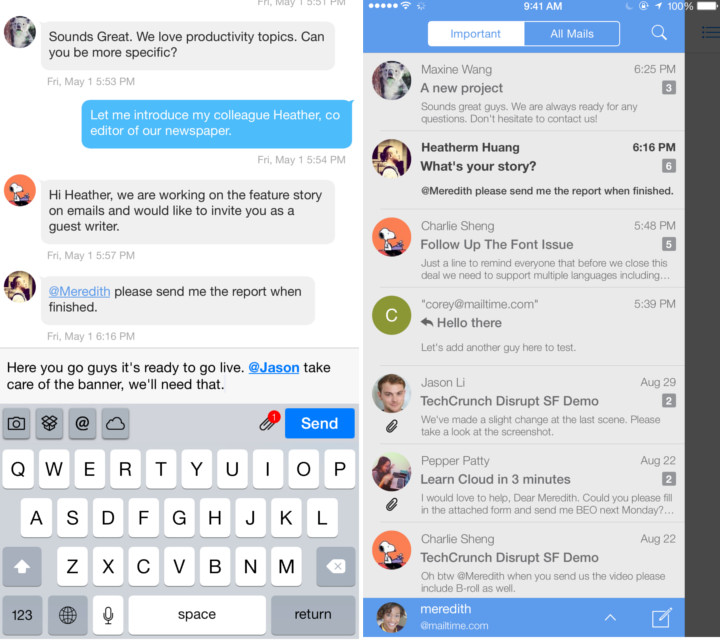
The app uses your existing email address. You can add images and other attachments just like you would in a chat app, CC other people into the conversation with a couple of clicks, and assign tasks using the @ sign.
On the other side of the conversation, for those using traditional email apps, a message sent from MailTime just looks like a normal email, albeit usually much more succinct. All the reformatting happens locally on the app.
Email 2.0
The first version of MailTime was in English only and was exclusive to Gmail. The MailTime team hails from Hong Kong, but they relocated the headquarters to San Francisco prior to launching at TechCrunch Disrupt in September last year.
The startup launched version 2.0 two weeks ago, with eyes back on Asia and the international market. It now supports 12 languages including Chinese, Japanese, and Korean, and nine email providers including QQ and 163, which are popular in China.
The previous version of MailTime took six months to reach 150,000 downloads, but Huang says it only took 10 days to reach the same number after launching v2.0, at a rate of about 20,000 downloads per day. It’s been featured in Apple App Stores in 18 countries, including China, Singapore, Hong Kong, Taiwan, Malaysia, and South Korea (in Chinese, the app is called 简信).
Currently, MailTime is only available for iOS, but Huang says he plans to launch an Android version in about two weeks.





Stay updated on the go with our mobile app.
Get latest insights with smoother, more personalized experience through TIA mobile app.