 Jonathan Chew · · 6 min read
Why L’Oréal’s tech and innovation culture isn’t just skin deep

There are many instances when things are not what they seem.
Take multinational corporations, for example. They sometimes get a bad rap when it comes to innovation, especially if they have long or storied histories. But in reality, some of these firms are agile, fast-paced, and teeming with cutting-edge technology.
Global beauty leader L’Oréal is one such company.
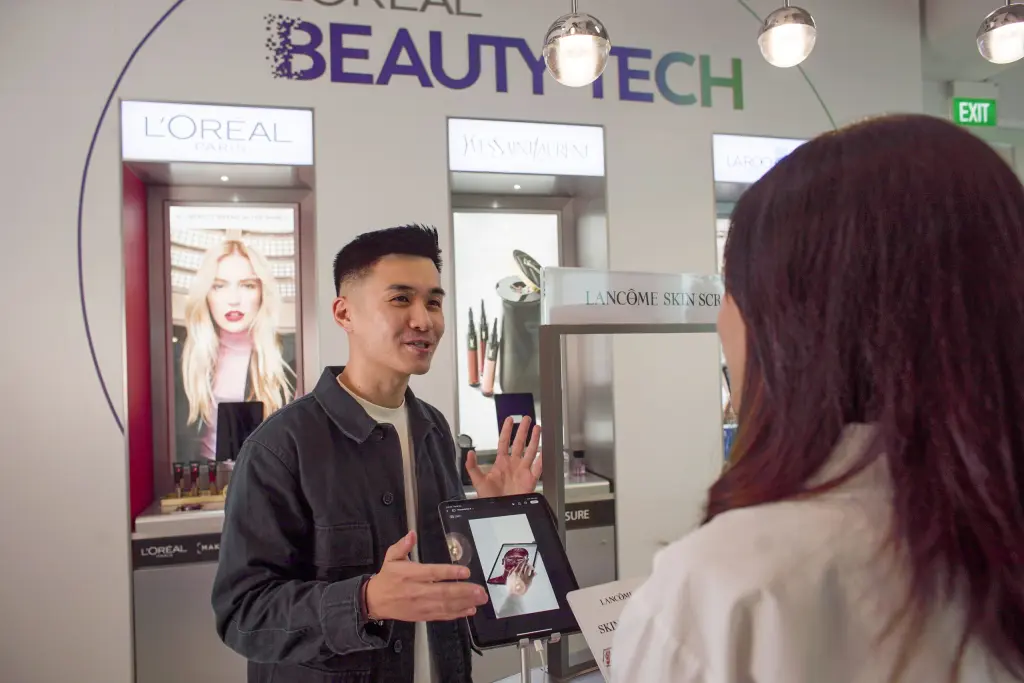
Photo credit: L’Oréal
Not only has L’Oréal fostered an environment that encourages employees to grow, but it has also implemented processes and solutions that wouldn’t be out of place in a tech company.
“People tend to think we just sell lipstick or serums, but there is a lot of tech under the hood in L’Oréal,” says Nicol Ong, a beauty tech project manager at the Paris-headquartered firm.
So what’s it really like to work at the world’s biggest beauty company? Tech in Asia spoke with Ong and Jasmine Seah, a data analytics project manager, to get a clearer perspective.
Misconception 1: It’s all about beauty
Many people see L’Oréal’s products in malls and drugstores and assume that the company is only about beauty and nothing else.
“When people think of tech-based companies, they think of FAANG,” Seah points out. A beauty brand wouldn’t necessarily be “top of mind for newly minted tech grads,” she adds.
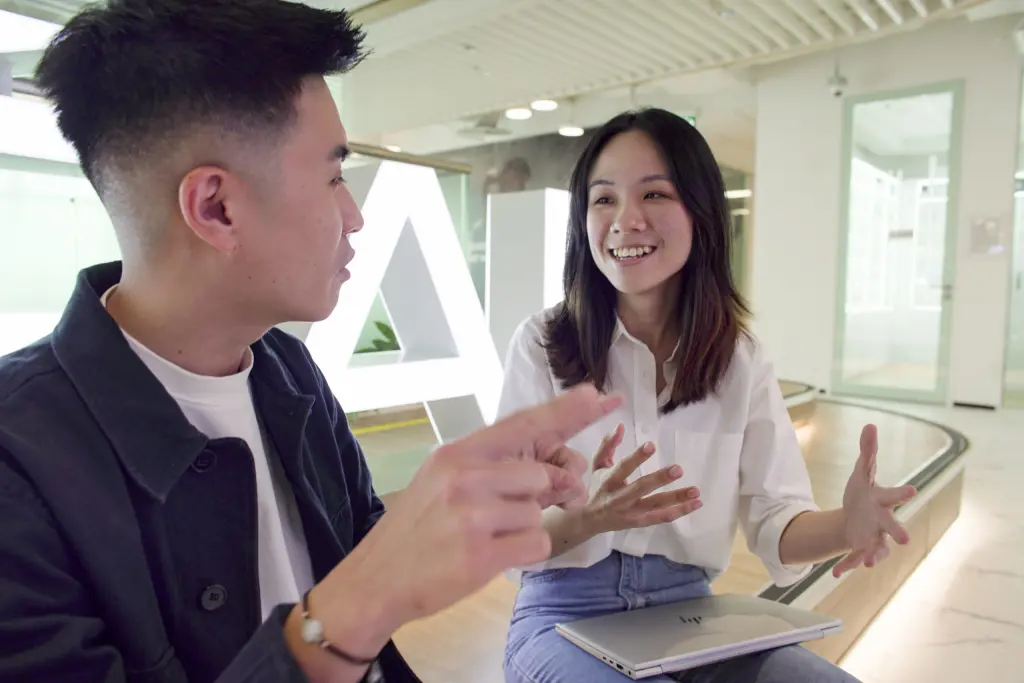
(From left) Nicol Ong, a beauty tech project manager and Jasmine Seah, a data analytics project manager / Photo credit: L’Oréal
But Seah, a recent business analytics graduate from the National University of Singapore’s School of Computing, says she chose L’Oréal because it’s “at the forefront of tech and beauty, with very strong roots in data-driven decision-making, especially in day-to-day operations.”
Her job scope includes providing internal stakeholders with data that’s cleaned and standardized across L’Oréal’s markets. Together with her team, Seah is building a data lake and business intelligence tools to empower other divisions to make data-backed decisions.
“For example, return on ad spend is calculated by capturing gross merchandise value (GMV) from retailers and spending on media platforms. This metric helps the marketing team measure how well a campaign performs across different demographics,” she explains.
According to Ong, L’Oréal’s work environment shares a lot of similarities with tech companies.
“Initially, I had the impression that L’Oréal wasn’t big on tech,” he shares. “But after I joined, I found out that the tech stack we use is no different from what’s used at tech companies.”
He adds that he was trained on agile workflow from the moment he joined the firm.
“It just goes to show how important tech is at L’Oréal,” he says.
Misconception 2: There’s limited room for innovation
Some people think it is harder to innovate at a large company since having so many teams could make it difficult for everyone to get on the same page.
“Friends who have worked at big companies told me that things are extremely structured, and they had to stick to their lane,” Ong says. “However, it didn’t take me long to discover otherwise while working in L’Oréal.”
“It’s in our DNA to have every team function like a startup that’s part of a bigger organization,” he observes.
Enjoy what you do and you’ll never have to work a day in your life / Photo credit: L’Oréal
Supporting the launch of Kérastase K-Scan for the SAPMENA (South Asia Pacific, Middle East, and North Africa) region was a memorable project for him. The K-Scan is an AI-trained smart camera that allows hairdressers to offer very precise care via enhanced hair and scalp assessments.
As part of the launch, Ong designed the dataflow solution, established processes and automations to simplify workflows, and collaborated with different teams across different geographies.
“Everyone was super receptive,” he shares.
According to Seah and Ong, this kind of environment is built around having the right attitude and a strong cross-collaboration culture.
“The entrepreneurial ‘test and learn’ mindset is ingrained in every employee at L’Oréal,” Seah says. “If it fails, we learn from it and iterate better versions.”
In such a culture, people can get the resources they need for their own initiatives. Case in point: Seah’s and Ong’s teams worked with two other departments – the research and innovation group and the firm’s beauty tech accelerator – to conduct data analysis on some of L’Oreal’s beauty tech offerings.
Another project that Ong and his team worked on was the Lancôme E-Skin Expert. The AI-powered online skin analysis tool allows consumers to analyze and diagnose their skin virtually.
“Analyzing these beauty tech tools and consumer data allows us to better understand our consumers and their pain points, paving the way for better products and services,” Ong says. “There’s always a deliberate intent for our cross-functional collaboration.”
Misconception 3: Career progression can be slower at large firms
People often assume that it’s difficult to stand out in large companies and advance your career. Having a fixed, hierarchical structure can sometimes create a lot of red tape too.
Seah and Ong say this isn’t the case at L’Oréal.
Seah recalls having opportunities to explore her professional interests by doing three rotations across different roles with separate teams as a management trainee. Her first role was with data analytics, the second with the Singapore market team, and the third was with digital IT. During her rotations, she handled projects ranging from executing ad campaigns to managing customer relationships.

It’s an all-round affair at L’Oréal / Photo credit: L’Oréal
“I feel like the company really values employee mobility and expanding our skill sets,” she says.
Meanwhile, Ong says that he’s expanded his current job scope as a beauty tech project manager to include an area that he’s personally interested in: customer relationship management.
“There’s a lot of ownership. As long as you show interest and do the work, you can grow in the way you want to,” he adds.
Tech-based cosmetics, anyone?
Both Seah and Ong have ideas for the kind of tech that they want to develop at L’Oréal.
Seah is excited to see how AI can help “democratize the digital and data scales,” which could help people understand data analytics a lot easier.
“All you’d need to ask is: ‘What’s my GMV?’ or ‘What’s my units sold for this month?’ The AI could just return the results automatically,” she explains. “This would help everyone streamline and automate their workflows.”
Meanwhile, Ong is keen to explore beauty tech solutions to assist the disabled. He cites the example of Hapta, a device unveiled by L’Oréal in 2023 designed to aid users with limited hand and arm mobility in applying lipstick. Thanks to Hapta, L’Oréal has won recognition from Time and Fast Company.
“There’s a misconception that beauty is superficial, but I’d say many people aren’t looking at it deeply enough,” Ong contends.
“Beauty has been essential to humans since the beginning of time. With beauty tech, we now have even more tools to reinvent the consumer experience.”
L’Oréal is the world’s leading beauty player and devoted to fulfilling the beauty aspirations of consumers around the world. With 87,400 employees including 5,500 tech and digital professionals, L’Oréal is focused on inventing the future of beauty and becoming a beauty tech powerhouse. To learn more about job opportunities at L’Oréal, check out its careers page.
This content was produced by Tech in Asia Studios, which connects brands with Asia’s tech community. Learn more about partnering with Tech in Asia Studios.
Stay updated on the go with our mobile app.
Get latest insights with smoother, more personalized experience through TIA mobile app.
Recommended reads
 AI hiring heats up in Singapore
 Building a human capital operating system for students
 The power of three: the art of making hard decisions
 How a brush with a human trafficker sparked a healthtech startup
 Asia’s AI divide: Creators vs. experimenters
 Has Southeast Asia reached its AI inflection point or stalled at pilots?
 Funding Societies on the SME gap (and how to bridge it)
 An AI interviewer being built on interview data, not CVs
 AppLovin CPO on how renting AI can be a waiting game
 HubSpot co-founder: stop hiring well-rounded executives





Editing by Stefanie Yeo, Winston Zhang, and Eileen C. Ang
(And yes, we’re serious about ethics and transparency. More information here.)





📅 Upcoming Events
22 October 2026
Payoneer x CSPN Summit 2026