 Jane Zhang · · 4 min read
5G to stimulate US$500b in China tech growth over next five years, researcher says
The roll-out of 5G services across China is predicted to spur new growth in the country’s technology sector amid trade tensions with the US, as industries meet the challenge of adopting advanced applications for the next-generation mobile infrastructure.
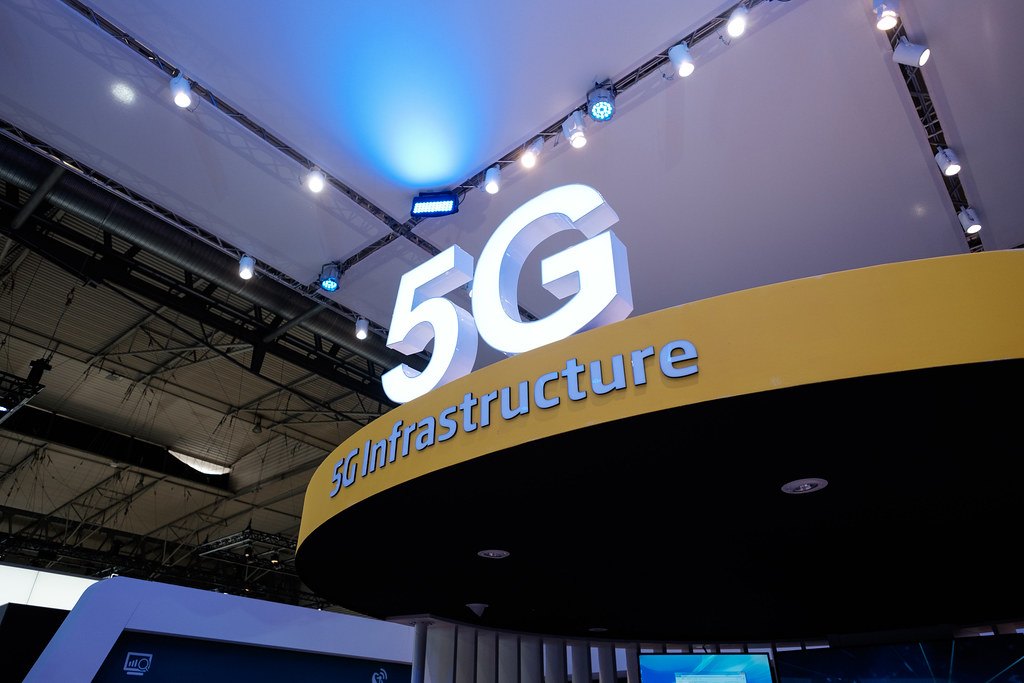
Photo credit: Kārlis Dambrāns
At the Global Mobile Internet Conference held in the southern coastal city of Guangzhou last week, a representative from the China Academy of Information and Communications Technology (CAICT) forecasted that 5G will stimulate growth in the country’s information technology industry by 3.3 trillion yuan (US$479 billion) over the next five years.
That development is expected to rev up digitization across traditional industries, which would yield more than 10 trillion yuan in growth over the same period.
“4G has changed people’s lives,” said Chen Jinqiao, deputy chief engineer at the academy, which is under the Ministry of Industry and Information Technology (MIIT), during his presentation on China’s 5G development in the conference. But he indicated that 5G has the potential “to change society” as different industries adopt the technology to their various requirements.
Chen’s growth estimates come amid the increased pace of 5G infrastructure spending in China, which is attempting to move ahead in the global race to deploy ultra-fast, next-generation mobile networks.
With peak data rates up to 100 times faster than what current 4G networks provide, 5G has been hailed as “the connective tissue” for the internet of things, autonomous cars, smart cities, and other new mobile applications, establishing the backbone for the industrial internet.
Initial commercial 5G mobile services have already been rolled out in South Korea, the US, Australia, the UK, Switzerland, Spain, and Monaco. Yet the scale of China’s market is likely to dwarf the combined size of those economies, negating any first-mover advantage.
During a panel discussion at the conference, the shift from 4G to 5G networks was expected to help upgrade industries and drive further innovation in the world’s second-largest economy.
“The most important thing for enterprises is the exploration of application scenarios,” said Li Zhihui, a senior consultant at Japanese management consulting firm Nomura Research Institute. “Fast networks or data alone cannot generate value. How to use data [generated from 5G devices] to provide value-added services to customers is the challenge that companies face.”
The likely impact of 5G has already become visible in China through various high-profile projects, according to the China Internet Report 2019. The report was published by the South China Morning Post and its sister site Abacus, in conjunction with Edith Yeung, managing partner at Proof of Capital. At Shanghai’s 2019 Auto Show last April, China Mobile promoted its support for autonomous vehicle technology using a trial 5G network. It allowed a driver at the Shanghai show to take the wheel and control a car more than 1,000 kilometers (620 miles) away in Beijing.
Chen from the CAICT said 5G would make it possible for China’s education sector to change its approach, from teaching based on experience to teaching based on data. In health care, 5G’s fast internet access speeds and low latency will make remote diagnosis and surgery more reliable, he said.
In March, China conducted its first remote surgery using robots, with the support of a 5G network deployed by China Mobile and telecommunications network gear maker Huawei Technologies, according to state media. The procedure involved a patient with Parkinson’s disease at the Chinese PLA General Hospital in Beijing. It was presided over by a neurosurgeon, who remotely controlled robotic arms in the operating room via a 5G network-linked computer from 3,000 kilometers away in Sanya City, located in the southern province of Hainan.
Nomura’s Li indicated that 5G in China will mark “a big leap, especially in the industrial internet”. She said “remote control [via 5G] can create a lot of productivity,” which is important in a vast market like China where resources are unevenly distributed between urban and rural areas.





Stay updated on the go with our mobile app.
Get latest insights with smoother, more personalized experience through TIA mobile app.










📅 Upcoming Events
22 October 2026
Payoneer x CSPN Summit 2026