- Premium Content It takes our newsroom weeks - if not months - to investigate and produce stories for our premium content. You can’t find them anywhere else.
 Apoorva Dutt · · 5 min read
LinkedIn co-founder Reid Hoffman explains why ‘bad management is a good idea’
When blitzscaling [growing an organization at a very fast pace], speed is more important than having a “well-run” organization.
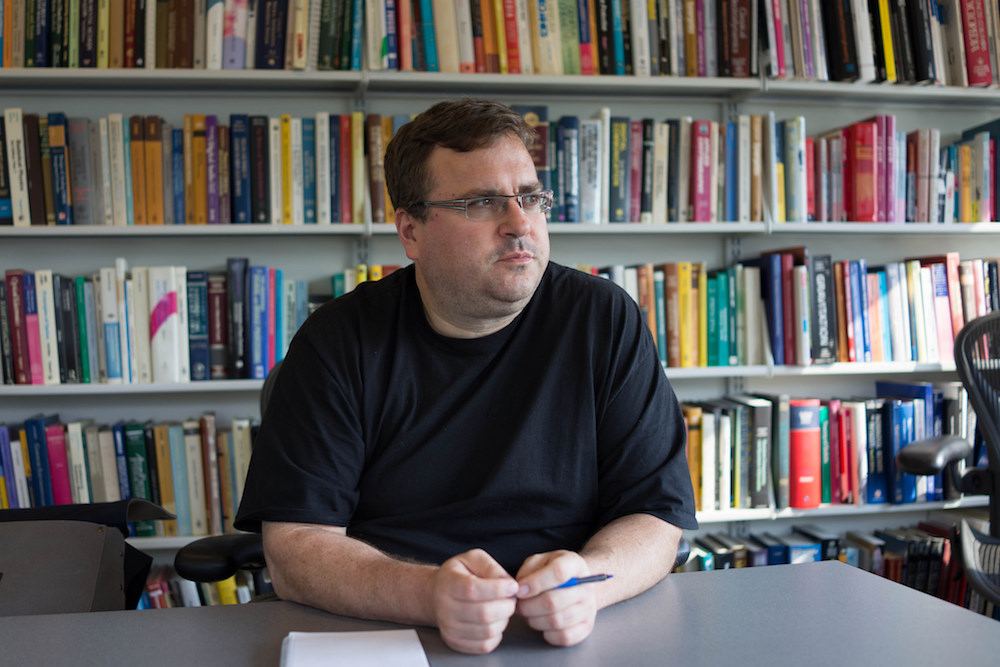
Reid Hoffman. / Photo credit: Joi Ito
The following is an edited excerpt from Blitzscaling: The Lightning-Fast Path to Building Massively Valuable Companies by Reid Hoffman and Chris Yeh. The excerpt was provided by Currency Publishing. You can buy a copy here.
When blitzscaling [growing an organization at a very fast pace], speed is more important than having a “well-run” organization.
Under normal circumstances, you should strive for organizational coherence and stability. Chaotic, unstable organizations make employees nervous and hurt morale. But when you’re scaling up at lightning speed, you may need to reorganize the company three times in a single year, or repeatedly churn through members of your management team. When your organization is growing 300 percent per year, you might have to promote people before they’re ready and then swap them out if they sink rather than swim. You don’t have time to be patient and wait for things to “work out”; you have to act quickly and decisively.
There’s always a lot of change, and much of it isn’t voluntary. You’re building teams and the company simultaneously. In the interests of speed, you might even surprise or blindside your people to cut down the time required to make and implement important decisions. Problems relating to job titles are one common symptom of this messiness. In the Family and Tribe stages, you don’t have time for a careful promotion process, and you don’t have time to sit around debating whether someone’s business card should read “head of engineering” or “senior VP of product” (nor, for that matter, do you have time to design and order business cards).
You might just keep employees’ titles the same even as they fail to reflect organizational progress and level of responsibility, or you might do things that no rational company would do, such as deliberately inflating job titles to keep people happy and counting on the ability to correct the situation “later.” Either way, you’re taking on organizational risk in exchange for being able to focus efforts wholly on growth.
Consider the example of PayPal. While PayPal was a great success, the company was badly managed – and I write that statement as one of its senior managers. We did a few good things, such as making sure that every employee had a clear primary job and staying focused when working on certain important projects, but for the most part PayPal’s management was a lack of management. There were no one-on-one career development conversations with employees. There was no work done to form teams beyond simply picking who was going to belong to them.
The few rules we had were more about individual incentives rather than team management. For example, when people were late to a meeting, the last person to arrive was fined US$100 to enforce discipline. Yet while we knew meetings were important, we didn’t designate a note taker to capture key points and action items, a common and basic practice in Silicon Valley.
But PayPal’s “bad” management provided a number of counterintuitive strengths while we were blitzscaling. During the critical times when PayPal was developing its business model innovations and scaling up, we found ourselves needing to navigate a series of make-or-break challenges, or, as I like to call them, “Oh shit!” moments. Oh shit, we have a fraud problem and we’re losing millions of dollars we don’t have. Oh shit, Visa says we have to change the product or they’ll shut us down. Oh shit, eBay, our most important business partner, just started its own venture to directly compete with us. Because of our “bad” management, we didn’t have any preconceived notions of “this is what the company must look like in three years.”
The chaotic nature of our management actually kept us nimble in the face of these serious, unexpected land mines. When everyone in the organization has roles that are undefined and in flux, it’s easier to say, “I know this is what you’ve been working on for the past four days, but now we’re doing something different.” The internal chaos had the effect of normalizing radical change for our people, which meant they were better able to adjust to the radical changes the outside world was throwing at us. We knew that we were slaloming through a minefield while other people shot at us. To paraphrase Bruce Banner/the Incredible Hulk from the movie The Avengers, the secret behind our superpower was that we were always changing.
We were also fortunate in our timing. One thing that holds teams together in the absence of management is an opportunity to win. After the dot-com bust began, a lot of tech companies were failing, but PayPal still had a chance to succeed. All you had to do was to look at the chart showing the continuing rise in daily transaction volume!
So our people put up with more than they would normally put up with because they wanted to win and liked being part of a team of high-powered, high-IQ players. Classic “good” management and planning presume a certain amount of stability that isn’t always available when you’re blitzscaling. One of the misconceptions of entrepreneurship is that you work out a plan and then execute it.
Think of the embedded metaphor in “building” a business – the very language suggests that you’re following an architectural plan. But when you’re creating and scaling an innovative business model, you often don’t have any detailed blueprints. Instead, it’s more like “I think a building over there would be a good idea. Let’s start digging!” Then once the cement is poured and the walls go up you realize, “It should be a hotel, and therefore we need to do this kind of a floor plan.” Is that “bad” management? Maybe.
Stay ahead in Asia’s tech landscape
This is premium content. Subscribe to read the full story.
If you have a fast-growing startup, that is.
We know this is not ideal. ⌛ Sign up in 20 seconds. Cancel anytime.
Our subscriber community includes professionals from these companies:





Stay updated on the go with our mobile app.
Get latest insights with smoother, more personalized experience through TIA mobile app.








📅 Upcoming Events
22 October 2026
Payoneer x CSPN Summit 2026