 C. Custer · · 4 min read
China’s Singles Day crushed Black Friday again. Here’s what etailers can learn from it.
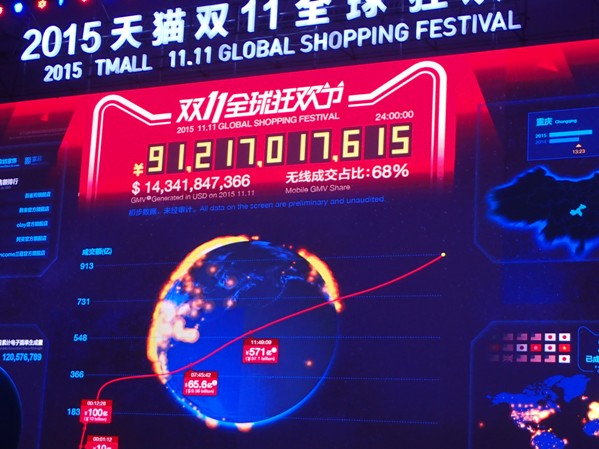
The final screen at Alibaba HQ on Singles Day
Singles Day was quite a while ago. But now that America, the original home of ecommerce, has finished its own fall holiday shopping bonanza, it’s worth taking one last look back to give some perspective on just how big China’s numbers are.
The comparison can be a little tough, because these days in the US there are three major shopping holidays that are raking in online sales: Thanksgiving (which was last Thursday), Black Friday (last Monday), and Cyber Monday (this past Monday).
Online sales for all three of those holidays were up this year, according to research reports and projections. Thanksgiving online sales hit US$1.73 billion. Black Friday sales were US$2.74 billion. Cyber Monday sales US$3.07 billion. All three days posted figures that represent double-digit growth over last year’s sales.
But even combined, they’re no match for China. Over these holiday shopping days, American ecommerce retailers raked in just US$7.54 billion, which is barely over half of the US$14.3 billion Alibaba alone raked in over Singles Day. JD.com hasn’t released revenue numbers but likely raked in at least a few billion itself, and China’s smaller ecommerce players had sales too. Clearly, China’s shopping holiday blew America’s out of the water. Why?
Why is China winning?
There are several reasons:
- More people: Americans may spend more per person, but China has more customers. In fact, Alibaba alone claims to have 386 million active buyers – that’s more Alibaba customers than the United States has people.
- Less retail competition: Singles Day is an online-only holiday, so there’s no real competition with brick-and-mortar retailers. In contrast, American ecommerce vendors do have to compete with retail shops, especially on Black Friday. Retail sales were actually down this year, but retailers still pulled in US$10.4 billion on Black Friday and another US$1.8 billion on Thanksgiving, and of course any purchase that’s being made offline is one that customers aren’t going to make online.
- Better discounts: Singles Day is famous for big savings, with some big items 50 to 75 percent off. Discounts for American online shoppers seem to have been weaker, averaging just 26 percent off on Thanksgiving (for example).
- More mobile: A whopping 68 percent of Alibaba’s Singles Day sales were mobile. JD.com says more than 70 percent of its orders were via mobile. But on the Western shopping holidays, American etailers didn’t even crack 40 percent. That makes a big difference, especially given that Thanksgiving and Black Friday are vacation days for most Americans, so shoppers aren’t likely to be spending time sitting in front of their computers.
Consequently, I think there are a few lessons everyone in the ecommerce space can learn from China’s massive sales day. Even if you don’t have 386 million active buyers to work with like Alibaba, you can borrow some pages from China’s ecommerce playbook and…
- Avoid competition with retail. In early November, Singles Day is nowhere near any traditional retail discount events in China. But Thanksgiving and Black Friday are big retail days in the US, and Cyber Monday comes just a few days later. Shoppers who already spent big at retail shops on Black Friday aren’t like to spend again so quickly on Cyber Monday, which reduces the potential buyers American ecommerce players can expect to attract. If you’re planning an online sales event, it’s probably best to follow Alibaba’s lead, and set it away from traditional shopping holidays so you don’t have to compete with retailers so directly.
- Offer good discounts. To really rake in sales, you have to get people excited. Nobody gets excited about 20 percent off. Getting your merchants (or your own accountants) to agree to offer products at discounts of 50 percent or higher may be difficult, or even painful. But the payoffs can be significant. One Western ecommerce player that has figured this out is video game company Valve, which offers games at massive discounts during a few yearly sales on its Steam platform. Some have complained that this devalues games, but developers say that their sales skyrocket thanks to the deep discounts, making the sale a valuable branding opportunity in addition to a potential revenue-driver. (Of course, the math is different if you’re selling physical rather than digital items, though).
- Go mobile. If you’re doing a 24-hour-style sales bonanza, then you really need to have a strong mobile app that gives your customers easy access to browsing and purchasing deals. Nobody wants to sit in front of a computer pressing refresh all day, but people take their phones with them everywhere, and they will check them for deals and make purchases throughout the day if your mobile shopping experience is good enough and if your customers are all familiar with the app. Chinese etailers have done a great job of getting shoppers onto their mobile apps and making purchases easy there; this year on Singles Day they reaped the benefits.





Stay updated on the go with our mobile app.
Get latest insights with smoother, more personalized experience through TIA mobile app.








📅 Upcoming Events
22 October 2026
Payoneer x CSPN Summit 2026