- Insights This article was written by a TIA community member. Insights pieces undergo the same rigorous editorial process that newsroom-produced articles have.
 Kevin Brockland · · 6 min read
Jensen Huang’s back, but the chips are still down for SEA
Two weeks ago, Jensen Huang was out at Nvidia. On November 23, the board reappointed him as CEO, and the US chipmaker’s stock was up 31% by that day’s market close.
Putting aside commentary on ethics, geopolitics, and conspiracy theories, it’s clear that the market has put a number on what a generational founder is worth.
Huang took a graphics chip business and built it into one of the most valuable companies on the planet. For 11 days, investors were forced to imagine Nvidia without him.
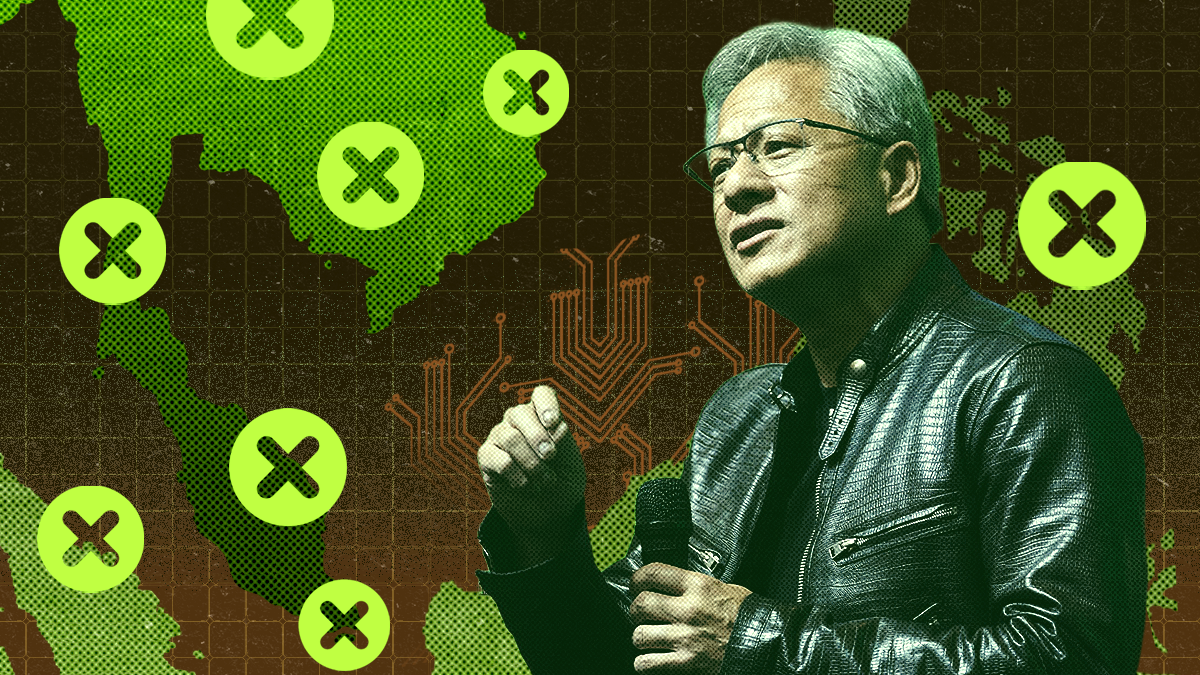
Digital collage by Ulla, photo from Shutterstock
The relief rally makes sense, but for those of us building and investing in Southeast Asia, it’s worth noting what hasn’t returned with Huang.
Nvidia plays three roles in the AI buildout. It is the inventor that makes compute better and cheaper every year as well as the supplier that decides who gets chips. The company has also become a banker, standing behind the loans that pay for data centers.
The CEO is back, so the inventor is back. But the supplier and the banker look different from a month ago, and Southeast Asia has felt the shifts.
11 days of key-person risk
Nvidia’s next two chip generations – Vera Rubin in 2027 and Feynman in 2028 – were already set, so its short-term outlook was never in doubt. What the 11-day scare exposed was what a company with no public succession plan had in store for the long term (or lack thereof).
Most AI business plans assume that inference – the process of serving and running AI models – will be much cheaper in two or three years than it is today. That assumption rests on the pace of cutting-edge chip technology, led by Nvidia.
See also: Nvidia’s crisis shines a light on Asia’s AI chip shift
Huang’s 11-day absence showed that the cost curve that the whole industry plans around depends on one person.
That is worth remembering in Southeast Asia, where founders sell to clinics, manufacturers, and SMEs that will not absorb a price increase. The cost of compute often spells the difference between healthy gross margins and none.
What didn’t return
The alleged diversion of Nvidia chips through Megaspeed, a Singapore-based cloud company, prompted the US Commerce Department to act. Megaspeed denies wrongdoing, and the allegations are being investigated.
Since November 19, advanced AI chips shipped to Malaysia, Singapore, Thailand, and Indonesia have required a US export license. Shipments to end users headquartered in the US are exempt, as long as they are reported monthly.
A guarantee that wobbled
What it means for founders in Southeast Asia
Where I could be wrong
Stay ahead in Asia’s tech landscape
This is premium content. Subscribe to read the full story.
The Nvidia chief’s return calmed markets, but US chip licenses and tighter financing leave Southeast Asia’s neoclouds and AI founders exposed.
We know this is not ideal. ⌛ Sign up in 20 seconds. Cancel anytime.
Our subscriber community includes professionals from these companies:










📅 Upcoming Events
30-31 March 2027
Upskill Fest