Steven Millward · · 3 min read
China’s Joome is a “Social Router” That Wants To Spread Free Wifi Love
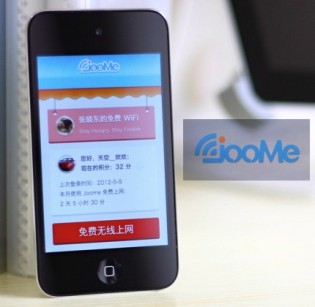
In this digital era, it’s all too easy to be selfish in public, staring down at smartphone screens, hooked up intravenously to the internet. And so the Chinese startup Joome is as much a movement as a service, aiming to create a platform for people to open up their wifi hotspots to users, for free, and for no financial return.
Joome’s co-founder is Issac Mao, the China-based venture capitalist and blogger who advocates the idea that sharing is innately human, hardwired into our neurons; he expands on this in his notion of Sharism which states that localized acts of giving and openness lead to global benefits. Isaac tells TiA that Joome is born of this philosophy and adds that, “The more you share, the more you gain.”
As for the nuts of and bolts of the startup, which is based in the Beijing satellite city of Tianjin, Isaac explains:
Joome is now at angel funding stage, backed by some private investors and co-founders. […] We won’t pay users to share [wi-fi], it’s totally a voluntary behavior. We’d like to see how it’s sustaining after several thousand alpha testers. We do pay users virtual credits for their sharing and those are redeemable in other Joome affiliated services.
He adds that business partnerships will also be built in at some stage so as to aid monetization. Joome comes after some other successful “social router” ventures around the world, such as Spain-based FON, or San Francisco’s WaveSpot. Though Joome’s not quite taking the same approach, those are some interesting paths to follow.
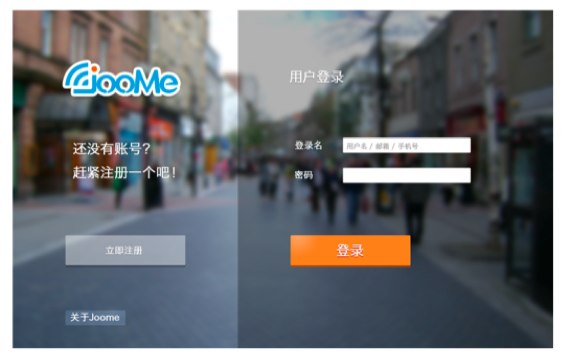
Folks who opt to join in with this wifi-sharing become “Joomers” and they’ll install some dual-channel router software so as to segregate public traffic from their own wifi data. Outside users can then use a service-wide system (like the login pages pictured below) to access, for free, the open wifi from any Joomers.
The Joome homepage is in Chinese, but has an English-language option that’s not yet rolled out. Explaining this, Isaac tells us:
The business is going to deploy its first product lines in major cities in China, including Beijing, Tianjin, Shanghai, and Guangzhou. Starting from businesses, we will also include homes and communities in the next step. The English [site] is for seeking open solution partners in other regions.
Aside from saving you your limited 3G data, another benefit of such wifi networks is that your smartphone becomes less of a social drain, and more of a social tool. If you’ve just snapped a photo that your friend – or, perhaps, a total stranger – would like to have, then that sharing is now easier – after some friendly human interaction – with the aid of an app like Bump so as to beam that image via your shared wifi network.





Stay updated on the go with our mobile app.
Get latest insights with smoother, more personalized experience through TIA mobile app.