- Premium Content It takes our newsroom weeks - if not months - to investigate and produce stories for our premium content. You can’t find them anywhere else.
 Gabriel Budi Sutrisno · · 6 min read
How this ride-hailing firm holds its ground against Grab, Gojek in Indonesia
Half a decade in, a ride-hailing company still stands resiliently in the face of Grab and Gojek’s dominance in Indonesia.
Its distinct yellow-jacketed riders continue to traverse the streets, creating a striking contrast with the ubiquitous green of its competitors across the archipelago.
Maxim, originally hailing from Russia, entered the Indonesian market in 2018. Since then, it has established a presence in over 200 cities throughout the country, having offices in most of them.
In addition to its transportation services, Maxim also offers cargo and food deliveries.
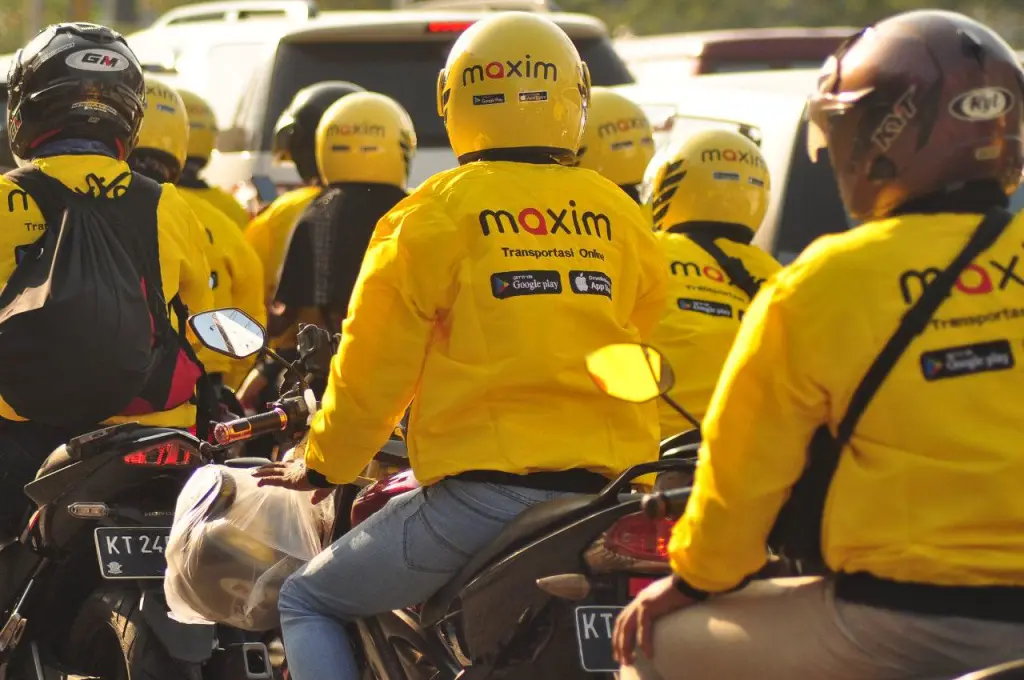
Photo credit: Maxim
According to Data.ai, Maxim’s active user base in Indonesia stood at over 12 million as of August this year. That’s notably lower than Grab’s 43 million users in the country and Gojek’s 66 million.
However, Maxim is confident that it has a unique angle to distinguish it from its competitors.
“We want to show that ride-hailing and delivery are not a luxury or a privilege,” says its spokesperson, Yuan Ifdal Khoir.
With that goal in mind, Maxim’s strategy revolves around providing more affordable services to cater to all segments of the Indonesian population.
Lower cost, but is it sustainable?
For 31-year-old Nugraha, a private sector employee in the city of Semarang, it used to cost him around 24,000 rupiah (US$1.6) to travel approximately eight kilometers from his home to his workplace using Gojek or Grab. In contrast, Maxim offers the same service for only 14,000 rupiah (US$0.9).
Nugraha considers the price difference to be quite significant. “It feels expensive in the moments when [Gojek or Grab] doesn’t provide any promotions,” he remarks.
Maxim, Gojek, and Grab adhere to a set of rules established by the Ministry of Transportation in 2019 that regulate price ranges and minimum tariffs depending on the region. The rules were later updated in August 2022.
Initially, Maxim focused on providing affordable transportation services to students, factory workers, and minimum-wage earners. According to Khoir, it also helped reduce the number of road accidents as many students were using vehicles without proper licenses.
The firm eventually expanded its reach to target all segments of the population.
Smaller commission rates
Diversification, market opportunities
Stay ahead in Asia’s tech landscape
This is premium content. Subscribe to read the full story.
Since entering the market in 2018, Maxim has expanded to over 200 cities across Indonesia.
We know this is not ideal. ⌛ Sign up in 20 seconds. Cancel anytime.
Our subscriber community includes professionals from these companies:





Stay updated on the go with our mobile app.
Get latest insights with smoother, more personalized experience through TIA mobile app.