 Terence Lee · · 4 min read
An ultimate wishlist to elevate Singapore’s startups, created after months of debate

Six months is a long time in the rapidly evolving world of tech startups, but policy-making is a different art. That was exactly how long it took for Singapore’s Entrepreneurship Review Committee (EnRC), a group consisting mostly of entrepreneurs and investors, to come up with a list of ways to improve Singapore’s status as a startup hub.
Announced this week at a press conference, the set of recommendations – a wishlist, really – was created over much deliberation. Since last July, the committee sought feedback from over 100 members of the startup scene through a series of meetups. The ideas and concerns were then sorted out, debated over, and distilled into a list of recommendations.
From here on, whether or not these ideas will be realized – and how quickly – depends on their ability to traverse the multi-layered bureaucracy of the Singapore government.
Some suggestions may fall by the wayside amidst the chaos of differing priorities, while others may be easier to implement because they involve fewer decision makers or don’t contradict the government’s existing policies.
Minister-of-State Teo Ser Luck, chairman of the Action Community for Entrepreneurship (ACE), the organization behind EnRC, says that the tech sector has been growing. It had 39,000 employing startups with 293,000 workers in 2012, up from 24,000 supported by 167,000 employees in 2005.
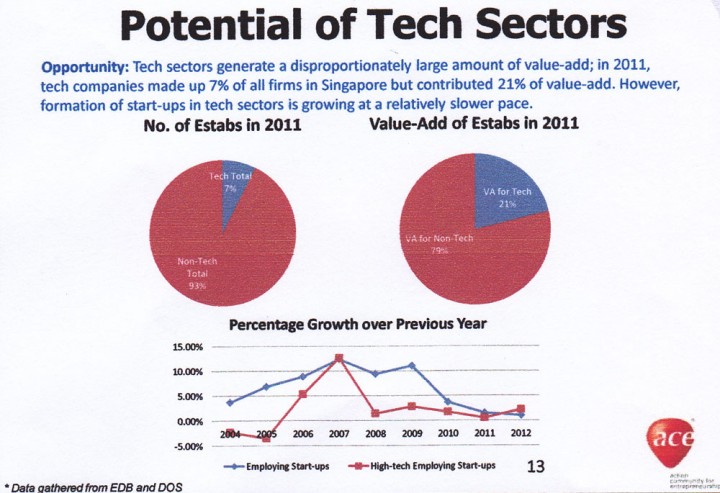
Yet the growth of this sector has still been slower than desired. The committee revealed that while tech startups – defined by the government as encompassing new companies in the infocomm technology, electronics, biomedical sciences, and engineering sectors – have contributed a disproportionately large amount of value to the economy, its growth has been slow from 2008 to 2011 compared to other types new companies.
Giok Lak Sim, founder of machine manufacturer company Zicom Group, attributes this to the global financial crisis in 2008, which burnt through many venture capital funds and led money to flow towards ostensibly safer industries. While the subsequent Eurozone crisis had also lowered risk appetites, Sim believes we’re due for an upturn.
“I personally believe it will improve… we feel that Singapore now is pretty vibrant,” he says.
With that in mind, here’s the list of recommendations that could further fuel the growth of Singapore’s tech startups:
1. Let private sector partners play a greater role in developing the entrepreneurial community
Minister Teo says that he is exploring how the government can reduce its outsized involvement in backing startups through ACE. He wants the private sector to take the helm while the state takes a backseat.





Stay updated on the go with our mobile app.
Get latest insights with smoother, more personalized experience through TIA mobile app.











📅 Upcoming Events
22 October 2026
Payoneer x CSPN Summit 2026