 C. Custer · · 2 min read
In Beijing, You’ll Be Able to Send Text Messages to Find the Toilet (Someday)
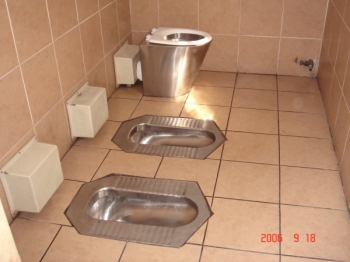
Use text messages to find this!
Public toilets seem few and far between in some areas of China’s capital, which can be a real problem, especially for areas that get heavy tourist traffic.But the government is aware of this, and by 2015 there’s a plan in place to have more public toilets — one every 300 to 500 meter radius across most of the city. And what’s more, in heavy-traffic areas, you’ll be able to text an automated system for directions.
A city spokesman told the media that the government planned to create an “electronic toilet map” and cooperate with telecom operators like China Unicom to create an automated guidance system that would serve heavily populated areas like tourist attractions and the CBD. Once that system is up and running, people in those areas who are feeling a bit “desperate” will be able to text a number to get directions to the nearest public bathroom.
Beijingers will also be happy to know that over the next five years, public toilets will be getting an upgrade. The eventual plan is for all of them to eventually feature flush-toilets, 24-hour service, free toilet paper and soap, and — thank god for this — an “anti-stench” device of some kind.
Anyway, the text messaging system sounds cool and all, but we can’t help but wonder if it’s going to be particularly relevant by 2015. True, SMS is hugely popular in China and 3G and other data services have been slow to catch on because of the related fees, but it’s hard to imagine that in another four or five years, most people won’t have phones that — at a bare minimum — can provide maps of China’s major cities and GPS location. That being the case, wouldn’t it make more sense for the government just to give the addresses of these public toilets to Google, Baidu, and other companies that run online map services?
We’re also not clear on exactly how this text messaging system will work. If it’s providing the location of the closest toilet, then presumably it has some geographic information about the phone’s location, but will the response be actual directions to the nearest toilet, or just a street address? A street address wouldn’t necessarily be too helpful for tourists unfamiliar with the city’s street names and layout.
Anyway, more toilets, mobile phone integration, this has to be a good thing, right? We’re sure Beijing’s more desperate denizens are looking forward to this convenient service. Don’t worry guys, just hold it for the next four years and you’ll be home free!





Stay updated on the go with our mobile app.
Get latest insights with smoother, more personalized experience through TIA mobile app.







📅 Upcoming Events
22 October 2026
Payoneer x CSPN Summit 2026