J.T. Quigley · · 3 min read
WOVN.io isn’t a translation service, it’s a multilingual localization service packed into one line of code
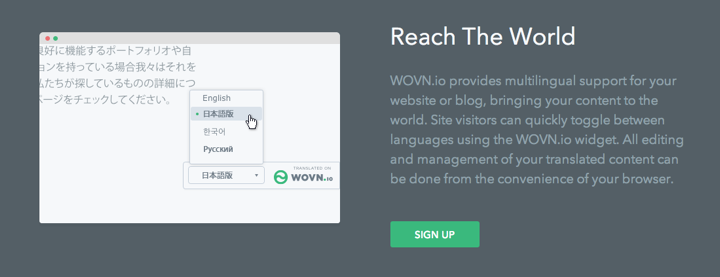
Ever tried using a website in a foreign language? Sure, you can click a button and let Google Translate give it a go, but don’t expect a perfect result. Tokyo-based startup Minimal Technologies wants to open up the internet with its WOVN.io widget – hidden in a single line of code in a website’s HTML header. Just don’t call it a translation service.
“A lot of people confuse our service with a simple translation service – we’re not, “ says co-founder Jeff Sandford. “We’re a multilingual localization service. There are a lot of translation services out there, but no one we know of offers a one-line option that’s as simple and straightforward.”
WOVN.io launched its public beta in June and has attracted more than 1,000 users since then – mostly websites that deal with food and beverage, tourism, and entertainment. The service allows visitors to translate a website one HTML tag at a time, offering both machine translation and “premium” human translation (courtesy of crowdsourced translation platform Gengo, a fellow Tokyo startup). New pages are auto-translated as they’re added and a subscription plan (to be implemented by the end of October) allows the site owner to customize the WOVN widget.
WOVN supports the top ten languages on the web based on percentage of total internet users (in order): English, Chinese, Spanish, Japanese, Portuguese, German, Arabic, French, Russian, and Korean. Perhaps the biggest difference between just clicking “Translate” at the top of your Chrome browser and using WOVN is customizability.
“For the end user, using Google Translate, you might be able to understand what it returns but it won’t be very good. As for the person managing the site, sure, you can use machine translation, but with WOVN you can edit what comes back right on-screen. It gives them control over what the visitors are seeing.”

Unlocking the web
At present, Minimal Technologies is a two-man team. Co-founder Hayashi Takaharu was inspired to create WOVN after using A/B testing platform Optimizely and realizing how locked down the web is without multi-lingual support.
Even if you speak English and Chinese, the two most common languages on the web, you’re only communicating with roughly half of the internet. There’s a huge market here, and a huge opportunity for developers. You can take your website, add WOVN, and have this huge new audience you never had before.
The duo raised approximately 31 million yen (US$280,000) across two rounds of seed funding from Incubate Fund in May and August. Sandford says the capital will be used to hire two developers, a marketing head, and an intern.
“Our short-term goal is to expand our audience and user-base globally, then implement features that users want the most,” he adds. “It might sound lofty, but our long-term goal is to translate the web – we want to see as many sites as possible using multilingual localization services.”
See: Japanese telco Docomo to tackle machine translation with new joint venture





Stay updated on the go with our mobile app.
Get latest insights with smoother, more personalized experience through TIA mobile app.