A startup is combining 3D scanning and weaving technology to make the perfect pair of jeans, as consumers’ preferences shift from big-name brands to tech-inspired and sustainable fashion.
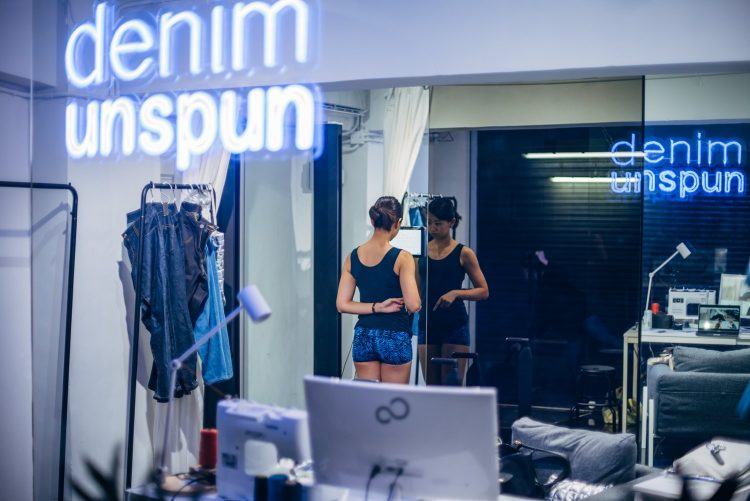
Unspun pop-up store. / Photo credit: Unspun
San Francisco-based Unspun, which joined Hong Kong’s The Mills Fabrica “techstyle” incubator in February, touts itself as a zero-inventory store; jeans are only made when an order is placed. The incubator says techstyle covers material and supply chain innovation, wearables merging technology and style, and new retail experiences.
The two-year-old robotics and apparel company, which counts the National Science Foundation, H&M Foundation, venture capital investor SOSV, and the Mills among its early backers, aims to become a zero-waste operation. It is developing a 3D weaving machine that would completely eliminate fabric waste, with plans to deploy it in stores as early as the end of this year.
“The best way to think about it is like a 3D printer for clothes,” said Walden Lam, one of Unspun’s three co-founders. “But when people think of 3D printed clothing, they think its plastic-y, not something people would want to wear. What we are actually doing is using yarn that goes into everyday clothing and manipulating it into the final product.”
With 3D weaving, Unspun will no longer have any cut waste, the discarded fabric from traditional apparel making techniques. For now, Unspun uses their cut waste to create reusable packaging for their jeans.
“The packaging also happens to be able to fit a 13-inch laptop, even though we did not intentionally make it that way,” Lam said.
Unspun is currently in talks to close a seed funding round, but declined to disclose further information on the deal or their valuation.
According to Statista, the size of the global denim market was US$60.4 billion in 2017 and is forecast to grow to US$87.6 billion by 2023.
A report from market intelligence firm ResearchAndMarkets.com last month showed that the growing popularity of online sales is enabling vendors to provide customised denim products tailored to each customer’s size and colour requirements.
Unspun joins a host of luxury labels, making everything from jewelry to glasses frames that employ 3D body scanning techniques to boost sales.
According to consultants at Deloitte, mass personalisation is being made possible with advances in 3D printing technology.
A recent report in Wired magazine, quoting a Deloitte survey in the UK, said that 15% of respondents were willing to pay 40% more than the regular retail price for a personalised fashion item.
Unspun is banking on the trend catching on. It has partnered with a body scan company called Fit3D to set up more than 1,000 infrared scanners worldwide where customers can get a 20-second body scan that allows for customised fittings, stitching, and styling.





Stay updated on the go with our mobile app.
Get latest insights with smoother, more personalized experience through TIA mobile app.











📅 Upcoming Events
22 October 2026
Payoneer x CSPN Summit 2026