- Premium Content It takes our newsroom weeks - if not months - to investigate and produce stories for our premium content. You can’t find them anywhere else.
 Katrina Balmaceda Uy · · 6 min read
A ‘gym membership for the mind’ serves up a new way to learn
If you’ve ever taken a massive open online course (MOOC), chances are you didn’t finish it – just like the majority of MOOC participants. These courses have a notoriously low completion rate, averaging 6 percent for HarvardX and 6.8 percent for Coursera.
Will Fan, co-founder and CEO of NewCampus, believes one major reason for the ineffectiveness of online learning is the lack of a physical community of learners. In February 2019, he and his co-founder Fei Yao launched their co-learning service in Singapore to fill this void.
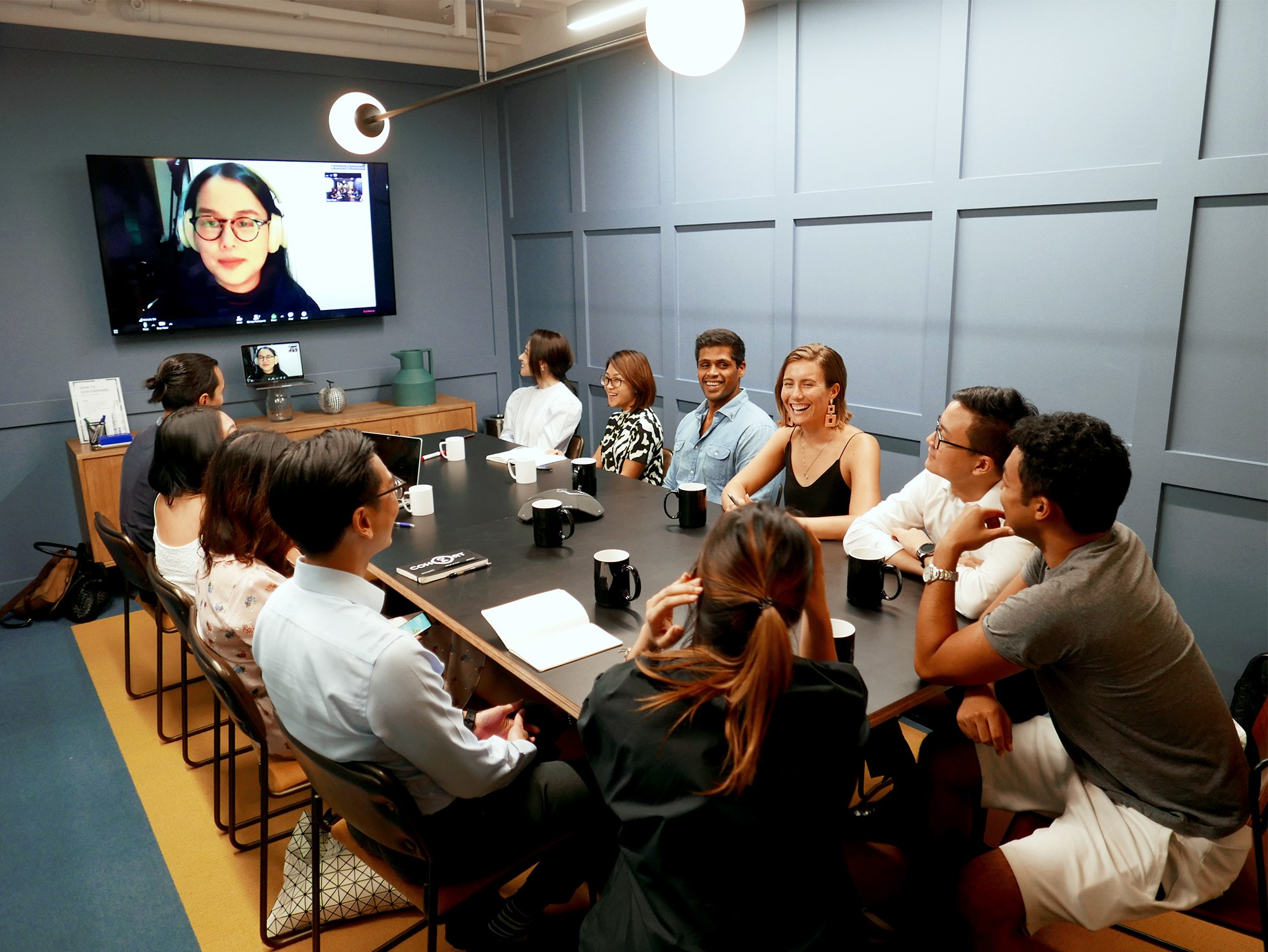
Class is in session / Photo credit: NewCampus
The co-learning concept gathers learners in one room to attend a class or workshop that’s delivered virtually. It’s an online-to-offline, membership-based communal learning program currently offered by only a handful of providers around the world, says Fan. He notes that Israel-based Jolt and a few companies in the US offer the same model.
While multiple pivots often doom a startup, NewCampus has persisted.
In 2014, Fan and Yao left their jobs as consultants at Accenture to focus on building Couchelo, an online furniture marketplace.
They were accepted into the JFDI Asia startup accelerator, where they quickly discovered that the market for vintage furniture in Asia was quite small. They also found that they didn’t really care about selling furniture.
They then shifted gears to start QLC, a service that gives professionals and students the chance to work on projects with startups before committing to a career path in a certain field or role. It aimed to help millennials deal with quarter-life crisis (hence the name QLC) by letting them try out a career change.
Launched in November 2014, the platform operated like a marketplace that bridged startups with working professionals or students through their universities, which paid for QLC programs. For example, through QLC, students at the University of New South Wales could join JFDI Asia’s Entrepreneur in Residence program.
Many of the projects, which QLC also positioned as hands-on learning experiences, could be done remotely. The company ran online courses, too.
All this time, the concept of “running QLC [in relation to the] idea of a community” had been at the back of our minds,” wrote Michelle Shi, NewCampus’ chief creative officer. They just hadn’t been able to integrate the community aspect into their business model.
That changed in early 2018. “Our biggest break was [when] we were invited by the crown prince of Dubai to launch our business into the Middle East. They were trying to solve a challenge, which was, ‘How can you help people have a job that doesn’t exist yet?’” says Fan, referring to work that could soon be replaced by AI.
QLC joined Dubai Future Accelerators, which was launched in 2016 by the crown prince. “QLC started a meetup group, Quarter Life Campus, which put us into contact with a global community of entrepreneurs, teachers, and curious minds who wanted to learn from each other,” wrote Shi.
The accelerator was held at Emirates Towers, which had a new co-working space that was underused at the time. This paved the way for QLC to run classes and workshops in person while building out its online presence. “We realized it was this in-person interaction that kept people coming back,” says Fan.
Stay ahead in Asia’s tech landscape
This is premium content. Subscribe to read the full story.
NewCampus is an online-to-offline, membership-based communal learning program.
We know this is not ideal. ⌛ Sign up in 20 seconds. Cancel anytime.
Our subscriber community includes professionals from these companies:





Stay updated on the go with our mobile app.
Get latest insights with smoother, more personalized experience through TIA mobile app.









📅 Upcoming Events
22 October 2026
Payoneer x CSPN Summit 2026