 Jack Ellis · · 3 min read
Grab launches hawker center cashless payments as part of big play beyond transport

GrabPay managing director Jason Thompson (L), Nornizam Bin Amin of Rayyan’s Waroeng Penyet (M),
and Grab co-founder Tan Hooi Ling at the launch of GrabPay QR code payments in Telok Ayer Street. Photo credit: Grab.
Ride-hailing firm Grab officially launched its in-store cashless payments solution today, marking its biggest move yet outside of the transportation segment.
Grab said it’s aiming to make its GrabPay cashless payments platform available to 20,000 cash-based merchants operating in Singapore.
Initially, it has signed up around 25 hawker stalls and restaurants in the city’s central business district and the largely residential area of Bishan. It said it will onboard “hundreds” more hawkers and small consumer-facing businesses over the next few weeks in the city-center areas of Telok Ayer, Tanjong Pagar, and Tiong Bahru.
Grab’s goal is to have 1,000 merchants using GrabPay by the end of the year. It also said it plans to introduce the platform elsewhere in Southeast Asia during 2018.
Merchants will not have to pay any transaction fees for their first six months using GrabPay. It is not yet clear what the cost will be after this period, but a Grab spokesperson told Tech in Asia that pricing “will be evaluated in six months” and will be “low-cost”.
For consumers, there will be no need for any additional downloads, as payments can be made through the existing GrabPay app. Users will also be able to earn GrabRewards loyalty points through their use of the ewallet.
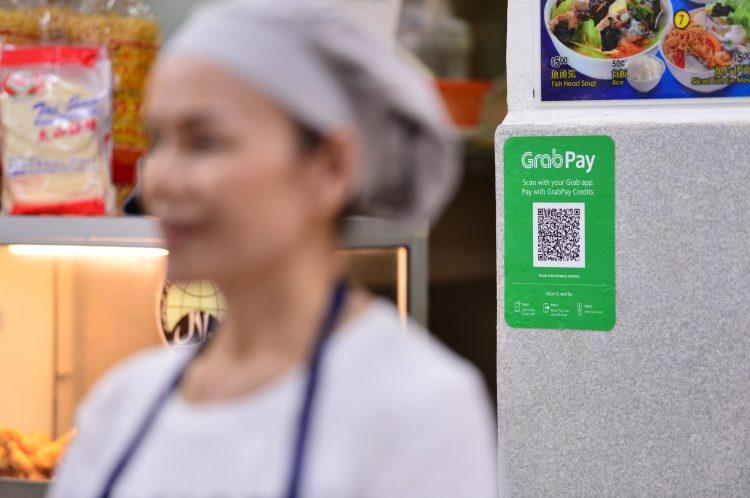
Photo credit: Grab.
Diversification
The company first revealed to take QR code payments to hawker centers back in August, when it launched a peer-to-peer transfer feature allowing GrabPay users to move credits between each other’s accounts.
This followed the introduction of a six-digit personal identification number (PIN) system aimed at providing heightened security for GrabPay Wallet users.
However, today’s announcement marks its first large-scale play outside of any transportation-related context.
GrabPay [is] designed to be scalable and flexible to work with other QR-code-based mobile payments systems.
It comes at a time when several rival service providers in Singapore are vying to implement a unified cashless payments system for the country. Gaming peripherals maker Razer published its proposal in September. Nets piloted QR code payments at Tanjong Pagar hawker center at around the same time, with a goal of rolling out its new NetsPay platform in 30 more food centers by the end of this year.





Stay updated on the go with our mobile app.
Get latest insights with smoother, more personalized experience through TIA mobile app.











📅 Upcoming Events
22 October 2026
Payoneer x CSPN Summit 2026