 Osman Husain · · 3 min read
Tremor tracking wearable helps people with Parkinson’s disease
Tremors, a neurological condition that causes unintentional trembling and shaking movements in your body, affects approximately 200 million people globally. While the disease is not life-threatening, it can inhibit everyday behavior and cause embarrassment for patients. The condition may also be caused by an onset of Parkinson’s disease, multiple sclerosis, or the after effects of a stroke.
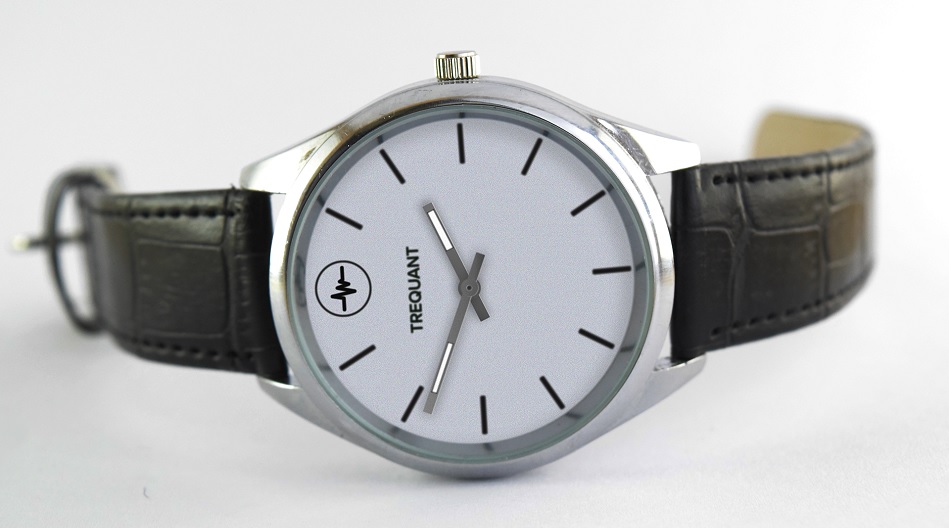
Tackling this issue is Trequant, a nifty wearable with pleasant aesthetics that has been in development for two years.The device tracks and analyzes tremor patterns to make it easier for patients to communicate critical information to their doctor, save data on the cloud, and get notifications when it’s time to take medication.
Trequant’s Kickstarter launched yesterday and comes with a super early bird price of US$99. It looks like a watch for everyday use, shipping with a leather wristband and an analog dial, but is powered by a lithium battery and syncs with smartphones via bluetooth.
There’s also an option of buying a cheaper band, which looks somewhat like a Fitbit, but essentially performs the same functions as the watch. It’s available for US$79.
Solving problems
Trequant’s mobile and desktop app track the wearable’s accelerometer and gyroscope to give a snapshot of how intense the tremors were over a specific period of time. Users can then bifurcate the data to understand the effect of their daily activities on the neurological condition.
For example, if symptoms increased during a time when they were smoking, drinking, or eating a specific food, then users understand that they need to avoid that activity.
Fawad Bhatti, CEO of Trequant, tells Tech in Asia that he belongs to a family with a history of tremor patients – both his uncles and his grandfather suffered from the disease. Therefore he has firsthand experience of how difficult it was to communicate progress to one’s doctor.
“Every time we visited the doctor, we could never properly explain to him what he wanted. There was always a gap as doctors wanted specific information and we could only give vague feedback. If the shaking had gone up, how much worse was it than the previous visit?” he outlines.
Fawad, an electrical engineer by training, says he was urged to build the product by his brother, who’s a movement disorder expert in the US. Work on the device started in June 2014, initially just as a research project while Fawad finished his undergraduate degree. A working prototype was engineered three months later.
Trequant’s been accelerated at Blackbox and was included in our list of startups from Pakistan to look out for in 2016. Fawad says he’s now in the final stages of moving his team to Palo Alto, where he hopes to connect with healthtech experts and be in a better position to address the problem.
The team’s also trying to integrate a community aspect with the product. Patients using the device are added to the ‘Trequant Circle’, where they can connect with one another, discuss unique symptoms, and help each other deal with the disease.
Editing by Nadine Freischlad and Meghna Rao





Stay updated on the go with our mobile app.
Get latest insights with smoother, more personalized experience through TIA mobile app.










📅 Upcoming Events
22 October 2026
Payoneer x CSPN Summit 2026