 Michael Tegos · · 3 min read
Google: games are moving to mobile, and so must your business
Sergio Salvador made his point early in the keynote he delivered at Tech in Asia Singapore 2015 with a stock photo of a family watching TV. The ideal-looking party of four is sitting on the couch, remote confidently wielded by the father figure, enjoying the entertainment on offer.
But that is just not true anymore, Salvador says. He quickly switches to a different stock image: here, the family looks no less beautiful (or staged), but it is spread out in the living room. The parents are watching TV while the kids are glued to their laptop, smartphone, or tablet screen. Basically, mobile is creeping in everywhere.
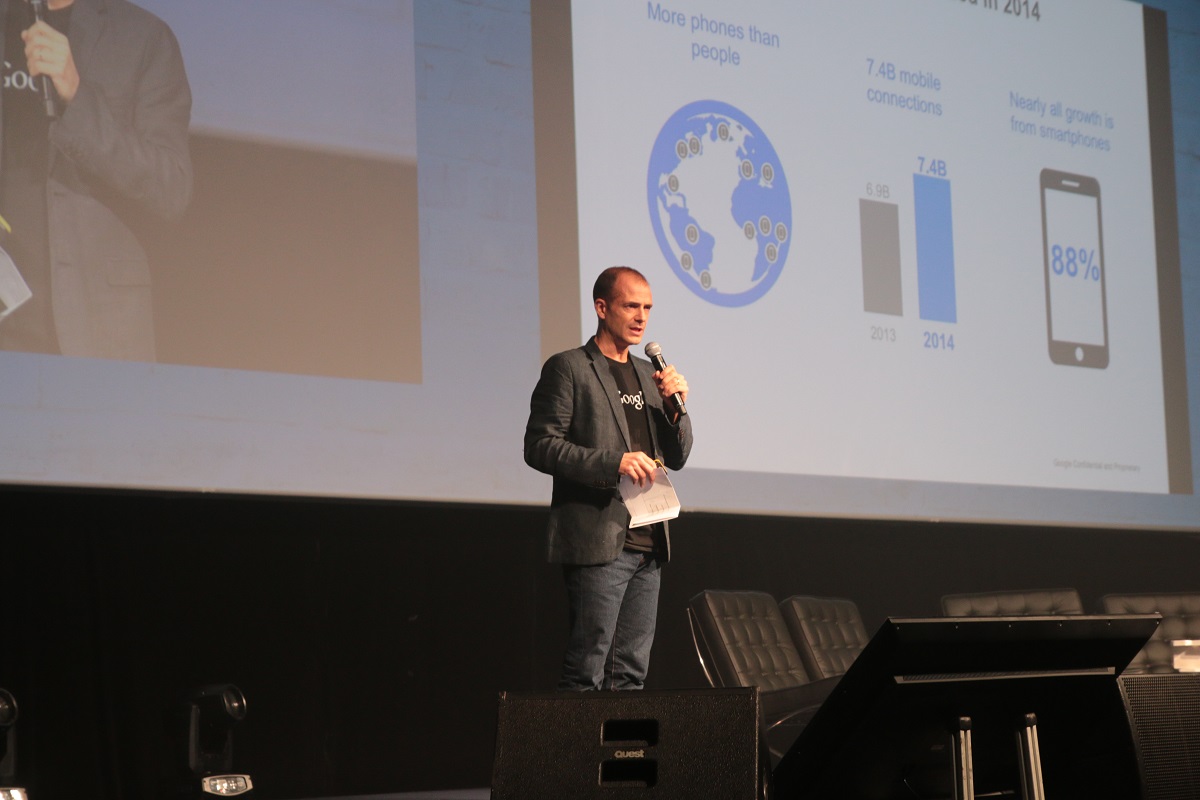
Now serving as Google’s global head of games partnerships, Salvador spent ten years at monolithic games publisher EA and has also had business development stints at Nokia and Yahoo. And he has seen mobile growth jump to the point that, as of last year, mobile devices outnumber people. Mobile connections worldwide have jumped to 7.4 billion in 2014 from 6.9 billion in 2013, and 88 percent of mobile connection growth now comes from smartphones.
Most of that growth can be traced to Asia, according to Salvador. Based on Google’s data, smartphones outnumber PCs in places like Singapore, Malaysia, South Korea, and China. And not just that: “Asia is becoming the world’s first mobile-only region,” Salvador says. Myanmar is a pretty vivid example of that, as 49 percent of people accessing the internet there do so through mobile devices. “[Myanmar] is becoming a hotbed for mobile innovation,” Salvador claims, and adds that will become more obvious within the next five to 10 years.
Learning from games
So where do games come in? As mobile games are on the rise, gamers drive mobile device usage, according to Salvador. “Gamers spend more time using smartphone and tablet apps than non-gamers,” he says. And as expected, users in Asia use a lot more apps than their Western counterparts.
More than 80 percent of smartphone owners in China and Korea use their smartphones to watch video, and more than 65 percent in China and Thailand play games on them. And a lot of those users would gladly give up things like chocolate, alcohol, or use of their car if they had to choose between those things and a mobile internet connection (very few of them would give up showering, fortunately for the rest of us)!
Salvador had four major messages to impart through his keynote. First, there is money to be made in apps, but in most categories these days, there’s room for only one really good product. So when launching an app, you have to think long and hard about how to turn it into a thriving business, and Google can provide a lot of services and advice in this area.
Second, Asia matters as a market. “More smartphones will be sold in India than the US this year,” Salvador says. So Asia is a good place to start a business.
Third, the proliferation of mobile devices means that more AAA game licenses are coming into this space. “This drives users, and also increases users that expect quality [in mobile game releases] rather than quantity,” he explains.
And finally, ignore social media at your peril, as it is a key tool for engaging users.
Pretty soon, we will be redefining what we consider mobile devices as well. A smartphone is also a gaming console, as Salvador points out, but now there are devices like smartwatches and other wearables coming. Most of them will be able to run games in one form or another. And of course, next year’s CES is probably going to be inundated with virtual reality devices, bringing VR into the mainstream. “Mobile gaming is a challenging industry, but holds great rewards for anyone who can figure out how to turn their idea into a business,” Salvador concluded.
This is part of the coverage of Tech in Asia Singapore 2015, our event running on May 6 and 7.
Stay updated on the go with our mobile app.
Get latest insights with smoother, more personalized experience through TIA mobile app.
Recommended reads
 Nykaa’s financial health in 5 charts
 AI blunder costs Google $100b
 Coinbase to halt operations in Japan amid crypto slump
 Netflix adds 1.8m Asia-Pacific subscribers in latest quarter
 Sea says it will add over 2,000 jobs in Malaysia
 GoTo accelerates profitability goal by 1 year
 Apple in talks with Baidu on AI partnership: report
 Foxconn to create 25,000 jobs with $500m investment in India
 ByteDance’s Slack-like offering to focus on overseas markets (Updated)
 Alibaba bumps up revenue by 7%, sees 13% increase in operating profits in Q4





Editing by J.T. Quigley and Daniel Tay
(And yes, we’re serious about ethics and transparency. More information here.)







📅 Upcoming Events
22 October 2026
Payoneer x CSPN Summit 2026