C. Custer · · 5 min read
How the deadly SARS epidemic gave rise to a portable air cleaner for germophobes
“I think the defining moment that made an impact on my life was the 2003 SARS outbreak,” Dr. Herman Tsui told me. “It was a chaotic time […] Hong Kong grinded to a halt, no one wanted to go out, shops didn’t want to open, and there was always someone getting in touch with you to make sure you were still alive.”
“I really felt a sense of helplessness at that time,” he said.
In the aftermath of the epidemic, which killed 774 people including 349 in China and another 249 in Hong Kong, Tsui said he was left grappling with some big questions. Why did this happen? Why hadn’t anyone been prepared? But most importantly, he wondered what he could do to protect himself and his family in the future.
“Being a man who likes to find answers, I was surprised to discover that there wasn’t any real solution,” he said. “It was at that moment that inspired me to make my own.”
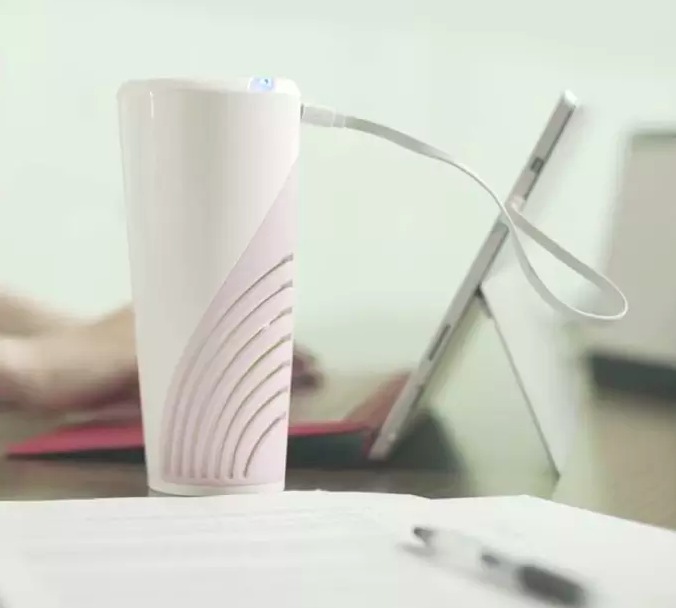
More than a decade later, Tsui’s quest is finally bearing fruit. His company A-OneTech recently launched a Kickstarter campaign for the Air Halo, a portable air cleaner that Tsui invented. How it works is actually pretty cool – the device creates “micro-lightning” to ionize the air into a plasma gas field, killing any biological agent that passes through it – but you don’t need to understand the science behind its patented “Plascide” technology. You just need to know it kills any germs floating in the air and then pumps that clean air up towards your face.
The Air Halo isn’t a mask, obviously, and it’s not going to clean every germ from the air around you when you’re walking outside. But Tsui said that it works kind of like an air conditioner, pushing the clean air toward your face and displacing infected air in the process so that even when you’re walking around outside, the air that you’re actually breathing is clean. Tsui said that the device can create a clean air bubble of around one cubic meter around your head, as long as it is positioned properly.
That means you can breathe easy if you’re worried about germs, but it doesn’t mean you’re breathing totally clean air. The Plascide air cleansing technique obliterates germs, but it doesn’t do anything to filter out particulate matter, so it won’t help at all with air pollution. If you were hoping for a way to deal with smog, you’ll have to look elsewhere. The Air Halo was designed entirely as a protection against the spread of infectious diseases like SARS.
Healthier air
Tsui didn’t start out aiming to build a handheld air cleaner. In fact, his Plascide technology was originally designed for building-scale air filters, and those filters are already in place in buildings across the world. “To be honest,” Tsui said, “the idea of Air Halo never really materialized until one day I was talking to a friend about my technology being used in some important buildings.” The friend said it was a shame the technology couldn’t be used everywhere he went, like on the train. “That got me thinking, can we make it handheld?” said Tsui. “And here we are with the Air Halo.”
Tsui has hopes for the device and the technology beyond the handheld market, though. He said the Air Halo shares many components with its building-based retrofit products, so producing the Air Halo at en masse will make that technology even more affordable thanks to economies of scale. He hopes it will also pave the way for more consumer-facing products, like a wall-mounted room-scale air cleaner.
Now more than ever, Tsui said, people need this technology. As the world gets more closely connected and air and train travel becomes more and more frequent, “Airborne germs which would normally be insignificant or isolated in remote areas can suddenly be exposed to new people and location, causing them to change and literally explode across cities and even jump continents.” And although it would be nice if we could simply adjust our work and travel habits, that simply isn’t realistic. So, Tsui said, “we should adapt technology and let people take hold of a healthier life within their own hands, wherever they go.”
Silly or serious?





Stay updated on the go with our mobile app.
Get latest insights with smoother, more personalized experience through TIA mobile app.