 Stefanie Yeo · · 5 min read
The path to growth for small businesses in the new normal

While companies around the world have been affected by the Covid-19 pandemic, small businesses have been hit particularly hard. And things have been especially challenging in Asia, where small and medium-sized businesses (SMBs) account for 90% of enterprises in the region.
Although governments have rolled out various fiscal and monetary stimulus packages to help SMBs navigate this tough period, businesses will need to adapt to the demands of the new normal in order to weather the storm and emerge stronger from the crisis.
Scrambling to adapt
“Covid-19 has exacerbated many of the challenges faced by smaller enterprises,” says Chris Yio, regional vice president of SMB in Asia for Salesforce.
These companies often have much smaller customer bases than big corporations and don’t have as much cash in the bank. They’re also not the most tech-savvy – a report by Ernst & Young in 2019 revealed that 54.9% of SMBs surveyed in Southeast Asia were only in the early stages of digital innovation.
As a result, when cities went into lockdown earlier this year, working practices at these firms were disrupted significantly, leaving many scrambling to adapt the way they operated.
Companies that were reliant on physical interactions with customers rushed to adopt digital solutions in order to stay afloat, and smaller businesses lagged in productivity, as they didn’t have the infrastructure in place to support work–from-home setups.
Revenues were also affected: Lockdowns led to a decrease in demand for various services, and 61% of SMBs in East Asia and the Pacific reportedly saw a significant decline in earnings as a result.
With that, cash, or the lack thereof, has become a major concern for SMBs, with 40% of smaller enterprises citing cash flow constraints as a challenge they have to grapple with.
All these issues have led to layoffs, pay cuts, and even business closures. In Singapore, for instance, about 3,800 businesses have ceased operations since April this year.
And for surviving businesses, the road ahead will not be an easy one either.
Although economies are beginning to reopen, social distancing guidelines and fears over new waves of infections mean that SMBs are confronting a “new normal” that’s bringing on a shift in customer demands.
Not only do these consumers now prefer to buy online and spend less time out and about, some are also tightening their purse strings because of the ongoing economic uncertainty.
The digital imperative
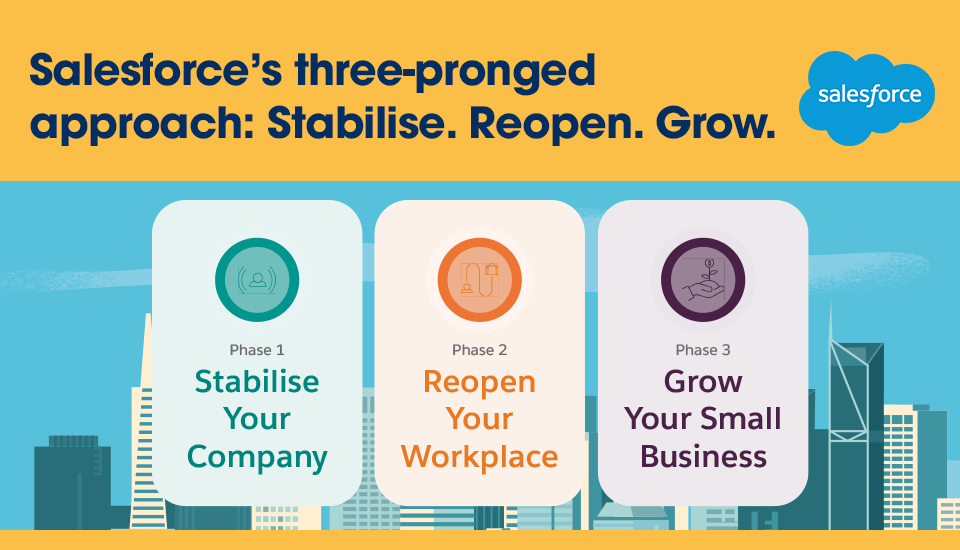
Photo credit: Salesforce
According to Yio, Salesforce recommends tackling these challenges through a three-step process: stabilizing, reopening, and focusing on growth.
The first step is to stabilize the business by putting processes in place to address customer needs effectively in the new normal. This might mean reaching out proactively to top customers or setting up virtual contact centers and self-service portals to offer services at scale.
“Customer engagement through digital channels has become more important than ever,” says Yio.
Leaders will need to ensure that any changes come from the top and that they lead by example, setting clear directions to the team and guiding this shift to digital.
Outbound engagements are another way companies can build stability into their businesses. While customers might not be willing to buy their products now, it’s important for SMBs to connect with and reach out to their audience to assure them that the company will be available when they’re ready to make a purchase.
By using digital tools such as customer relationship management (CRM) platforms, SMBs can adapt the way they engage with customers at every stage of the customer lifecycle.
Such tools, like Salesforce’s Customer 360 platform, enable businesses to track data about their users, allowing them to understand and meet consumer needs effectively across every aspect of the business.
Case in point, when cities went into lockdown, dental cosmetics brand Zenyum was unable to book customers for offline consultations and treatments. Using the Salesforce CRM platform, the company created a “Covid-19” tag to monitor the customers whose experience of its product had been affected by restrictions. This allowed it to deliver comprehensive customer service and enabled its users to move onto the next step of treatment as quickly as possible when clinics reopened.
Such platforms will come in handy when businesses enter the reopening phase. Remote work is likely to remain the norm for the foreseeable future, and having a comprehensive CRM platform sets staff up to easily access information from a centralized cloud database, even while working from home.
And when businesses are ready to focus on growth, having access to a comprehensive CRM platform empowers employees and allows them to make data-driven decisions to deliver better service to customers.
As the pandemic shifts business processes, customers are likely receiving information across both physical and digital channels. Having one common platform as the key source of information helps employees give customers a coherent experience no matter where they’re interacting with the company.
But SMBs can go even further to figure out how to manage customer relationships and grow their businesses during this period. Salesforce has rolled out several initiatives, such as its Small Business Growth Kit and on-demand webinars, to enable business leaders to learn more about effective CRM strategies amid the pandemic.
The small business path to growth
While SMBs may struggle to find their footing, Yio is confident that smaller enterprises will be able to adapt to the challenges of the new normal successfully.
Ultimately, these firms are more nimble than large corporations, so it’s easier for them to make changes, take action, and roll out new initiatives faster.
“Take advantage of this opportunity to change quickly and adapt to the new norm,” Yio advises. By being quick on their feet and ready to respond to customer demands, SMBs will be able to weather this crisis and come out ahead.
Salesforce is a global leader in integrated customer relationship management, which gives all departments in a company – from marketing and sales to commerce and service – a single, shared view of every user, allowing them to deliver the personalized experiences that their customers expect.
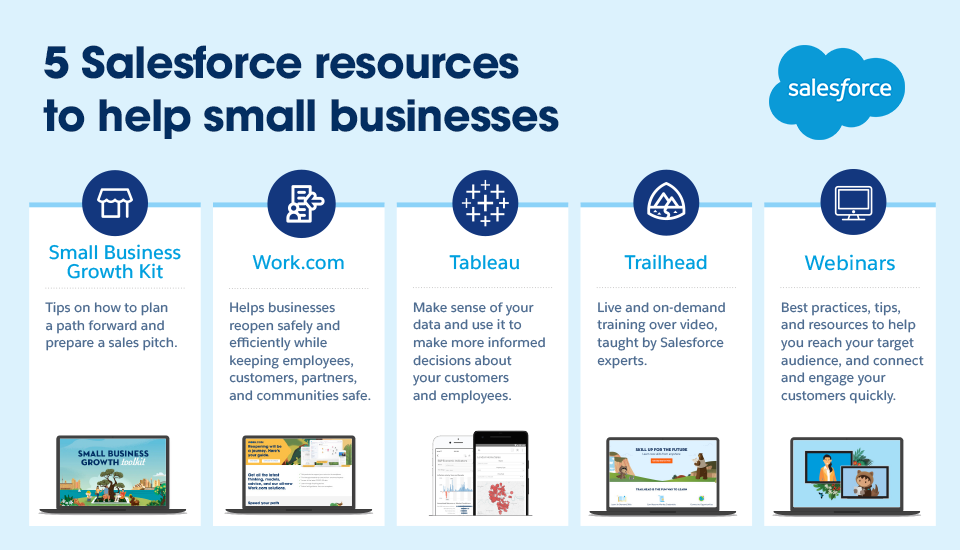
Photo credit: Salesforce
Accelerating out of crisis requires speed, flexibility, and resilience, and small businesses need the right tools to stay connected with their employees, customers, and community. Salesforce has rolled out various initiatives to help small businesses across Asia embrace digital transformation and adapt to the new normal.
Check out its blog for the full list of available resources.
This content was produced by Tech in Asia Studios, which connects brands with Asia’s tech community. Learn more about partnering with Tech in Asia Studios.
Stay updated on the go with our mobile app.
Get latest insights with smoother, more personalized experience through TIA mobile app.
Recommended reads
 Forrest Li on scaling Sea, building smarter bots, and founder grit
 SGX’s CEO says it doesn’t need a unicorn to win
 SMEs want AI too, but not the kind Big Tech is selling
 Oatside’s alt-milk rise hits a profitable gear
 Alibaba’s financial health in 12 charts
 Asia’s telcos bundle AI into mobile plans. Will it pay off?
 M-Daq chases bigger clients as revenue falls, losses grow
 VC tracker: Accel raises US$3.5b, including US$550m for India
 Graas buys Temasek-backed Trustana in agentic commerce push
 Doctor Anywhere posts healthier operations in 2025





Editing by Nathaniel Fetalvero and Jaclyn Teng
(And yes, we’re serious about ethics and transparency. More information here.)




